OverviewAll statesWisconsin
76/100
Grade: B- — A Data Powerhouse Built on Solid Foundations
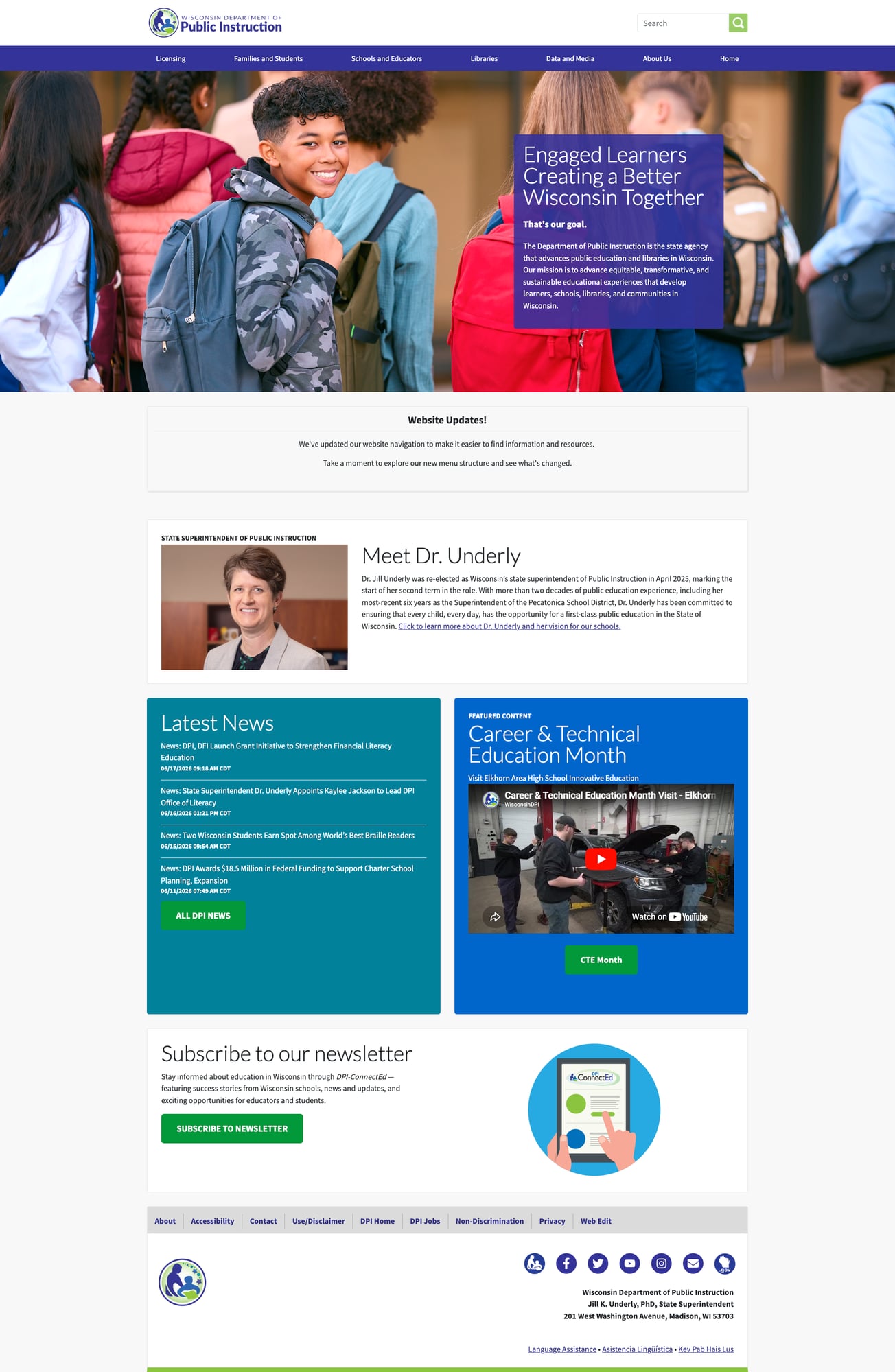
Wisconsin's Department of Public Instruction (DPI) website at dpi.wi.gov runs on a recently upgraded Drupal 10 platform with a custom Radix theme, and it shows. The site is fast, well-organized, and anchored by one of the strongest data ecosystems in the country — the WISE suite. With blazing 29ms time-to-first-byte performance, a recently overhauled navigation structure, and 100% link health across all tested pages, this is a site that gets the fundamentals right. It also stands out as one of the few SEA sites with a dedicated Libraries section, reflecting Wisconsin's unique dual mandate over public education and libraries.
Where Wisconsin falls short is in content freshness and multilingual support. The Families and Students section leads with a COVID-19 resource block that hasn't been updated since the pandemic era, and the site removed its built-in Google Translate feature, relying instead on browser-level translation — a real barrier for non-English-speaking parents. The visual design is professional but conservative, and some sections lean heavily on link lists rather than rich, engaging content.
For parents, educators, and data researchers, Wisconsin DPI delivers a highly functional experience. The data tools alone — WISEdash, the Report Card Portal, downloadable datasets — put it in the top tier. But the site needs a content refresh and a multilingual strategy to truly serve all of Wisconsin's families.
Strengths
1. Outstanding Data Ecosystem — The WISE Suite
Wisconsin's data infrastructure is among the best in the nation. The WISE (Wisconsin Information System for Education) umbrella includes:
- WISEdash Public Portal — Interactive Highcharts dashboards showing graduation rates (92%), enrollment (791,794 students for 2025-26), attendance rates, and more
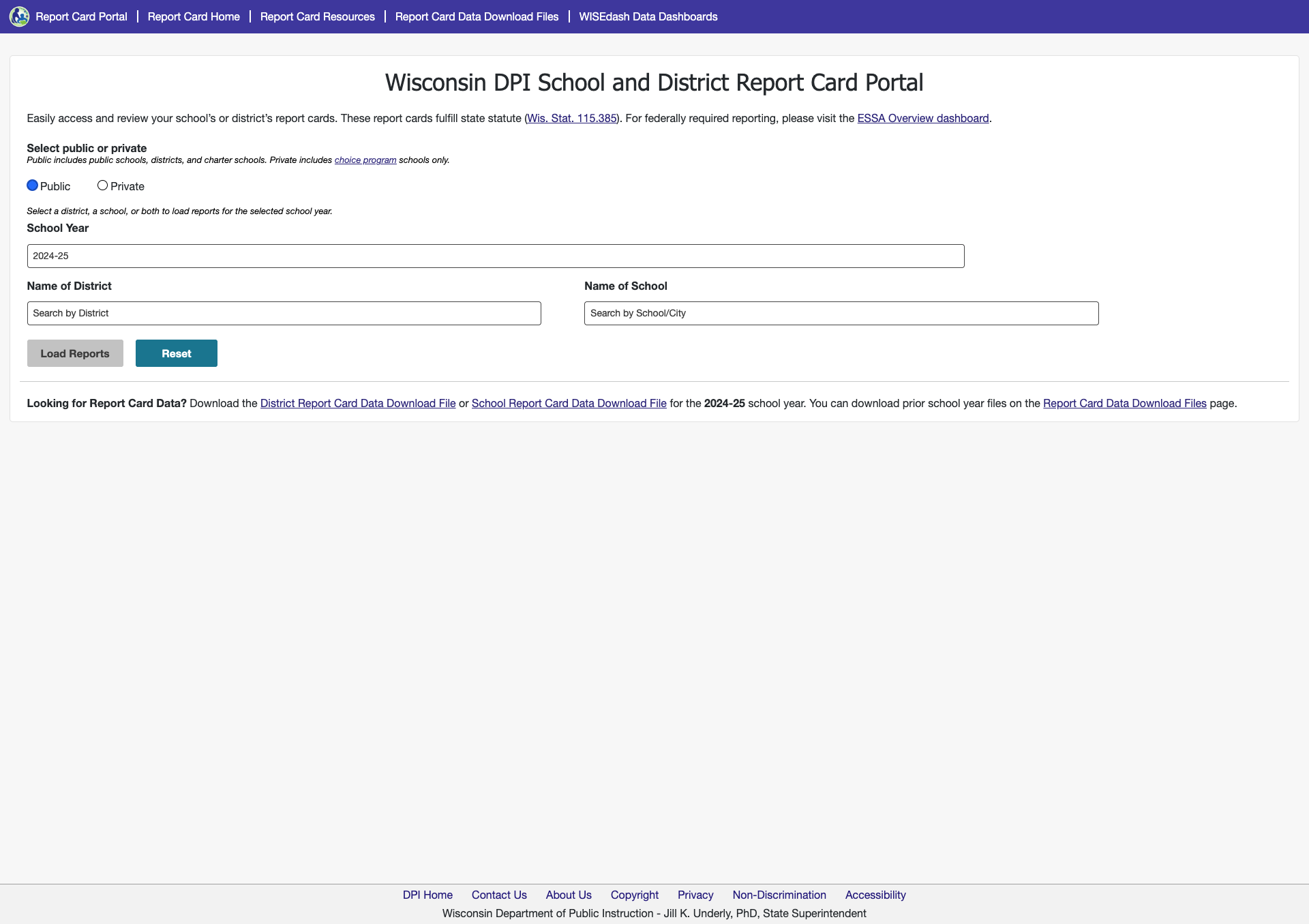
- Report Card Portal — Search by district or school, filter public/private, with 2024-25 data already loaded and downloadable CSV files at both district and school levels
- WISEdata — Data collection and reporting
- WISEgrants — Grants management
- WISExplore — Data exploration tools
- WISElearn — Professional resource sharing for educators
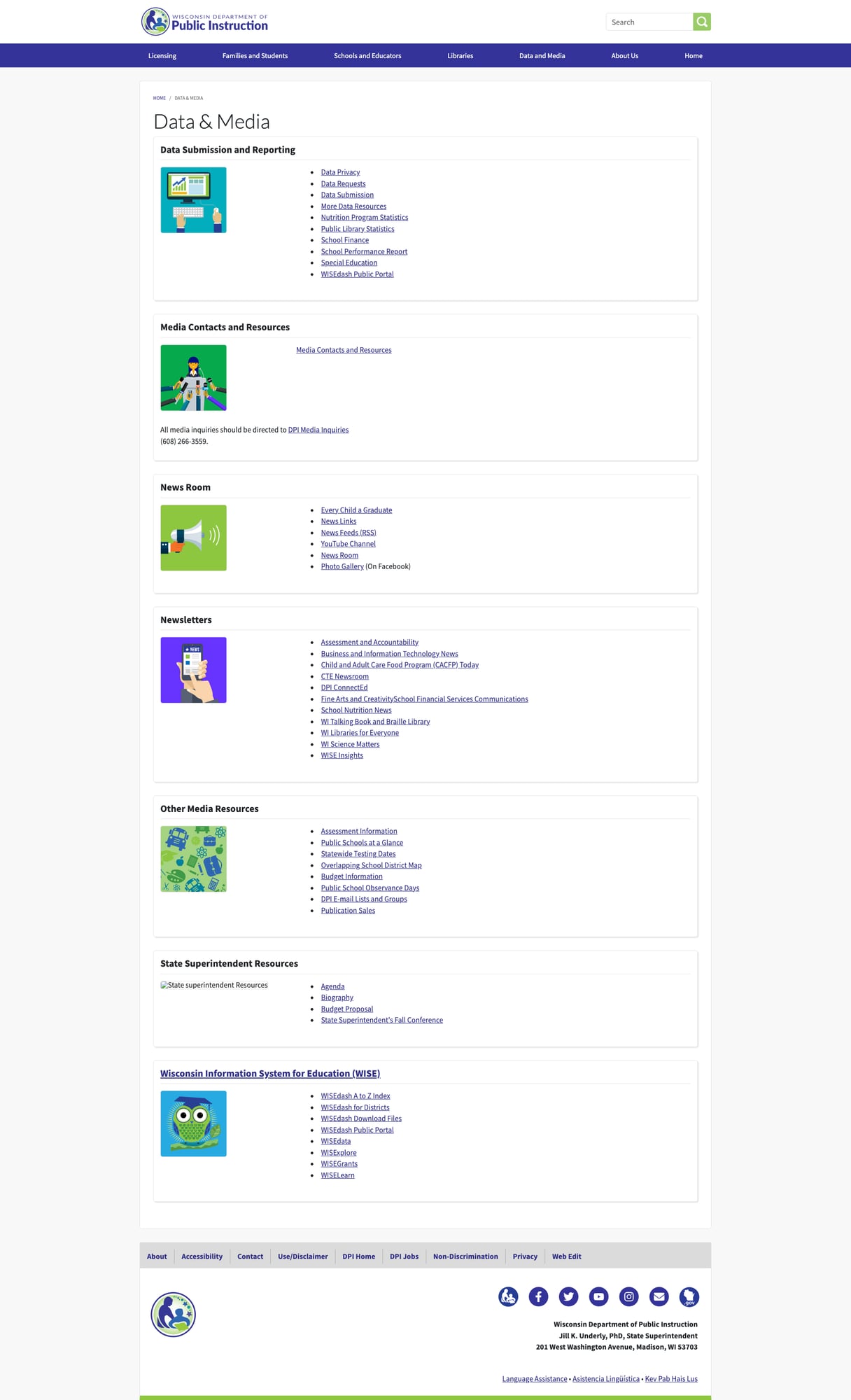
The Data and Media landing page alone links to data privacy resources, school finance, nutrition statistics, public library statistics, and special education data. The Report Card Portal offers district and school-level data download files and links directly to the ESSA Overview dashboard for federal accountability.
2. Comprehensive and Functional Navigation
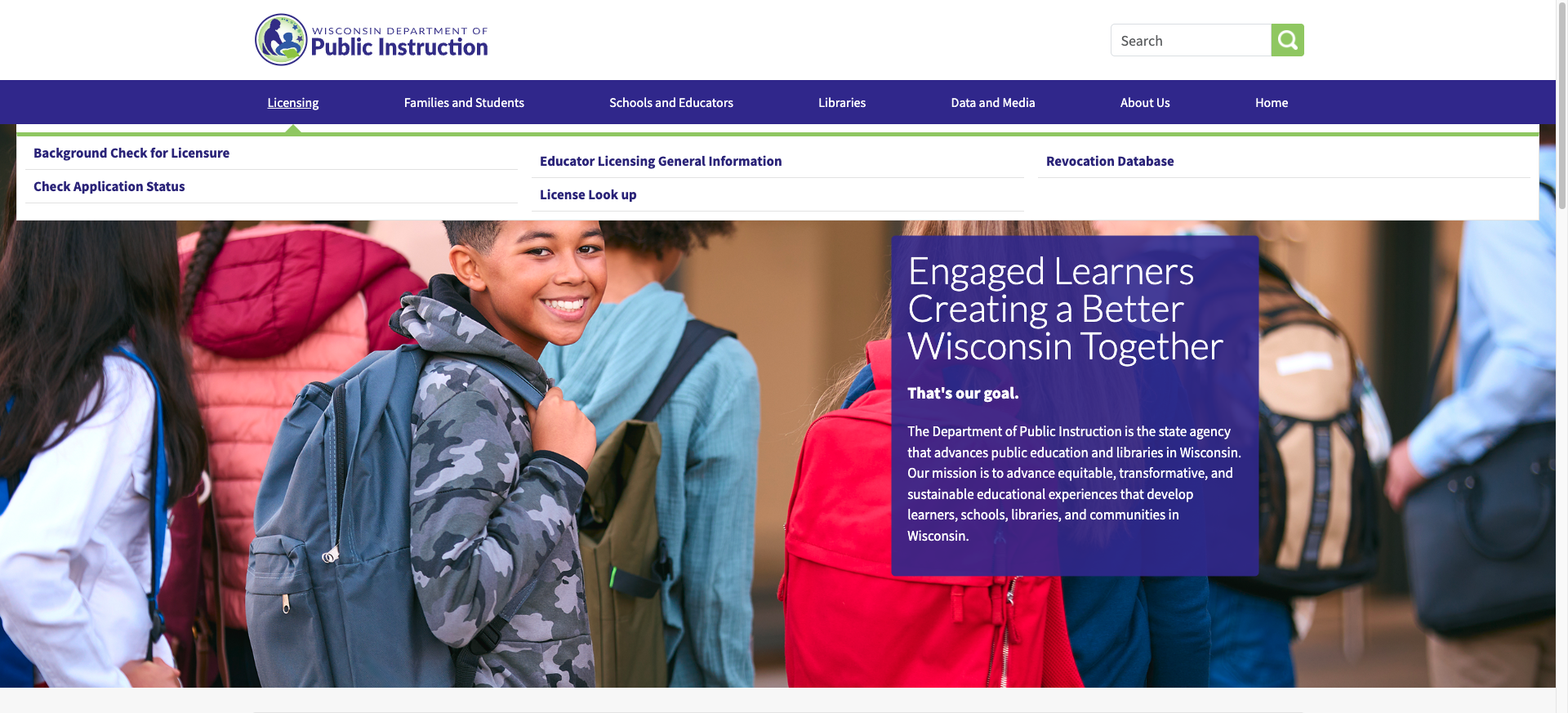
DPI recently overhauled its navigation, and it shows. The site features a multi-level mega menu with seven top-level sections: Licensing, Families and Students, Schools and Educators, Libraries, Data and Media, About Us, and Home. Every single top-level landing page returns HTTP 200, and all 18 dropdown submenu links tested return 200 as well — a perfect link health score.
The Families and Students dropdown is particularly deep, with organized sub-sections for Assessment (ACT, Forward Exam), Private Education Options (choice programs, special needs scholarships, homeschooling), Public Education Options (open enrollment, charter schools), Special Education, School Mental Health, and School Report Cards. Breadcrumbs appear throughout.
3. Excellent Search with Google Programmable Search Engine
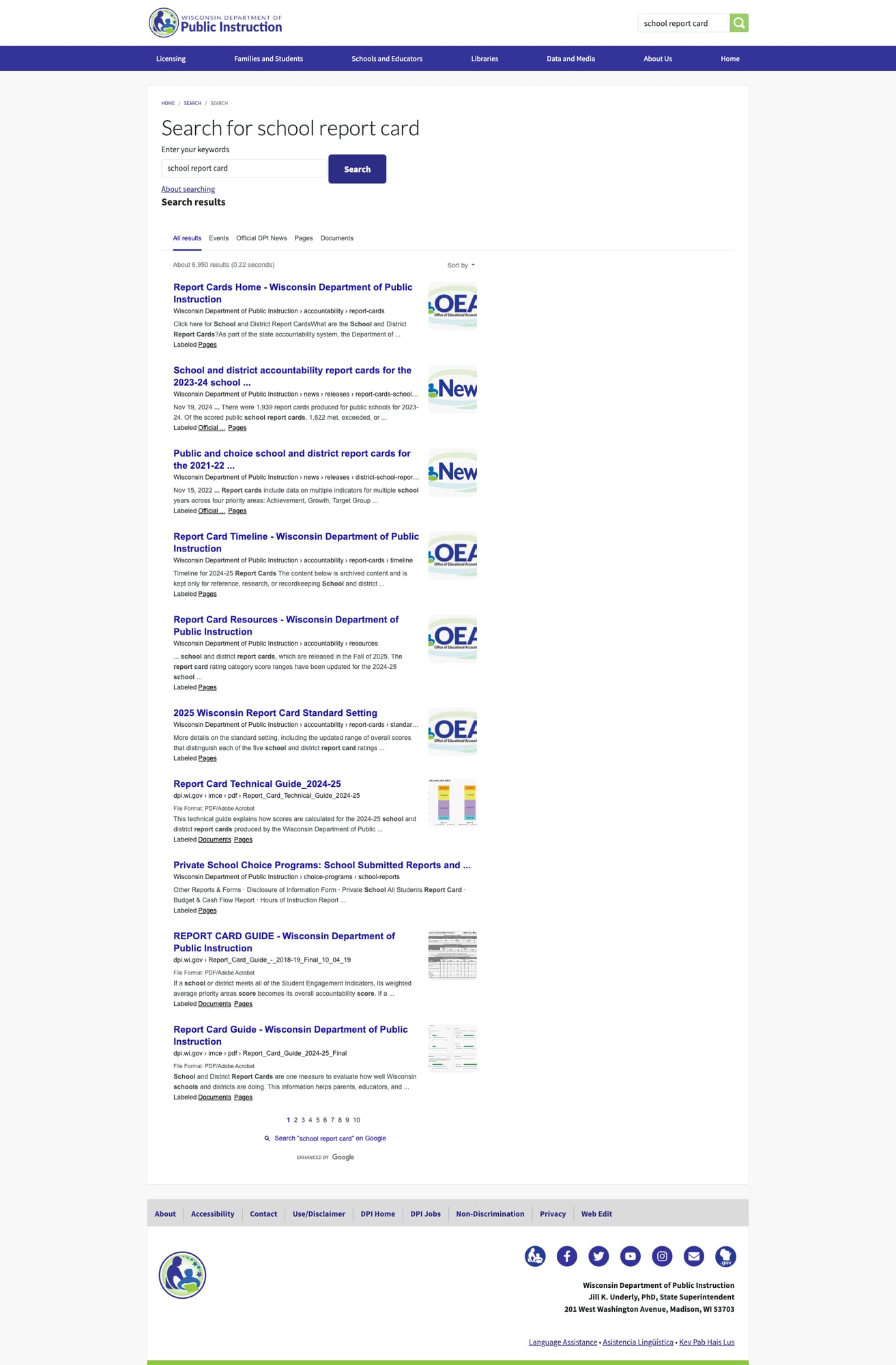
The site uses Google Programmable Search Engine (CSE) integrated into the Drupal platform. Searching for "school report card" returns approximately 6,990 results with:
- Category filters: All Results, Events, Official DPI News, Pages, Documents
- Sort options for relevance ranking
- Thumbnail previews for PDF documents and pages
- Pagination across multiple result pages
- A dedicated search page at
/search/googlewith a secondary search form
This is one of the more feature-rich search implementations we've seen across state education agency sites. The only notable absence is autosuggest/autocomplete.
4. Strong Educator Licensing Portal
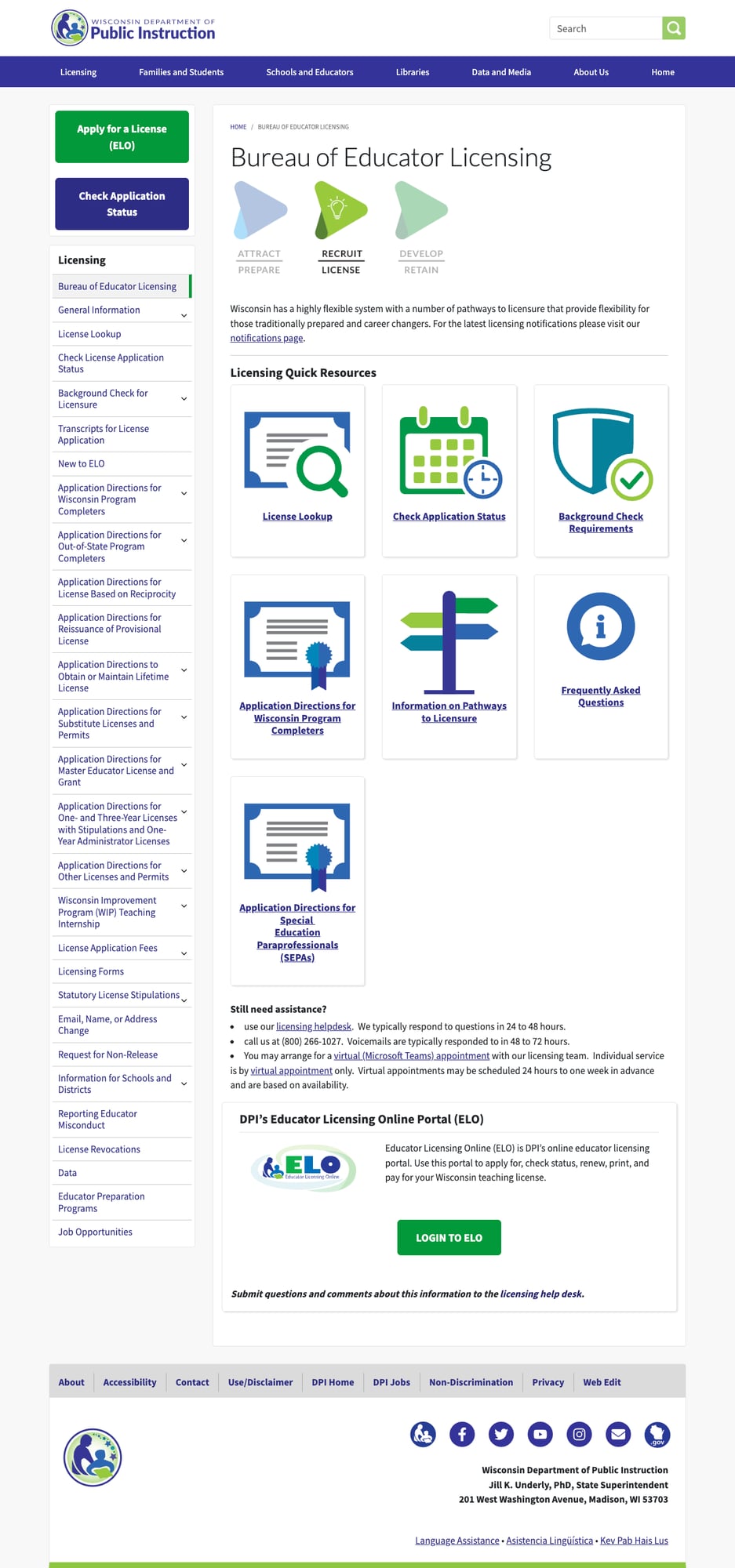
The Bureau of Educator Licensing page is a standout. It features:
- A visual pipeline graphic (Attract → Prepare → Recruit/License → Develop → Retain)
- Six visual card-based quick resources: License Lookup, Check Application Status, Background Check Requirements, Application Directions, Pathways to Licensure, and FAQs
- The ELO (Educator Licensing Online) portal for applying, checking status, renewing, and printing licenses
- A comprehensive sidebar with 20+ category links covering everything from out-of-state reciprocity to substitute licenses
- Virtual (Microsoft Teams) appointment scheduling with the licensing team
- Phone helpdesk with 24-48 hour response times
5. Unique Libraries Section
Wisconsin is one of the few states where the education agency also oversees public libraries. The dedicated Libraries section includes:
- Public Libraries and School Libraries portals
- BadgerLink — Wisconsin's free online library with statewide database access
- WISCAT — Interlibrary Loan system
- Wisconsin Document Depository Program
- Director Certification, Grants & Funding, and Data & Reporting
- Council on Library and Network Development (COLAND)
- Wisconsin Talking Book and Braille Library (WTBBL)
This dual education-and-libraries mandate makes the site uniquely comprehensive compared to most SEA websites.
Weaknesses
1. Stale COVID-19 Content Front and Center
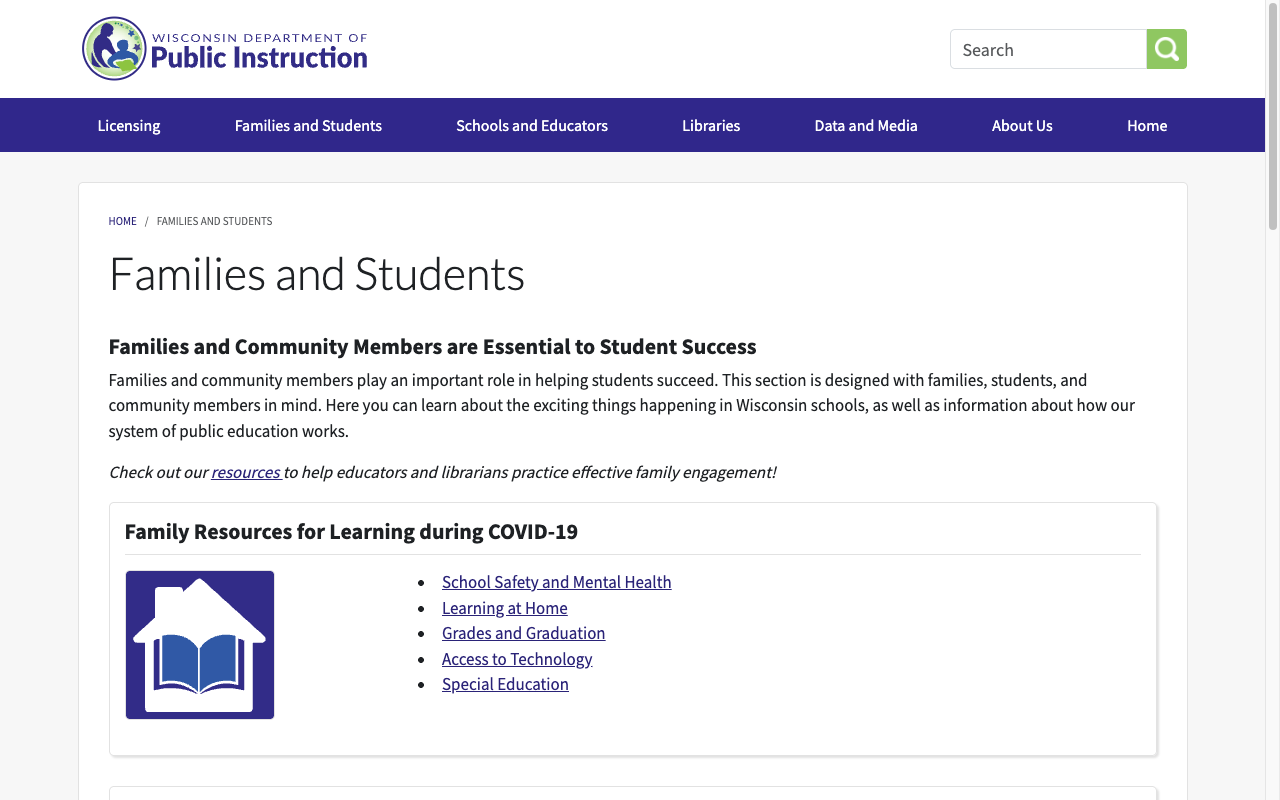
The Families and Students landing page — likely the most-visited section for parents — leads with a "Family Resources for Learning during COVID-19" block as its first content section. In mid-2026, this sends an immediate signal of staleness. The links (School Safety and Mental Health, Learning at Home, Grades and Graduation, Access to Technology, Special Education) may still be relevant individually, but framing them as pandemic resources feels years out of date.
This section should be retired or reframed. The underlying topics are evergreen — they just need fresh positioning.
2. No Built-In Multilingual Support
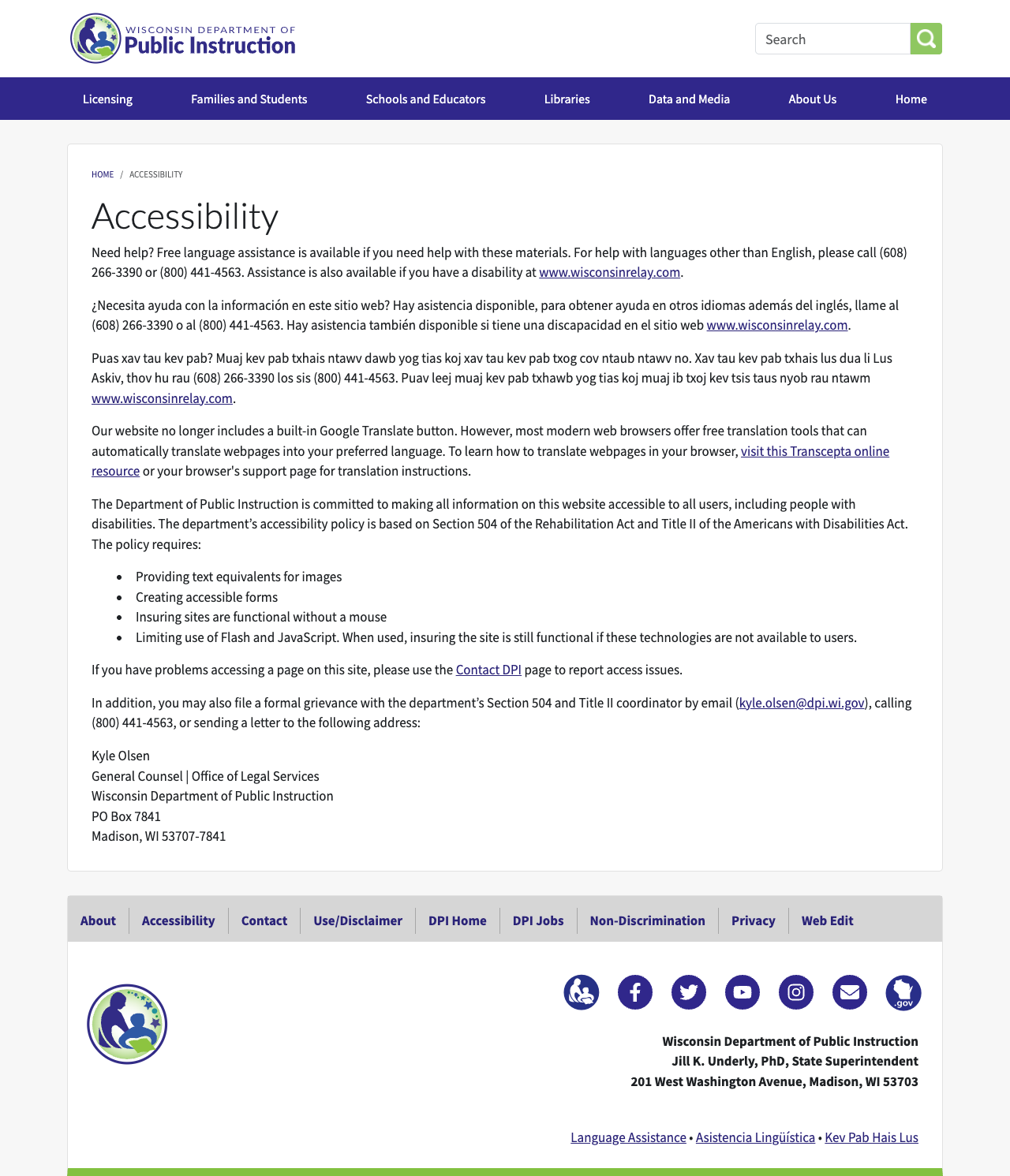
Wisconsin removed its built-in Google Translate button and now directs users to rely on browser-level translation tools. The accessibility page states: "Our website no longer includes a built-in Google Translate button. However, most modern web browsers offer free translation tools..."
For a state with significant Hmong, Spanish, and other non-English-speaking populations, this is a regression. The footer does include trilingual Language Assistance links (English, Spanish, Hmong), but these all point to the same accessibility page that offers a phone number — (608) 266-3390 or (800) 441-4563 — not in-page translation.
Many parents accessing this site from older devices or less feature-rich browsers won't know how to activate browser translation. A built-in translation widget is table stakes for a modern government website.
3. Link-List Heavy Landing Pages
While functionally complete, several landing pages — Families and Students, Schools & Districts, Data & Media — are essentially organized lists of links with small icons. There's no rich content, no featured resources, no callout boxes, and no progressive disclosure. A parent arriving at the Families and Students page sees a wall of categorized link lists rather than engaging, contextual content.
Compare this to states like Georgia or Florida, which use card-based layouts, feature spotlights, and audience-specific entry points. Wisconsin's content is all there, but the presentation doesn't guide users effectively.
4. Accessibility Policy References Flash
The accessibility page includes this policy point: "Limiting use of Flash and JavaScript. When used, insuring the site is still functional if these technologies are not available to users."
Adobe Flash has been dead since December 2020. Referencing it in a 2026 accessibility policy suggests the policy document hasn't been reviewed in years. While harmless, it undermines confidence in the department's commitment to current web standards. The policy should be updated to reflect modern accessibility concerns (ARIA patterns, responsive images, progressive enhancement).
Opportunities
Refresh the Families and Students section — Retire the COVID-19 framing and reorganize around current priorities. Feature the Report Card Portal and school search prominently. Add plain-language guides for Assessment, School Choice, and Special Education.
Restore integrated multilingual support — Add a Google Translate widget or equivalent back to the site. Wisconsin's Hmong, Spanish, and other non-English-speaking communities deserve in-page translation, not a phone number.
Modernize landing page design — Transform link lists into card-based layouts with featured resources, Quick Start guides, and audience-specific pathways. The Data and Media section, in particular, could benefit from a visual dashboard-style landing page.
Threats
Growing digital equity gap — Removing built-in translation while serving increasingly diverse school communities creates a two-tier accessibility situation. Parents who know how to use browser translation tools get served; those who don't are effectively locked out of non-English information.
Content drift — The COVID-19 section and Flash-referencing accessibility policy suggest governance processes for content review may be lagging. As the Drupal 10 migration continues, there's a risk that migrated content inherits stale framing without editorial review.
Standout Feature
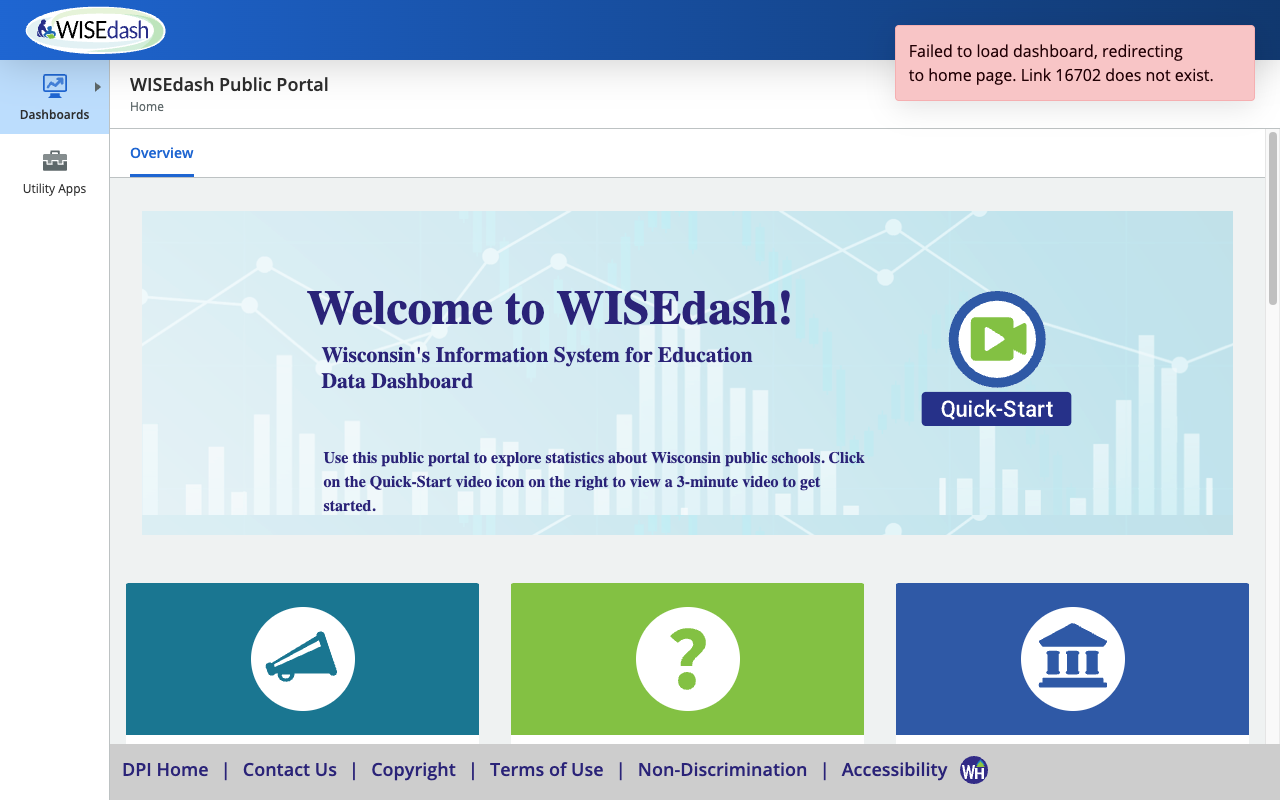
The WISE suite is Wisconsin's crown jewel. WISEdash provides public access to statewide education data via interactive Highcharts dashboards — graduation rates, enrollment trends, attendance, special education indicators, and more. Combined with the Report Card Portal (2024-25 data with downloadable CSV files), WISEdata, WISEgrants, and WISElearn, this is one of the most comprehensive, integrated data ecosystems of any state education agency. The data is current, downloadable, and well-documented — exactly what transparency advocates ask for.
Bottom Line
Wisconsin DPI delivers a technically solid, content-rich website with outstanding data tools and a recently modernized Drupal 10 platform. Parents and educators can find what they need across a well-structured navigation with zero broken links. Data researchers will love the WISE suite. But the site needs a content refresh to retire pandemic-era framing, a multilingual strategy to serve all families, and richer landing page designs to move beyond organized link lists. The bones are excellent — it's the finish work that needs attention.
Grade Breakdown
| Criterion | Weight | Score | Notes |
|---|---|---|---|
| Navigation & Information Architecture | 15% | 7/10 | Multi-level mega menus with breadcrumbs, 100% link health across all 24 tested URLs. Recently updated nav structure. Landing pages are functional but link-list heavy. |
| Accessibility (WCAG 2.1 AA) | 15% | 7/10 | Skip-to-content, 173 ARIA attributes, all images have alt text. Section 504/Title II policy with formal grievance process. Language assistance in English/Spanish/Hmong (phone only). Accessibility policy references Flash (outdated). |
| Search Functionality | 10% | 8/10 | Google Programmable Search Engine with ~6,990 results, category filters (Events, News, Pages, Documents), sort options, thumbnails. No autosuggest. |
| Mobile Responsive Design | 10% | 8/10 | Proper viewport meta, Bootstrap/Radix theme, hamburger menu at mobile widths, clean content reflow, no horizontal scroll. |
| Data Transparency & Open Data | 10% | 9/10 | Outstanding WISE ecosystem: WISEdash interactive dashboards, Report Card Portal (2024-25 data), downloadable CSV files, WISEdata/WISEgrants/WISExplore/WISElearn. Comprehensive state and national reporting links. |
| Parent Resources | 10% | 6/10 | Families and Students section covers assessment, health, special education, school choice. But COVID-19 section is stale and listed first. Link-list format. No integrated multilingual support. |
| Educator Resources | 10% | 8/10 | Strong ELO licensing portal with visual cards, application status, virtual appointments. Schools & Districts covers curriculum, professional learning, CESAs. WISElearn for resource sharing. |
| Visual Design & Branding | 10% | 7/10 | Consistent purple/white/green branding, custom Radix Drupal 10 theme. Professional but conservative. Twitter still references pre-X branding. Some sections feel link-heavy. |
| Performance & Load Speed | 10% | 9/10 | Exceptional 29ms TTFB. Drupal 10 with dynamic cache HIT. HSTS, X-Content-Type-Options, X-Frame-Options headers. Reliable uptime. |
| Overall | 100% | 76/100 | B- |
Discussion