OverviewAll statesVirginia
73/100
Grade: C+ — Deep Content, Surface-Level Technical Gaps
Virginia's Department of Education (VDOE) sits on a paradox: its content library is among the richest of any state education agency we've reviewed, yet the website's technical execution doesn't match that ambition. With a comprehensive A-Z Index, audience-segmented accountability resources, and an enormous statistics repository, the information is there — the question is whether parents, educators, and administrators can efficiently get to it.
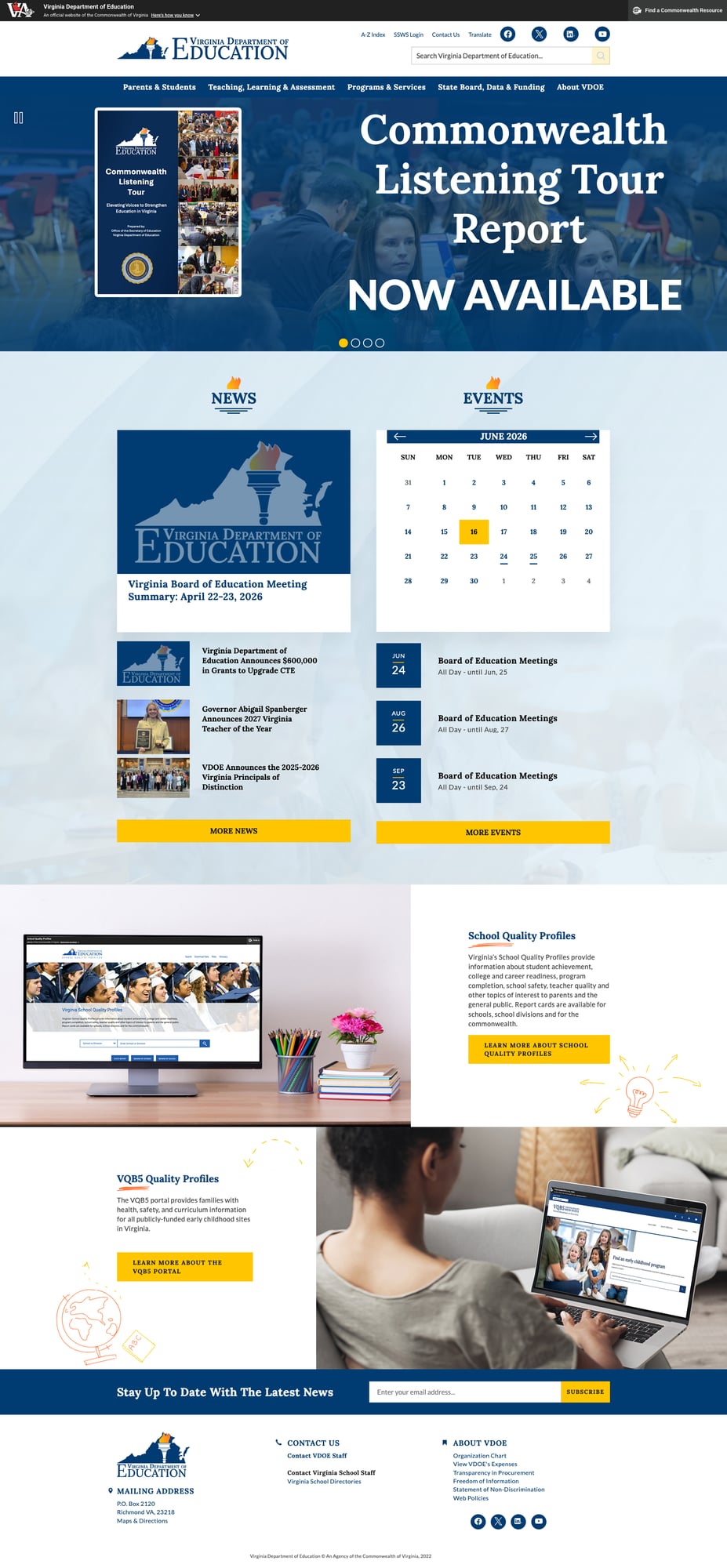
The site serves the Commonwealth's 1.2+ million public school students across 132 school divisions. First impressions are professional: a clean blue-and-gold brand, prominent search bar, and a five-section mega-menu that reveals deep content hierarchies on hover. But dig into Page speed, mobile rendering, and accessibility internals, and cracks start to show. A 3+ second load time, missing landmark roles, and a copyright footer frozen at 2022 suggest a site that was well-built at launch but hasn't received the ongoing technical maintenance its content deserves.
Strengths
1. Exhaustive A-Z Index as a Navigation Safety Net
VDOE's A-Z Index is one of the best we've seen in any state. Every program, policy, report, and resource is listed alphabetically with direct links — from "Accreditation" to "Year-Round & Extended Year Schools." This is an enormous help for users who don't know which top-level category their topic falls under, effectively providing a flat alternative to the hierarchical navigation. It's also well-maintained, which suggests a CMS team that takes content governance seriously.

2. School Performance and Support Framework Resource Hub
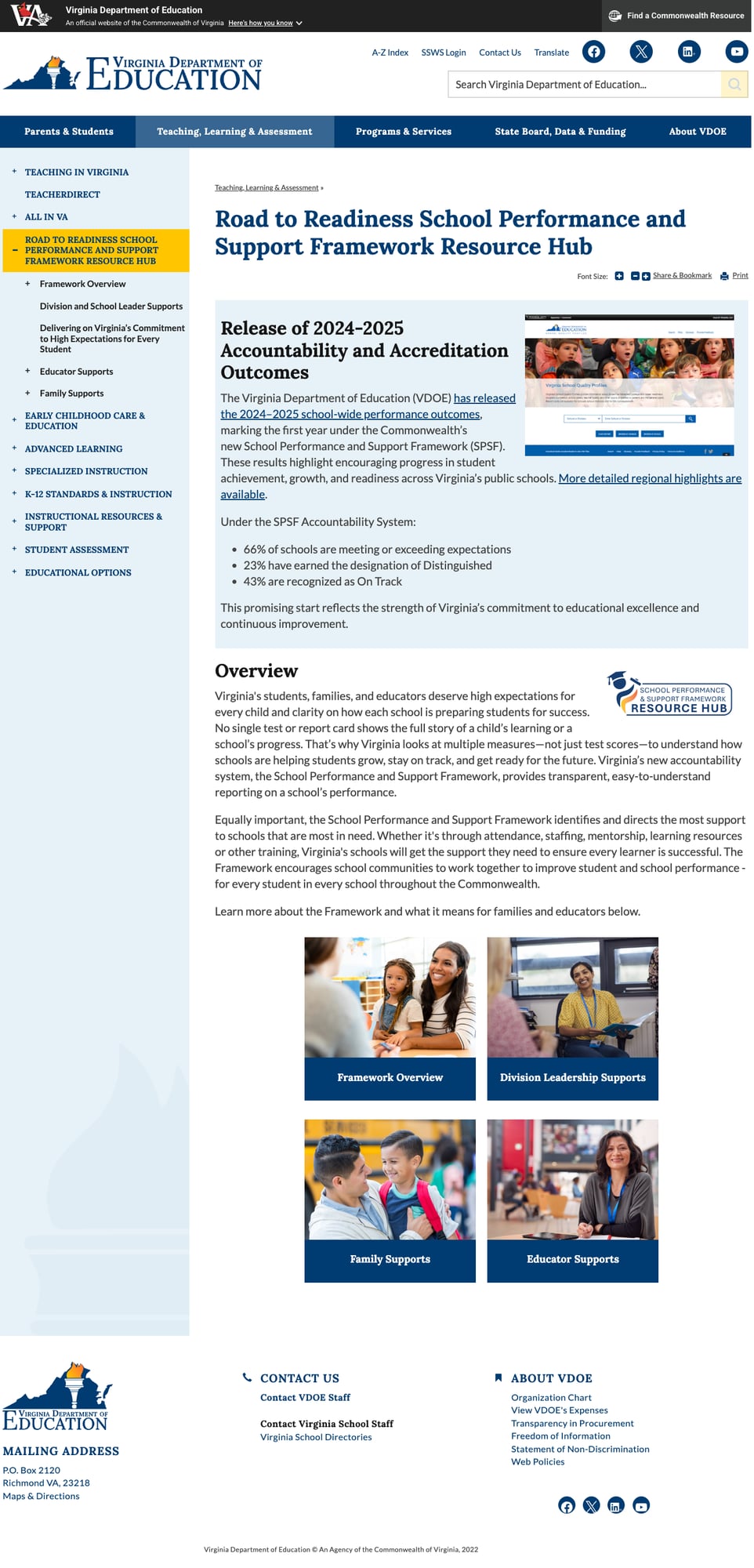
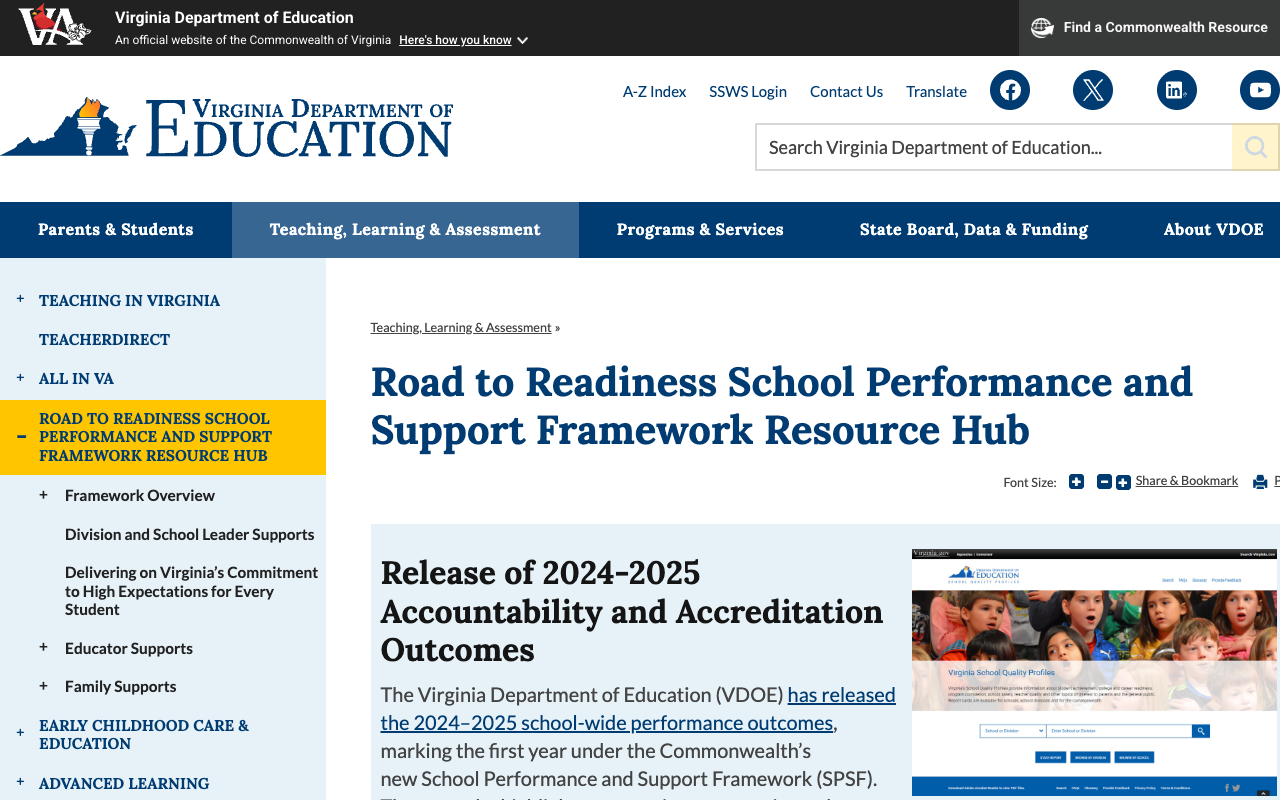
The Road to Readiness SPSF Resource Hub is a standout. Rather than dumping accountability data into a single undifferentiated page, VDOE segments its SPSF materials into four audience-specific pathways: Framework Overview, Division Leadership Supports, Family Supports, and Educator Supports. The 2024–2025 release shows 66% of schools meeting or exceeding expectations, with 23% earning "Distinguished" designation. This audience-aware architecture is exactly what parents and educators need — the same data, presented at different levels of complexity.
3. Deep Statistics and Reports Library
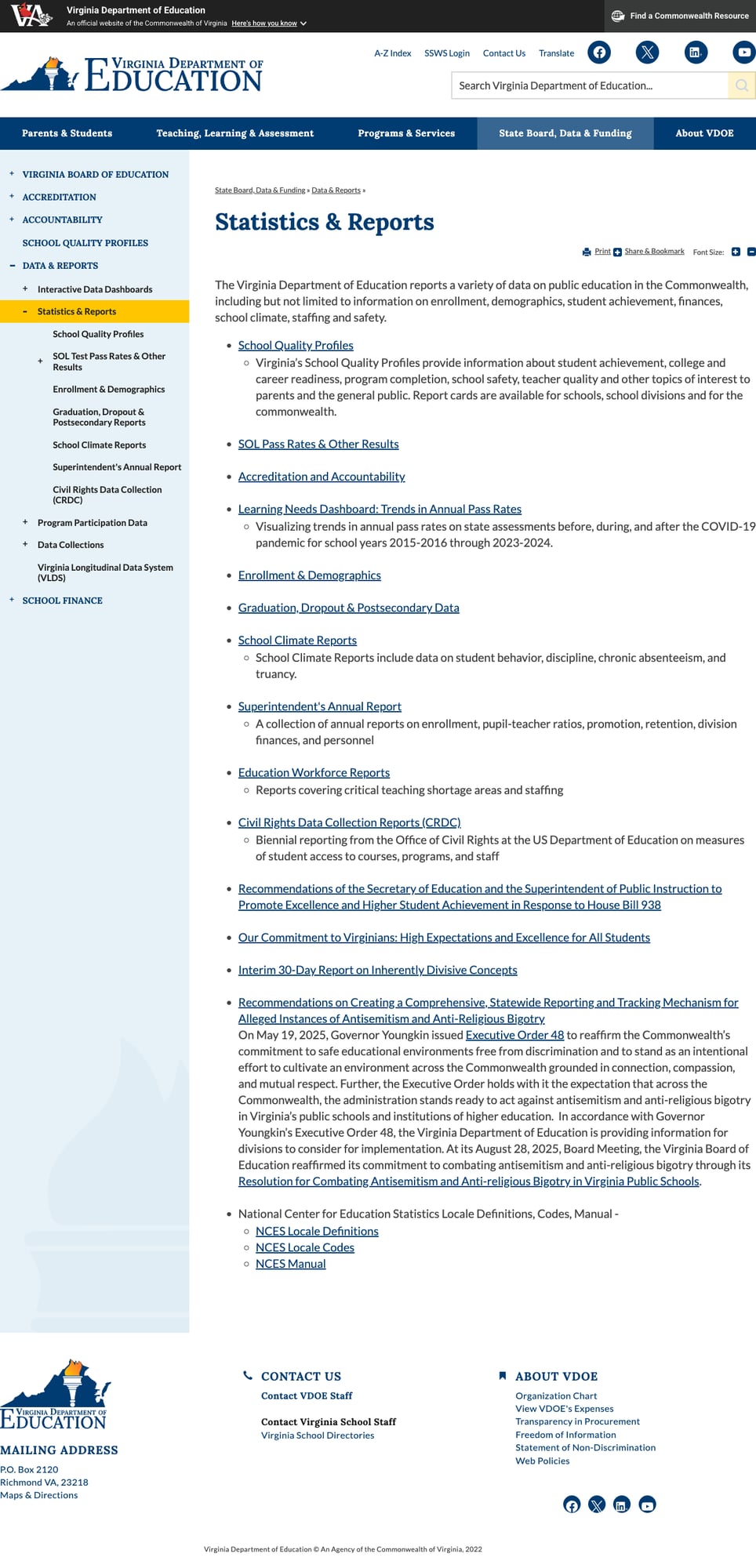
The Statistics & Reports section is expansive. It covers School Quality Profiles, SOL pass rates, accreditation and accountability, enrollment and demographics, graduation and dropout data, school climate reports, superintendent's annual reports, education workforce reports, and Civil Rights Data Collection. The left sidebar navigation makes it easy to move between subcategories. VDOE also maintains the Virginia Longitudinal Data System (VLDS), program participation data, and data collections — offering real depth for researchers and policymakers.
4. Robust Site-Wide Search with Filtering
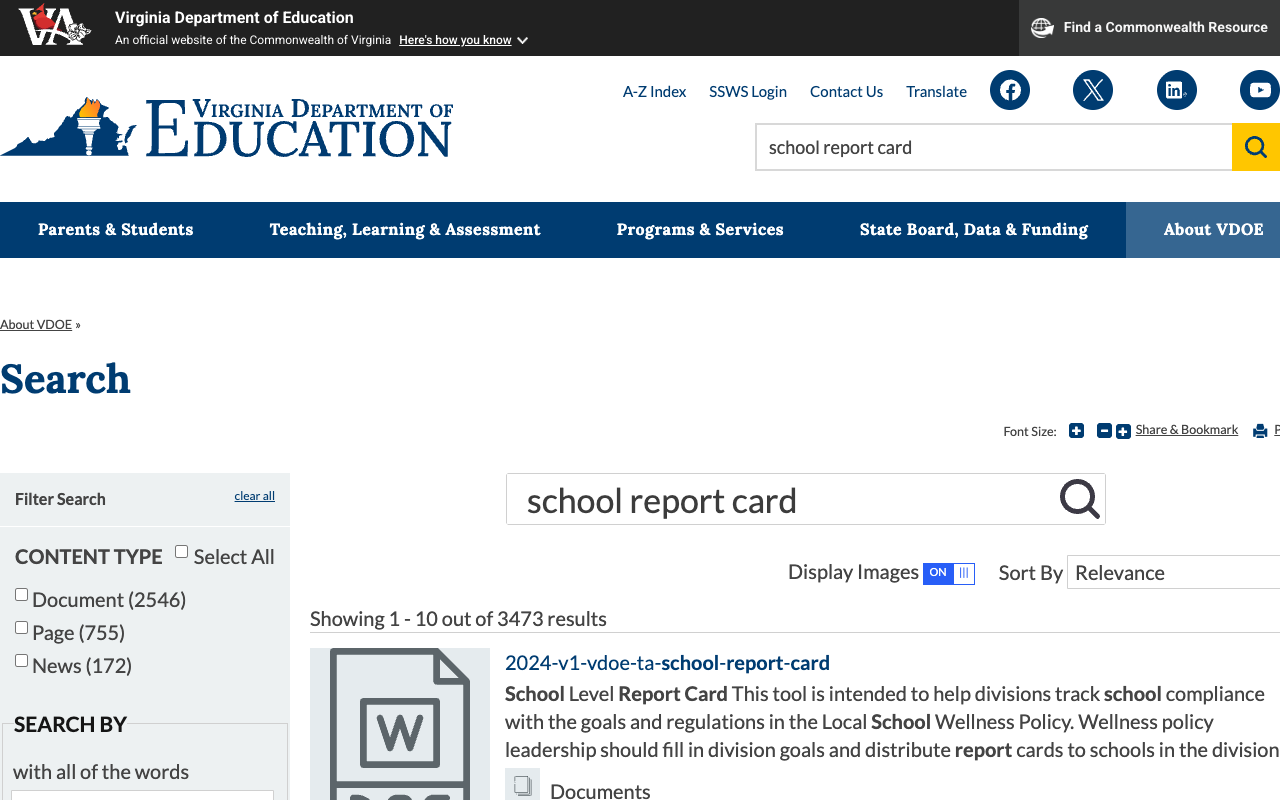
VDOE's search is genuinely useful. A test query for "school report card" returned 3,473 results with content type filtering (Document, Page, News), sort-by-relevance options, and advanced search fields including "exact word or phrase" matching. The persistent search bar in the header makes it accessible from any page. While it lacks autosuggest/typeahead, the filtering and result quality are well above average for state education sites.
5. Well-Organized Five-Section Mega Navigation
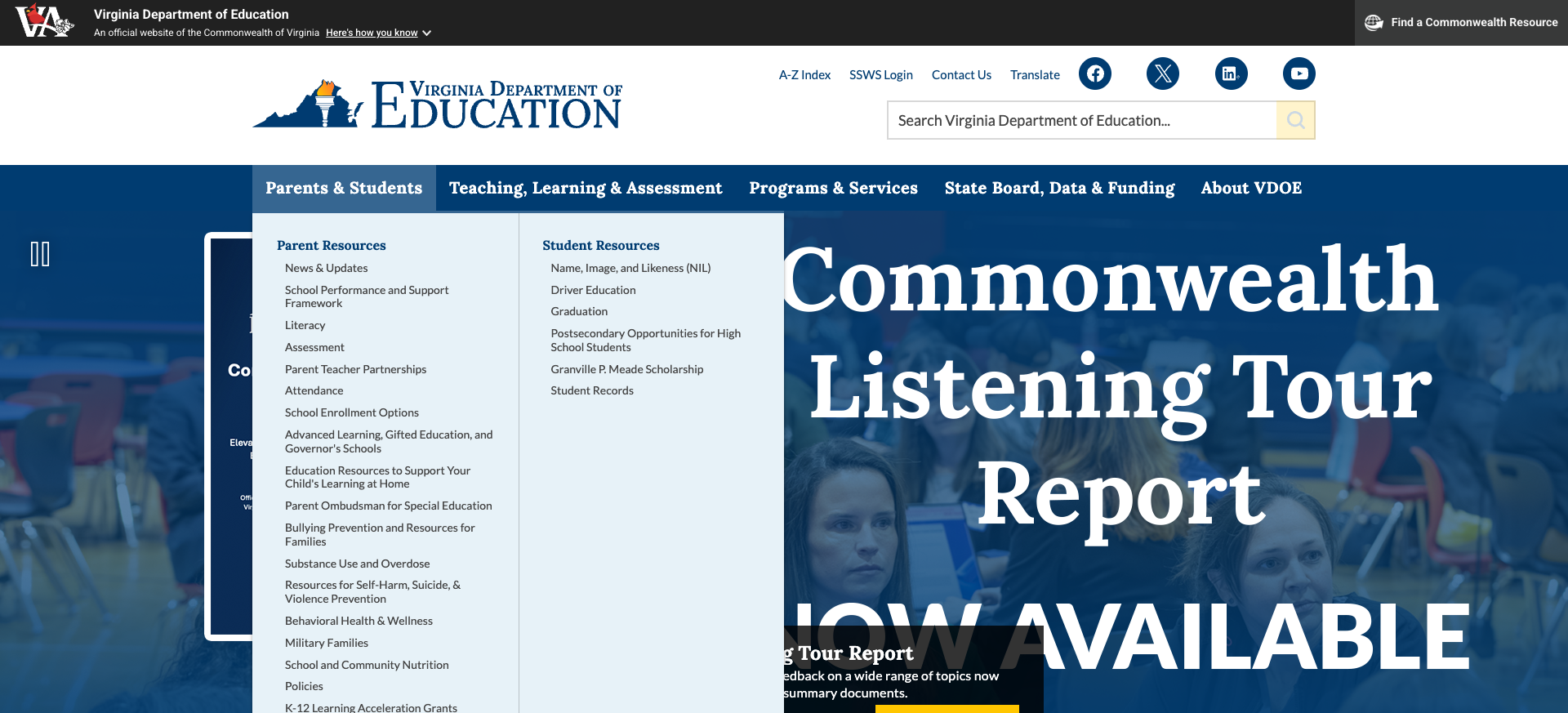
The top-level navigation splits cleanly into five audience/topic areas: Parents & Students, Teaching, Learning & Assessment, Programs & Services, State Board, Data & Funding, and About VDOE. Each reveals a rich mega-dropdown on hover, organizing dozens of sub-pages into logical columns. The "State Board, Data & Funding" dropdown alone exposes Virginia Board of Education, Accreditation, Accountability, School Quality Profiles, Data & Reports (with sub-items), and School Finance — all visible without a click. Sub-pages include consistent left sidebar navigation with expandable sections.
Weaknesses
1. Mobile Rendering Has Visual Overflow Issues
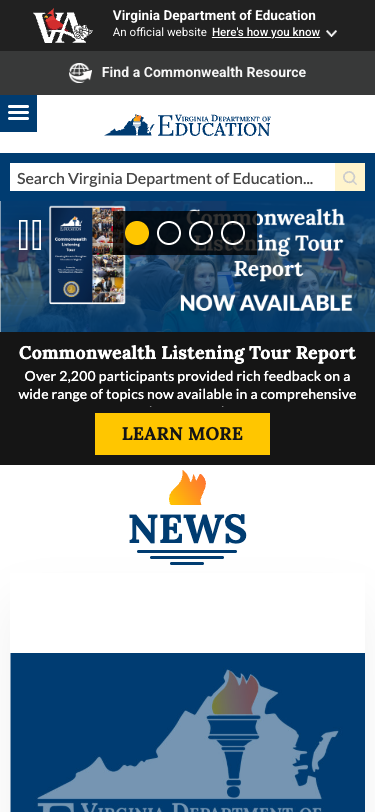
On a 375px mobile viewport, the homepage hero carousel clips text and images awkwardly, with overlapping layer elements. The slide indicators compete for space with the carousel content. Below the fold, the layout generally stacks correctly with a hamburger menu, but the hero — the first thing mobile visitors see — makes a poor impression. Given that a significant percentage of parent users will be accessing this site from phones, the mobile experience needs polish.
2. Translation Relies on Google Translate Redirect
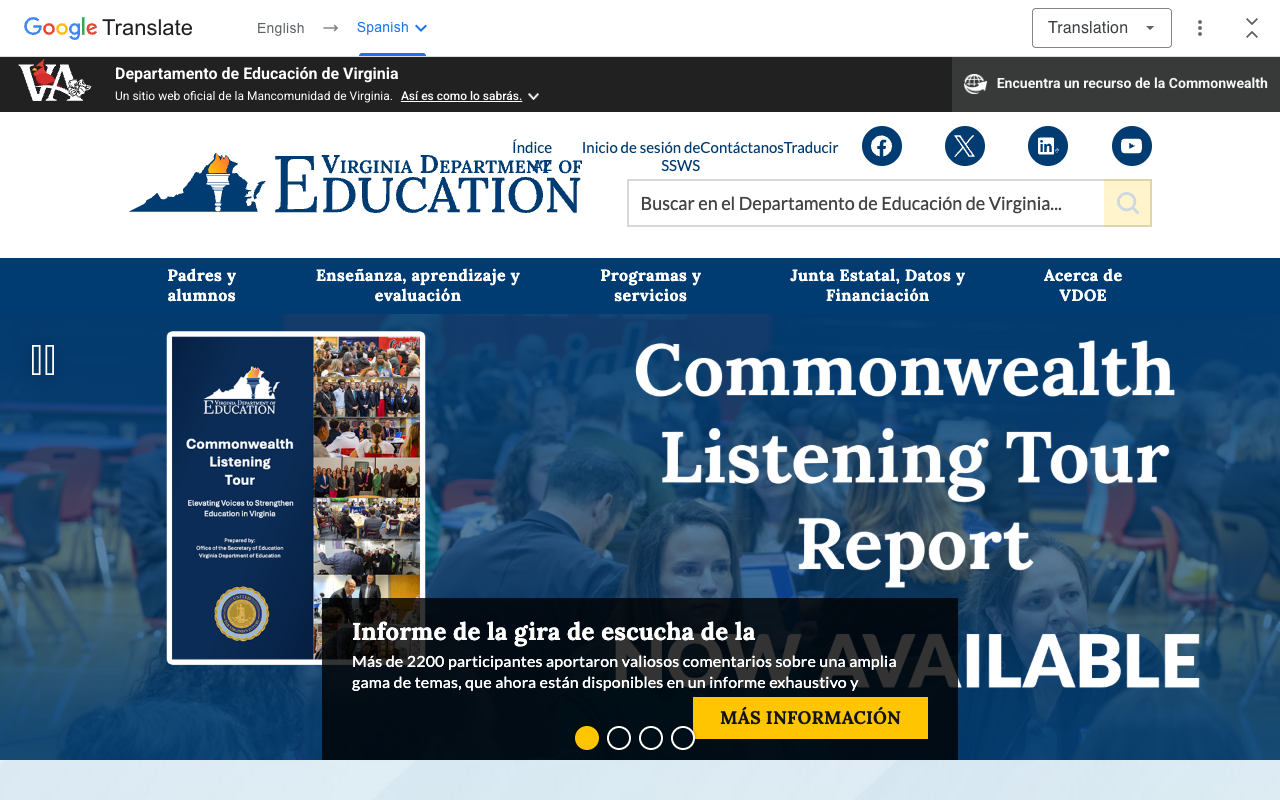
The "Translate" link in the header doesn't lead to native multilingual content — it redirects to www-doe-virginia-gov.translate.goog, a Google Translate proxy page pre-set to Spanish. While this technically provides translation into many languages, it's a basic implementation with known limitations: machine-translated education jargon is frequently inaccurate, PDFs and embedded content don't translate, and the Google Translate toolbar can confuse less technical users. States like California and New York offer curated, human-reviewed translations of key parent-facing documents — Virginia would benefit from at least translating its most critical parent resources natively.
3. Stale Copyright Footer and Missing HTML Landmarks
The site footer displays "Virginia Department of Education © An Agency of the Commonwealth of Virginia, 2022" — four years out of date. While minor on its own, it signals a lack of ongoing maintenance attention. More substantively, the homepage lacks a <main> landmark element, which impacts screen reader navigation. Four images on the homepage are missing alt attributes entirely. The site does have a skip-to-content link and 227 ARIA labels, showing accessibility was considered — but the fundamentals need a maintenance pass.

4. Heavy Page Weight and Moderate Load Times
The homepage loads 68 resources totaling approximately 6.8 MB, with a full load time of ~3.2 seconds. This is driven by an image-heavy hero carousel, 15 JavaScript files, and 12 stylesheets. While not unusable, it falls short of the 2-second target for broadband connections and could be significantly improved with image optimization, lazy loading, and script consolidation. Users on slower connections — common in Virginia's rural western regions — will feel this.
Opportunities
Native multilingual parent resources: Virginia has a growing multilingual population. Translating the top 10-20 parent-facing pages (enrollment, school quality, testing) into Spanish, Vietnamese, Arabic, and Amharic would dramatically improve accessibility for the families who need it most.
Interactive data dashboards: While VDOE's data library is deep, much of it lives in static reports and PDFs. Building public-facing interactive dashboards (similar to Virginia's School Quality Profiles site) for enrollment trends, achievement gaps, and school climate data would make the information more accessible and engaging.
Performance optimization: Implementing lazy loading for below-the-fold images, consolidating scripts, and optimizing the hero carousel could shave 1-2 seconds off load time — a meaningful improvement for mobile and rural users.
Threats
School Quality Profiles certificate issue: During testing, the external School Quality Profiles site returned a certificate authority error, potentially blocking parent access to one of VDOE's most important resources. If this persists, it undermines the entire accountability transparency effort.
Content sprawl without governance: The A-Z Index lists hundreds of pages. Without active content auditing and retirement, this deep library risks becoming increasingly stale, with orphaned pages and outdated documents creating confusion — especially for the many PDF-linked reports throughout the site.
Standout Feature
The Road to Readiness School Performance and Support Framework Resource Hub is Virginia's best feature. Rather than treating accountability as a data dump, it segments resources by audience: families get plain-language summaries, educators get professional support tools, and division leaders get implementation guidance. The 2024–2025 results are prominently featured with clear statistics (66% meeting expectations, 23% Distinguished). This kind of audience-aware information design is exactly what state education websites should aspire to — making the same data meaningful for different users.
Bottom Line
Virginia's DOE website is a content powerhouse with real depth in data, educator resources, and accountability frameworks. Parents will find dedicated resources and a robust search engine. Educators get a comprehensive Teaching, Learning & Assessment section. But the technical shell — mobile rendering, performance, accessibility landmarks, and multilingual support — hasn't kept pace with the content. It's a solid site that could be excellent with a focused technical maintenance sprint.
Grade Breakdown
| Criterion | Weight | Score | Notes |
|---|---|---|---|
| Navigation & Information Architecture | 15% | 8/10 | Excellent mega-menus, A-Z Index, consistent side nav, breadcrumbs |
| Accessibility (WCAG 2.1 AA) | 15% | 7/10 | Skip link, ARIA labels, good contrast; missing <main> landmark, 4 images without alt |
| Search Functionality | 10% | 7/10 | 3,473 results with content type filters and sort; lacks autosuggest |
| Mobile Responsive Design | 10% | 7/10 | Hamburger menu works, content stacks; hero carousel clips on mobile |
| Data Transparency & Open Data | 10% | 8/10 | Deep stats library, SPSF, VLDS, School Quality Profiles; mostly PDF/static reports |
| Parent Resources | 10% | 7/10 | Dedicated section with broad topics; translation via Google Translate proxy only |
| Educator Resources | 10% | 8/10 | TeacherDirect, SPSF audience resources, ALL In VA, comprehensive instructional materials |
| Visual Design & Branding | 10% | 7/10 | Professional blue/gold brand, Lato typography; footer copyright frozen at 2022 |
| Performance & Load Speed | 10% | 6/10 | ~3.2s load, 6.8 MB, 68 resources; image-heavy carousel is the main culprit |
| Overall | 100% | 73/100 | C+ |
Discussion