OverviewAll statesVermont
75/100
Grade: B- — A USWDS-Powered Workhorse With Serious Substance Behind a Plain Exterior
Vermont's Agency of Education website is one of the strongest government-framework implementations in our SEA review series. Built on Drupal 10 with the U.S. Web Design System (USWDS), the site delivers excellent accessibility infrastructure, rock-solid navigation, and a remarkably deep data ecosystem — all wrapped in the kind of understated, functional design that prioritizes getting things done over making a visual splash.
For a state with roughly 82,000 public school students, the AOE website punches well above its weight in data transparency. The Vermont Education Dashboard provides nine distinct data categories — from enrollment and assessment to chronic absenteeism and exclusionary discipline — all publicly accessible. The State Report Card page offers detailed school identification breakdowns under ESSA, with 2024-2025 accountability data already published. For a small-state agency, this is an impressively comprehensive data operation.
The site's biggest weakness is its visual austerity. The USWDS framework provides excellent bones (accessibility, responsive layout, consistent components), but the implementation feels almost aggressively utilitarian. The color palette is limited to dark green and white, the typography is serviceable but unremarkable, and the homepage relies on a carousel of two slides rather than a curated content strategy. The COVID-19 Resources section still occupies a top-level navigation slot four years after the emergency ended, and the search function — while technically operational — offers only basic Drupal core search without filters, autosuggest, or relevance tuning.
Strengths
1. Exemplary Data and Reporting Infrastructure
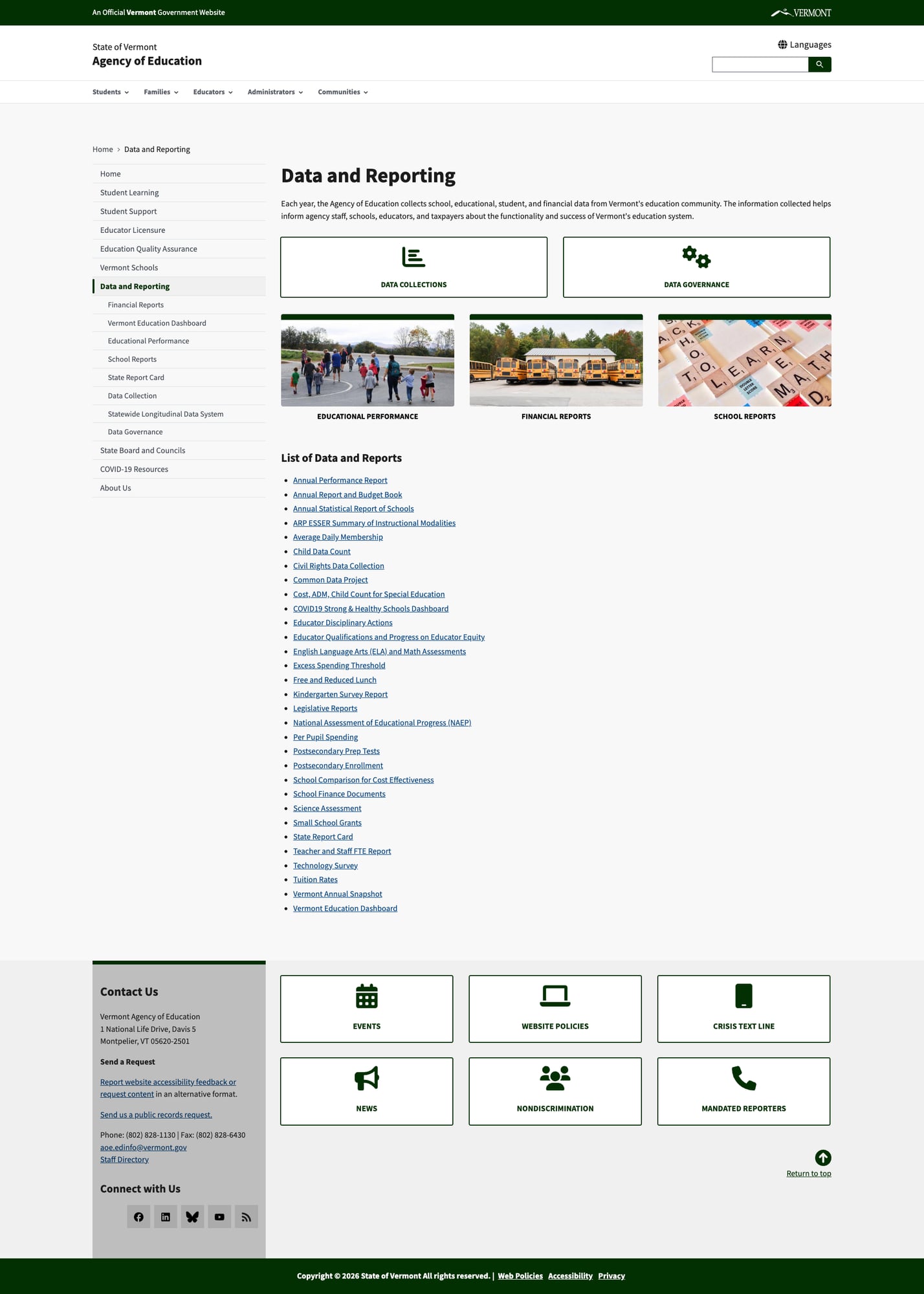
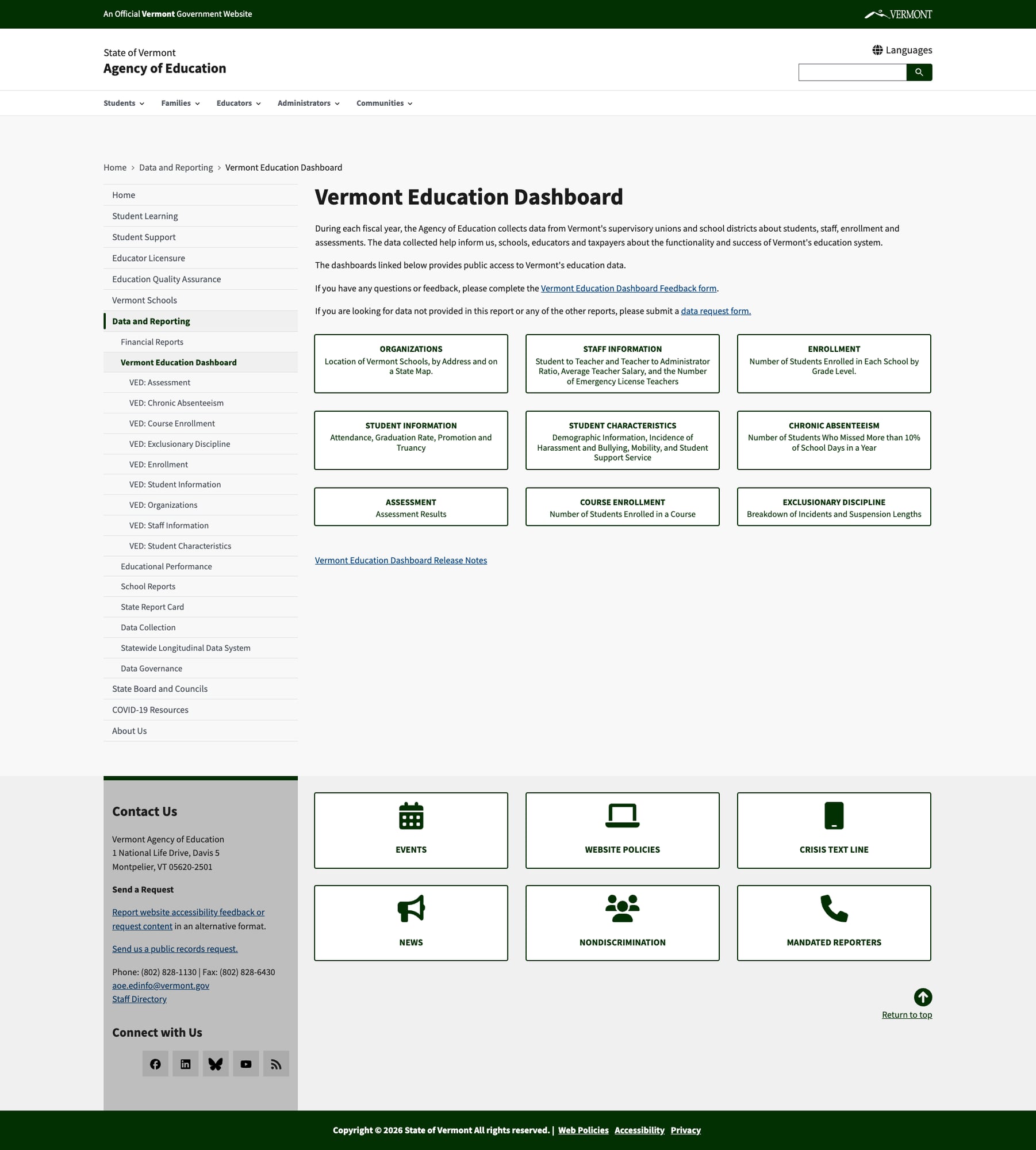
The Data and Reporting section is the crown jewel of this site. It offers 30+ distinct reports and datasets organized into clear categories: Educational Performance, Financial Reports, School Reports, Data Collection, and Data Governance. The Vermont Education Dashboard is a standout — a structured portal providing nine separate dashboards covering Organizations, Staff Information, Enrollment, Student Information, Student Characteristics, Chronic Absenteeism, Assessment, Course Enrollment, and Exclusionary Discipline. Each dashboard links to publicly accessible data with release notes and a feedback form.
The list of downloadable data and reports is extensive: Annual Performance Reports, Average Daily Membership, Civil Rights Data Collection, Per Pupil Spending, ELA and Math Assessments, NAEP results, Free and Reduced Lunch data, and many more. For researchers, journalists, and district administrators, this is a gold mine.
2. Strong Educator Licensure Portal
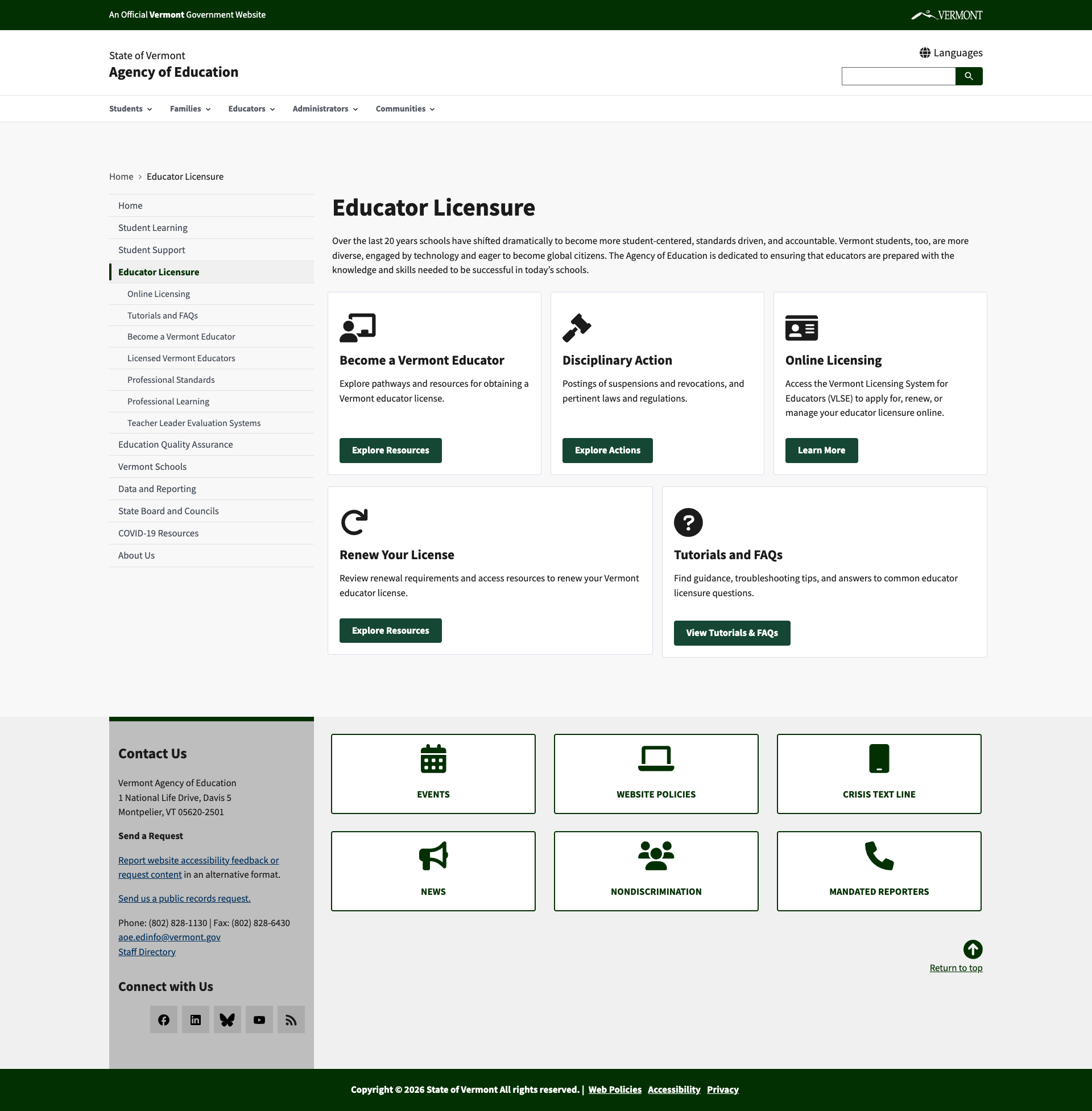
The Educator Licensure section is well-organized with clear pathways for different user needs: Become a Vermont Educator (Traditional Route and Alternative Route), Licensed Vermont Educators (Renew and Reinstate), Online Licensing (VLSE system), Disciplinary Action postings, and Tutorials & FAQs. Each section uses card-based layouts with descriptive text and clear calls-to-action. The Professional Standards and Professional Learning subsections provide additional resources for continuing education. This is a genuinely useful resource for both prospective and current educators.
3. Solid USWDS-Based Accessibility and Mobile Responsiveness
The site is built on the U.S. Web Design System (USWDS) — the federal government's open-source design framework — which provides a strong accessibility foundation out of the box. Key accessibility features include: lang="en" on the HTML element, proper skip-to-content links, ARIA landmarks (banner, navigation, main, search roles), aria-expanded attributes on accordion/nav buttons, alt text on all images (including descriptive alt text like "figure: the Statehouse in Montpelier is shown next to the Capitol Dome in Washington D.C."), and proper form labeling with usa-sr-only screen-reader labels.
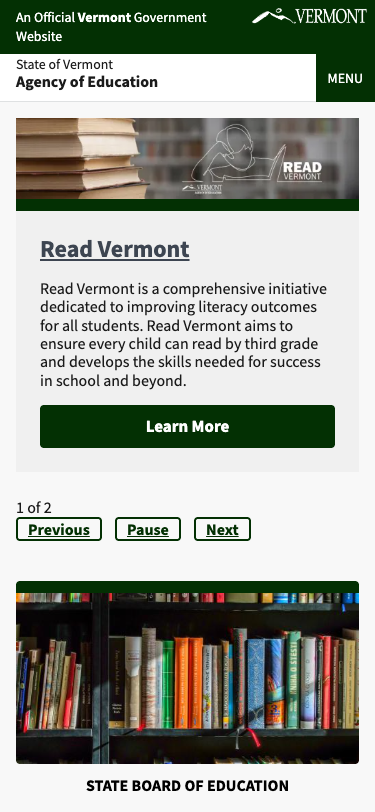
Mobile responsiveness is excellent. At 375px, the site collapses to a hamburger "MENU" button, content reflows cleanly without horizontal scrolling, touch targets are appropriately sized, and the hero carousel adapts with responsive srcset images at four breakpoints (480w, 640w, 1024w, 2560w). The viewport meta tag is properly configured with width=device-width, initial-scale=1.0 — no user-scalable=no restrictions.
4. Detailed State Report Card Under ESSA
The State Report Card page is comprehensive, providing school identification data based on School Year 2024-2025. It includes breakdowns of Comprehensive Support and Improvement (CSI) schools, schools with Additional Targeted Support and Improvement (ATSI), and schools entering or exiting various identification categories. The page provides detailed narrative explanations of identification criteria, data questions, and a summary of findings — including specific performance metrics on ELA, math, science, chronic absenteeism, and graduation rates. This goes beyond a simple data dump to provide genuine context and analysis.

5. Audience-Organized Navigation With 100% Link Health
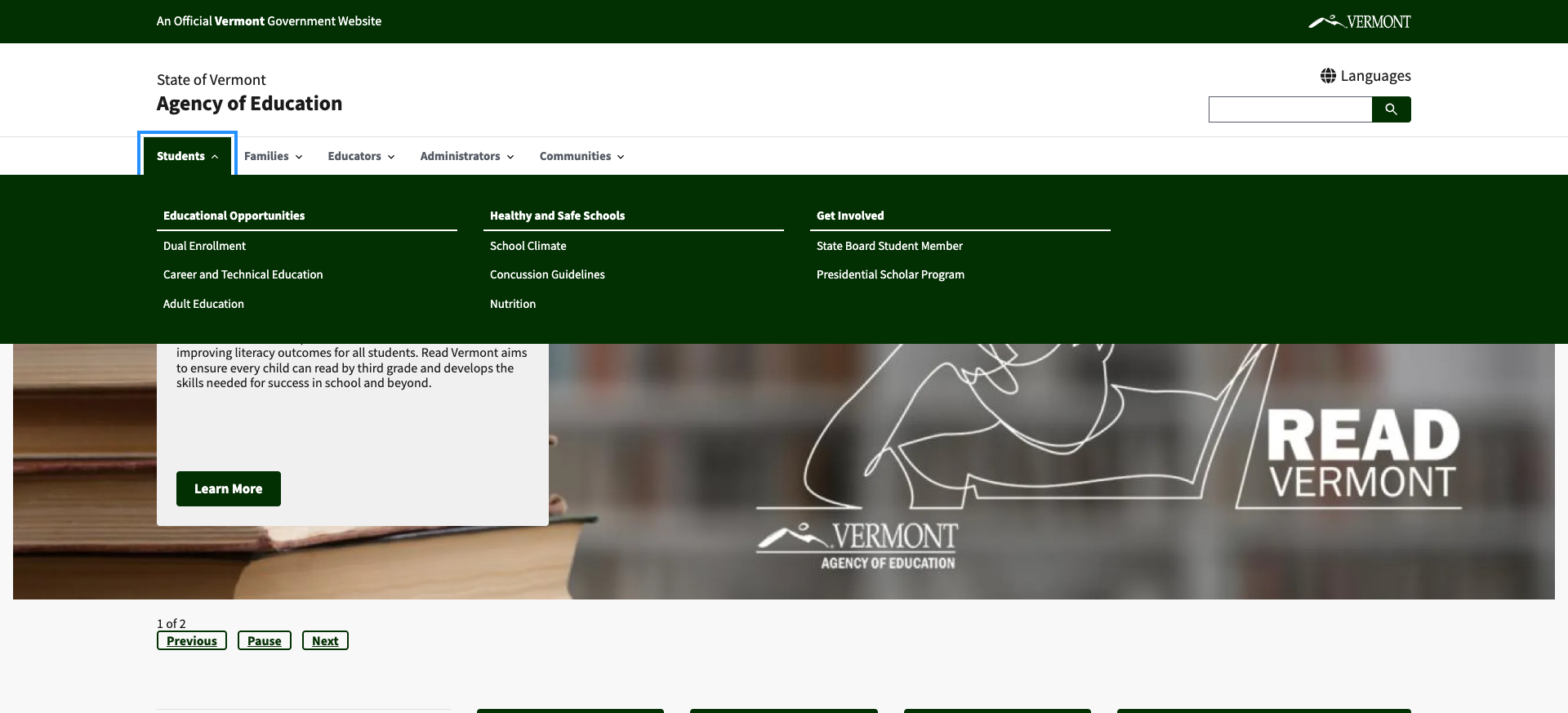
The top-level navigation is organized by audience (Students, Families, Educators, Administrators, Communities) with well-structured mega-dropdown menus. Each dropdown groups links into thematic categories — for example, the Students menu offers "Educational Opportunities" (Dual Enrollment, CTE, Adult Education), "Healthy and Safe Schools" (School Climate, Concussion Guidelines, Nutrition), and "Get Involved" (State Board Student Member, Presidential Scholar Program).
The sidebar navigation provides a complementary topic-based structure: Student Learning, Student Support, Educator Licensure, Education Quality Assurance, Vermont Schools, Data and Reporting, State Board and Councils, and About Us. Every sidebar and mega-menu link tested returned HTTP 200 — a perfect link health record across the entire site.
Weaknesses
1. Basic Search Without Filters or Autosuggest
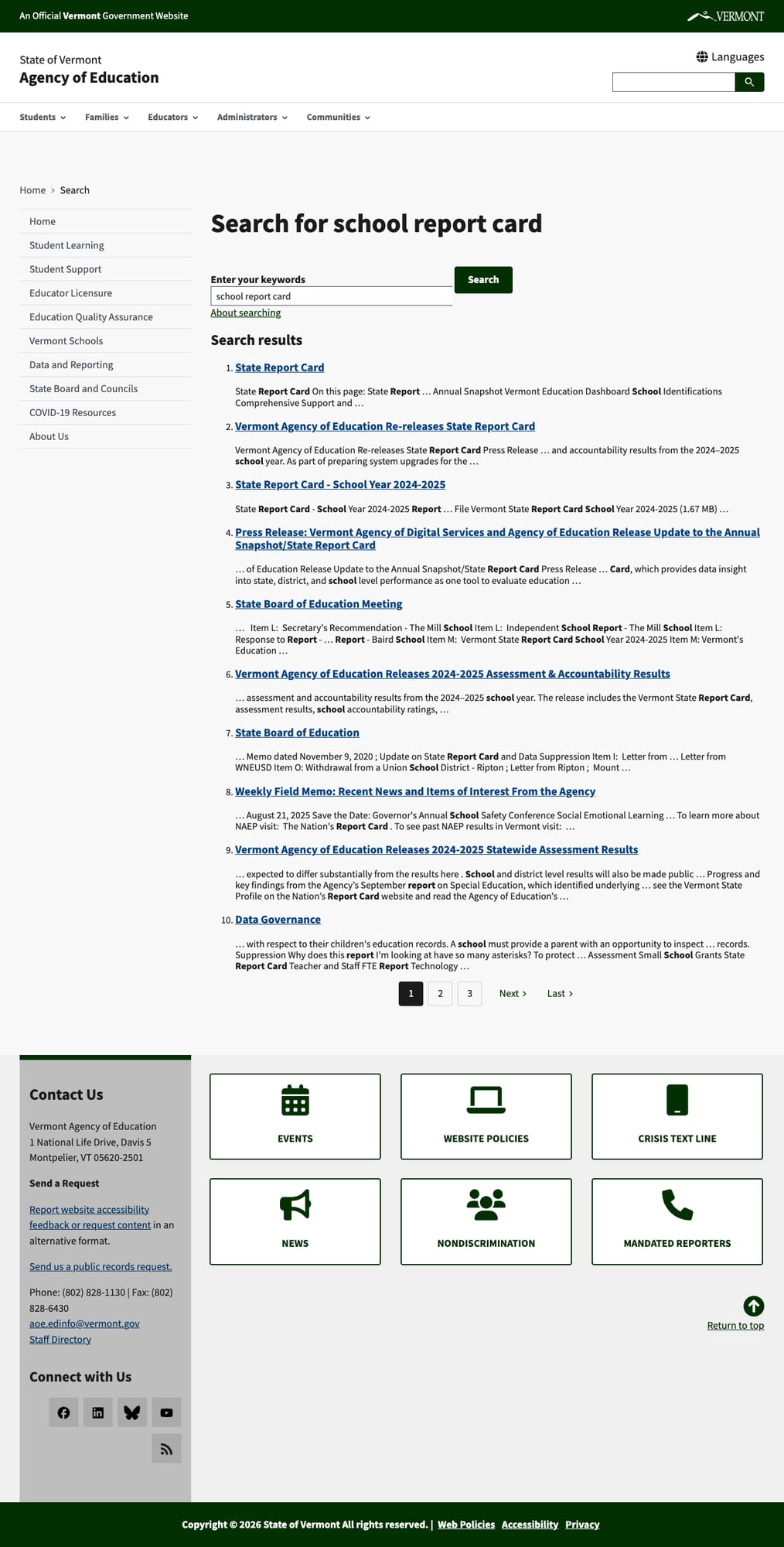
The search function uses Drupal's core search module at /search/node, which is functional but minimal. A search for "school report card" returns 28 results with keyword highlighting and pagination — that's the good news. The bad news: there are no filters (by content type, date, topic), no autosuggest/autocomplete, no relevance tuning, and no spelling correction. Results are presented as a flat list with snippets, making it difficult to find specific content types like data reports vs. press releases vs. policy documents. For a site with this much content, the search experience is a missed opportunity.
2. COVID-19 Resources Still in Main Navigation
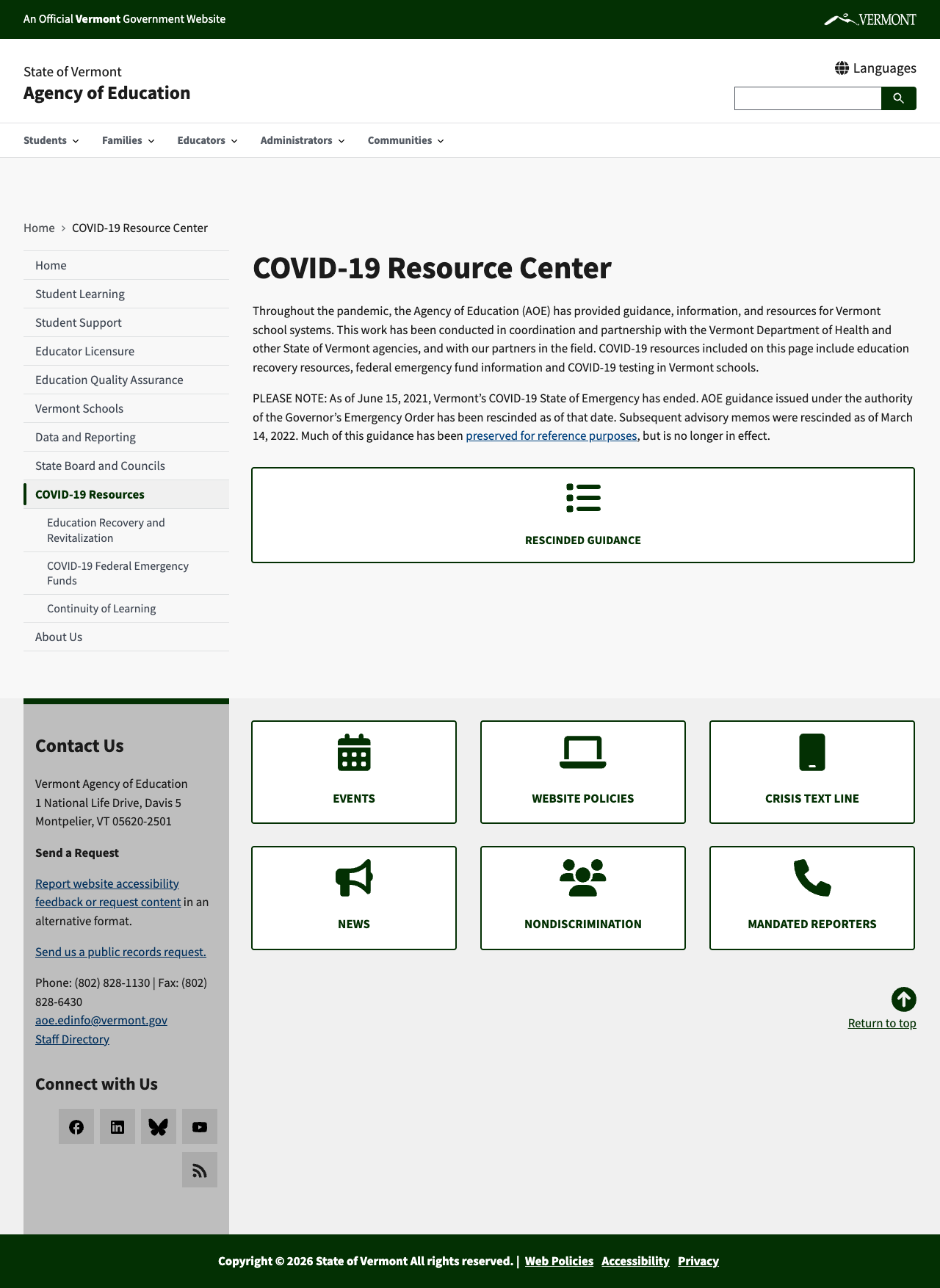
The COVID-19 Resource Center still occupies a top-level sidebar navigation slot in 2026 — five years after Vermont's State of Emergency ended and four years after the advisory memos were rescinded. The page itself acknowledges this ("As of June 15, 2021, Vermont's COVID-19 State of Emergency has ended... Much of this guidance has been preserved for reference purposes, but is no longer in effect"), but it still takes up prime real estate in every page's left sidebar. This should be archived or nested under a historical resources section, not competing for attention with current operational sections like Data and Reporting or Educator Licensure.
3. Austere Visual Design
The USWDS framework provides great structure, but the visual implementation is spartan even by government standards. The color palette is essentially two colors: dark green (#1b4332 or similar) and white, with gray for borders and backgrounds. There's minimal use of photography on interior pages — most section landing pages use small icon cards rather than engaging imagery. The homepage carousel has only two slides (Read Vermont and Federal Updates), and the main content area below it is a simple three-column layout of feature cards, a news list, and an events sidebar. The overall impression is functional and trustworthy but not inviting — the site reads as "government compliance" rather than "education community resource."
4. Translation Requires Separate Page Visit
The "Languages" link in the header navigates to a dedicated /translate-this-website page with a Google Translate widget and a legal disclaimer, rather than offering inline translation from any page. This creates friction for non-English speakers who must first navigate to the translate page, select their language, and then navigate back to their content of interest. The disclaimer-heavy approach (while legally prudent) adds another barrier. Many modern state education sites integrate Google Translate directly into the header with a dropdown selector on every page.
Opportunities
Implement faceted search: Adding content-type filters (Reports, News, Events, Policies), date ranges, and topic tags to the search function would dramatically improve discoverability across the site's extensive content library. A search overlay with autosuggest would also reduce friction.
Archive COVID-19 resources: Move the COVID-19 Resource Center out of the main sidebar navigation and into an archived resources section. Replace that navigation slot with something timely — the Federal Updates page is a strong candidate given the current political moment.
Enhance visual storytelling: Adding more photography, data visualizations, and varied layout templates to interior pages would make the site more engaging without sacrificing the USWDS accessibility foundation. Even simple changes like a full-width hero image on section landing pages would break up the text-heavy monotony.
Threats
Federal funding uncertainty: The homepage prominently features a "Federal Updates" carousel slide acknowledging impacts on districts and students. If ESSA reporting requirements change under a new federal administration, the site's robust accountability infrastructure could require significant reworking.
Drupal 10 maintenance burden: While Drupal 10 is a modern, well-supported CMS, maintaining a custom USWDS theme on top of it requires ongoing development resources. As a small-state agency, Vermont may face challenges keeping pace with both Drupal core updates and USWDS version changes.
Standout Feature
The Vermont Education Dashboard (education.vermont.gov/data-and-reporting/vermont-education-dashboard) is the site's standout feature. It provides nine distinct publicly accessible data dashboards covering every major dimension of Vermont's education system: Organizations (school locations on a state map), Staff Information (student-teacher ratios, salaries, emergency license teachers), Enrollment (by school and grade level), Student Information (attendance, graduation rates, truancy), Student Characteristics (demographics, harassment, bullying, mobility), Chronic Absenteeism, Assessment results, Course Enrollment, and Exclusionary Discipline (incidents and suspension lengths). Each dashboard includes release notes and a feedback form. For a state of Vermont's size, this level of data transparency is remarkable.
Bottom Line
Vermont's Agency of Education website is a substance-over-style success story. Educators, administrators, and data-minded parents will find an impressively deep repository of reports, dashboards, and accountability data — all built on a rock-solid accessibility framework. What they won't find is visual polish, modern search capabilities, or multilingual convenience. If you need data about Vermont schools, this site delivers; if you're a parent looking for an inviting, easy-to-navigate guide to your child's education options, the clinical presentation may feel more like navigating a government filing system than browsing a community resource.
Grade Breakdown
| Criterion | Weight | Score | Notes |
|---|---|---|---|
| Navigation & Information Architecture | 15% | 8 | Excellent audience-based mega-menus plus topic-based sidebar. 100% link health. Breadcrumbs throughout. COVID-19 in sidebar is only blemish. |
| Accessibility (WCAG 2.1 AA) | 15% | 9 | USWDS foundation provides strong ARIA, skip links, alt text, landmarks, proper form labels. Responsive images with srcset. No user-scalable restrictions. |
| Search Functionality | 10% | 5 | Functional Drupal core search returns relevant results (28 for "school report card") with pagination. No filters, autosuggest, or content-type facets. |
| Mobile Responsive Design | 10% | 8 | Clean hamburger menu at 375px, proper viewport meta, srcset responsive images at 4 breakpoints, no horizontal scroll. Touch targets adequate. |
| Data Transparency & Open Data | 10% | 9 | Outstanding. 30+ reports, VT Education Dashboard with 9 data categories, State Report Card with 2024-2025 data, downloadable datasets, data governance page. |
| Parent Resources | 10% | 6 | Families nav dropdown covers Special Education, Home Study, Independent Schools, Find a School. Student Support page has family engagement. No dedicated parent portal, limited plain-language guides. |
| Educator Resources | 10% | 8 | Strong licensure portal (become, renew, reinstate, online licensing), Professional Learning, Professional Standards, Teacher Leader Evaluation. Content Areas linked from nav. |
| Visual Design & Branding | 10% | 5 | Consistent but austere USWDS implementation. Dark green/white palette. Minimal photography on interior pages. Homepage carousel limited to 2 slides. Functional but uninviting. |
| Performance & Load Speed | 10% | 8 | 117ms TTFB, 62KB page size, WebP responsive images with lazy loading, minimal third-party scripts (Google Analytics). Drupal caching well-configured. |
| Overall | 100% | 75/100 | B- |
Discussion