71/100
Grade: C+ — A Solid Data Ecosystem Behind an Aging Frontend
Utah's State Board of Education (USBE) website at schools.utah.gov sits at an interesting crossroads: behind a competent but aging Bootstrap frontend powered by OmniUpdate CMS, there's a genuinely impressive data infrastructure. The Data Gateway at datagateway.schools.utah.gov, the School Report Card portal at reportcard.schools.utah.gov, and an AI-powered licensing assistant called ULA represent forward-thinking investments in transparency and usability. But the main site's information architecture — particularly the "Sections" mega-menu that dumps 26 alphabetical links without grouping — reveals a site that has grown organically without enough structural discipline.
For a state serving nearly 668,000 K-12 students, the USBE site does many things right: every single navigation link resolves successfully (100% link health across 24+ tested paths), search returns relevant results, and the Parent Portal provides genuinely useful content with a named contact person. The 22-language Google Translate integration shows awareness of Utah's growing multilingual population. But the visual presentation lags behind peers like Georgia and Florida, and the site's own ADA statement candidly admits it's still working toward full Section 508 compliance.
Strengths
1. Comprehensive Data Gateway
The Utah Educational Data Gateway (datagateway.schools.utah.gov) is the crown jewel of the USBE web presence. This standalone ASP.NET Core application organizes education data into clearly defined categories: Assessment (Compare Schools, Student Proficiency, Student Growth, ACT, Utah Aspire Plus, Early College, Graduation Rate, Acadience Reading/Math, WIDA ACCESS), Accountability (School Report Card, Accountability Indicators, Historical PACE/SFAR), Enrollment/Membership (Enrollment Trends, Chronically Absent Trends, Youth In Care), and Finance (USBE Financial Overview). The portal includes dedicated training resources, data privacy documentation, and links to 12 additional administrative systems (CACTUS, SSID, SEATS, UPEFS, and more) in its footer navigation.
2. Dedicated Parent Portal with Named Contact
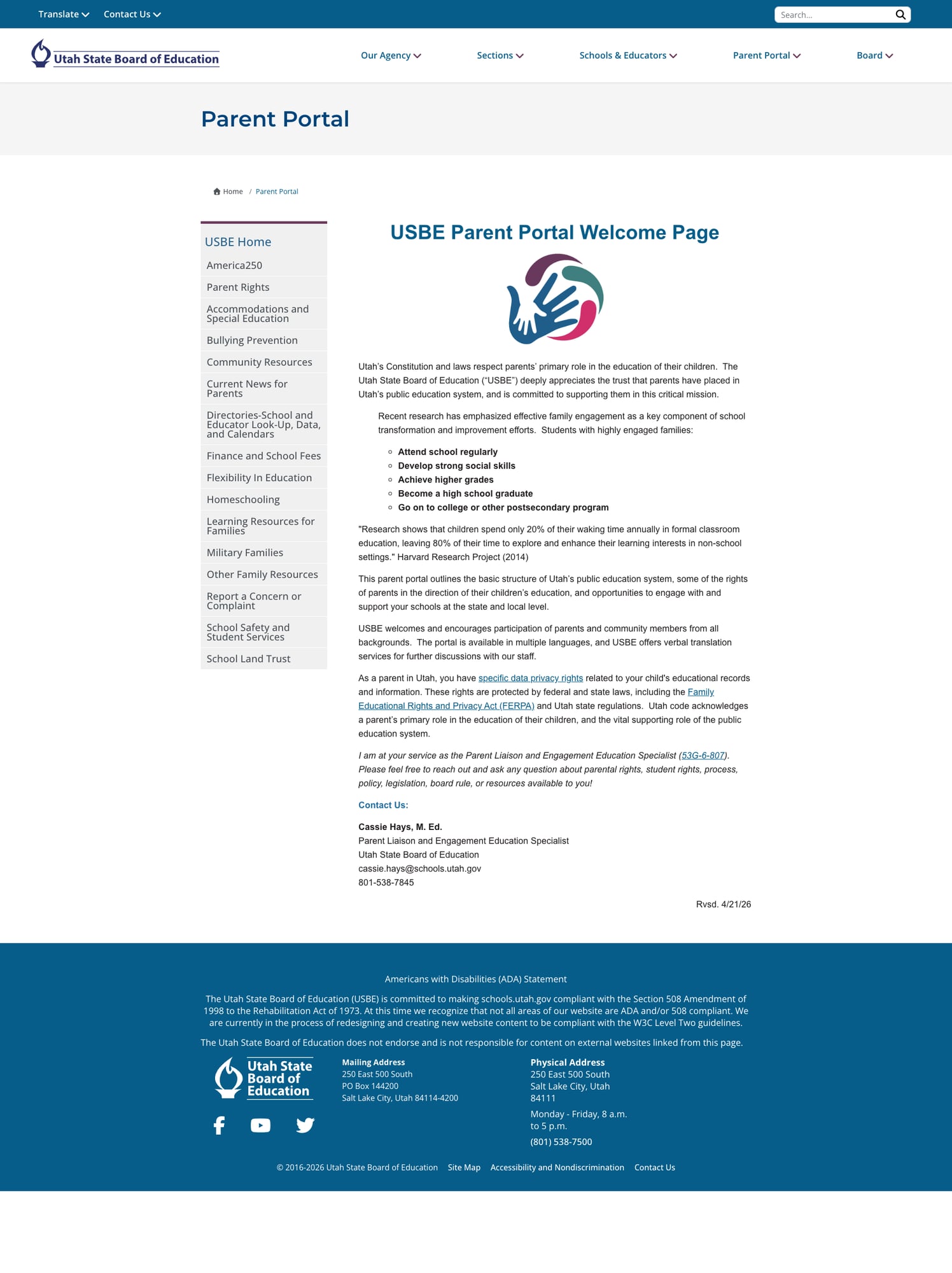
The USBE Parent Portal goes beyond the typical sparse "for parents" landing page. It features 15+ sidebar sections covering Parent Rights, Accommodations and Special Education, Bullying Prevention, Community Resources, Current News for Parents, Directories/School and Educator Look-Up, Finance and School Fees, Flexibility in Education, Homeschooling, Learning Resources for Families, Military Families, Report a Concern or Complaint, School Safety, and School Land Trust. The page identifies a specific contact person — Cassie Hays, Parent Liaison and Engagement Education Specialist — with direct email and phone number. It also references Utah's constitutional framework for parental rights in education, making the legal basis for parent engagement explicit.
3. Functional Site Search with 549+ Results
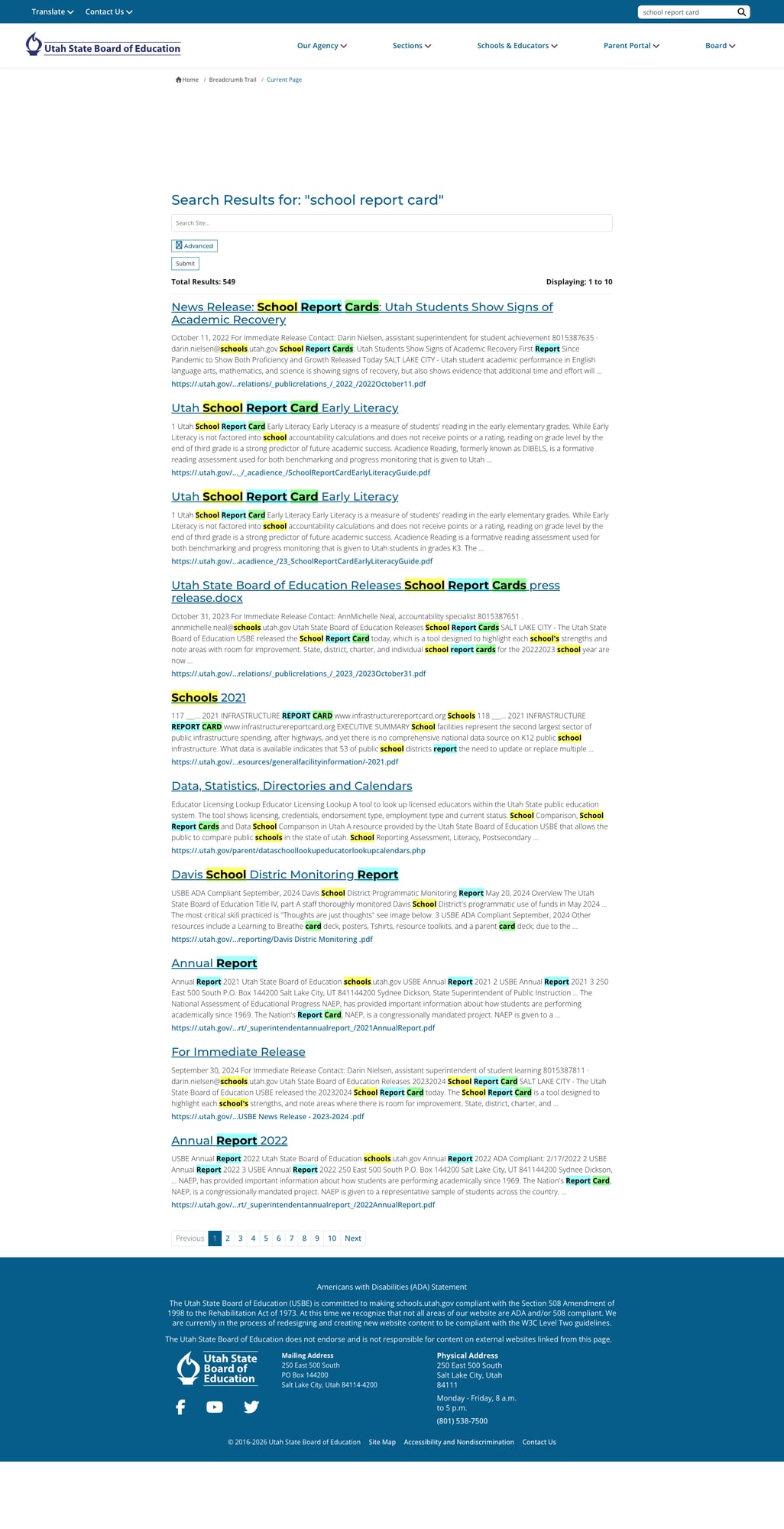
The OmniUpdate-powered site search delivers genuinely useful results. A query for "school report card" returns 549 total results with pagination (10 per page), displaying titles, URLs, and content excerpts with highlighted keywords. The search page includes an "Advanced" option for more refined queries. While it lacks modern features like autosuggest, faceted filtering, or spelling correction, it gets the fundamentals right — relevant results, clear presentation, and working pagination. This puts Utah ahead of approximately one-third of state education sites we've reviewed that have broken or non-functional search.
4. Educator Licensing with AI Chatbot
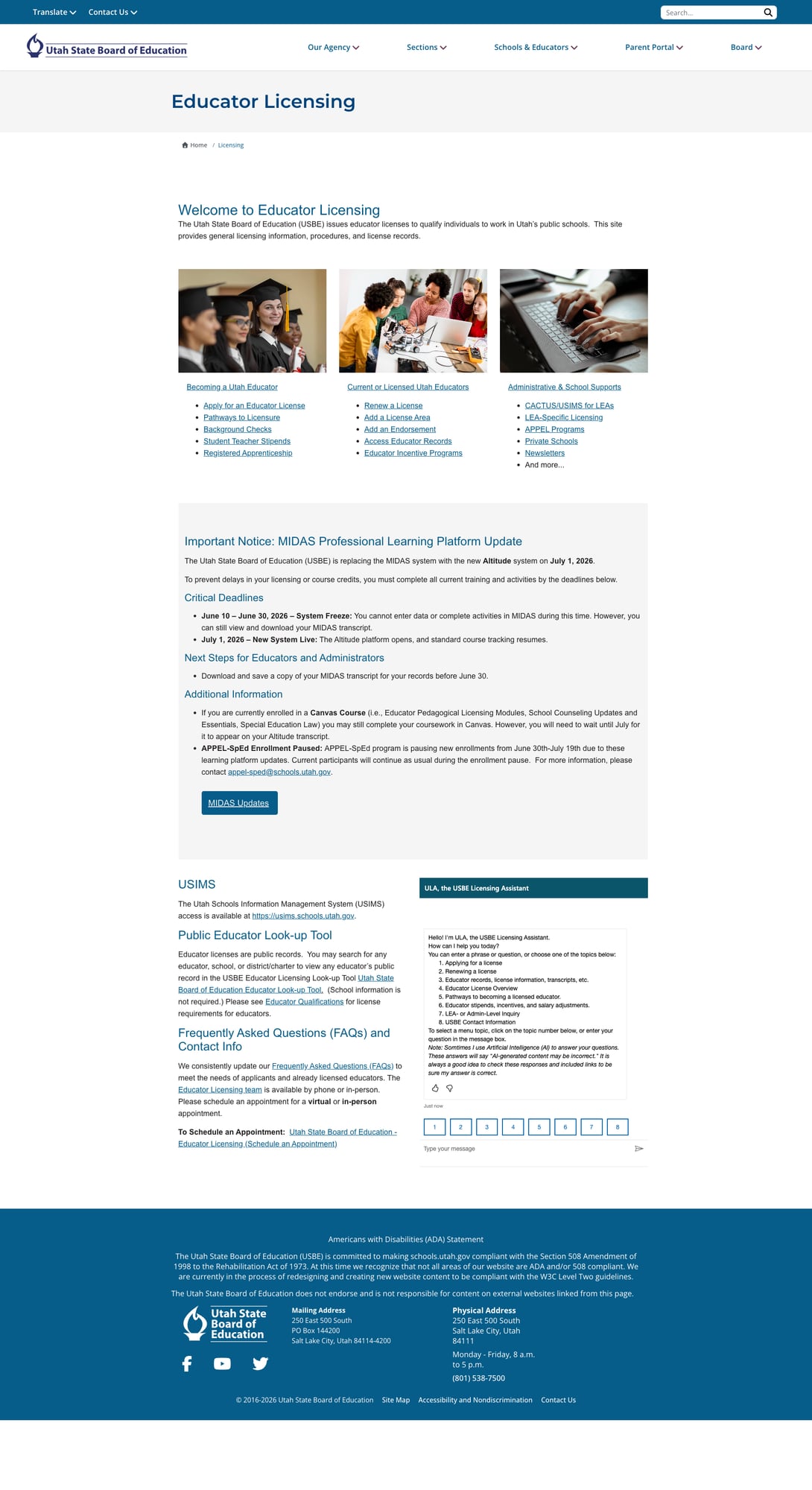
Utah's Educator Licensing section is one of the most comprehensive we've encountered. It's organized into three audience columns — Becoming a Utah Educator, Current or Licensed Utah Educators, and Administrative & School Supports — each with 5-6 relevant links. The page includes a prominent notice about the MIDAS-to-Altitude platform migration (July 1, 2026), showing active system maintenance. Most notable is ULA, the USBE Licensing Assistant — an AI-powered chatbot embedded directly on the licensing page that offers topic-based navigation (applying for a license, renewing, educator records, FAQs) and free-text question input. It even includes a disclaimer: "Sometimes I use Artificial Intelligence (AI) to answer your questions. These answers will say 'AI-generated content may be inaccurate.'" This is one of the first AI chatbots we've seen deployed on a state education website.
5. Forward-Looking AI Guidance Framework
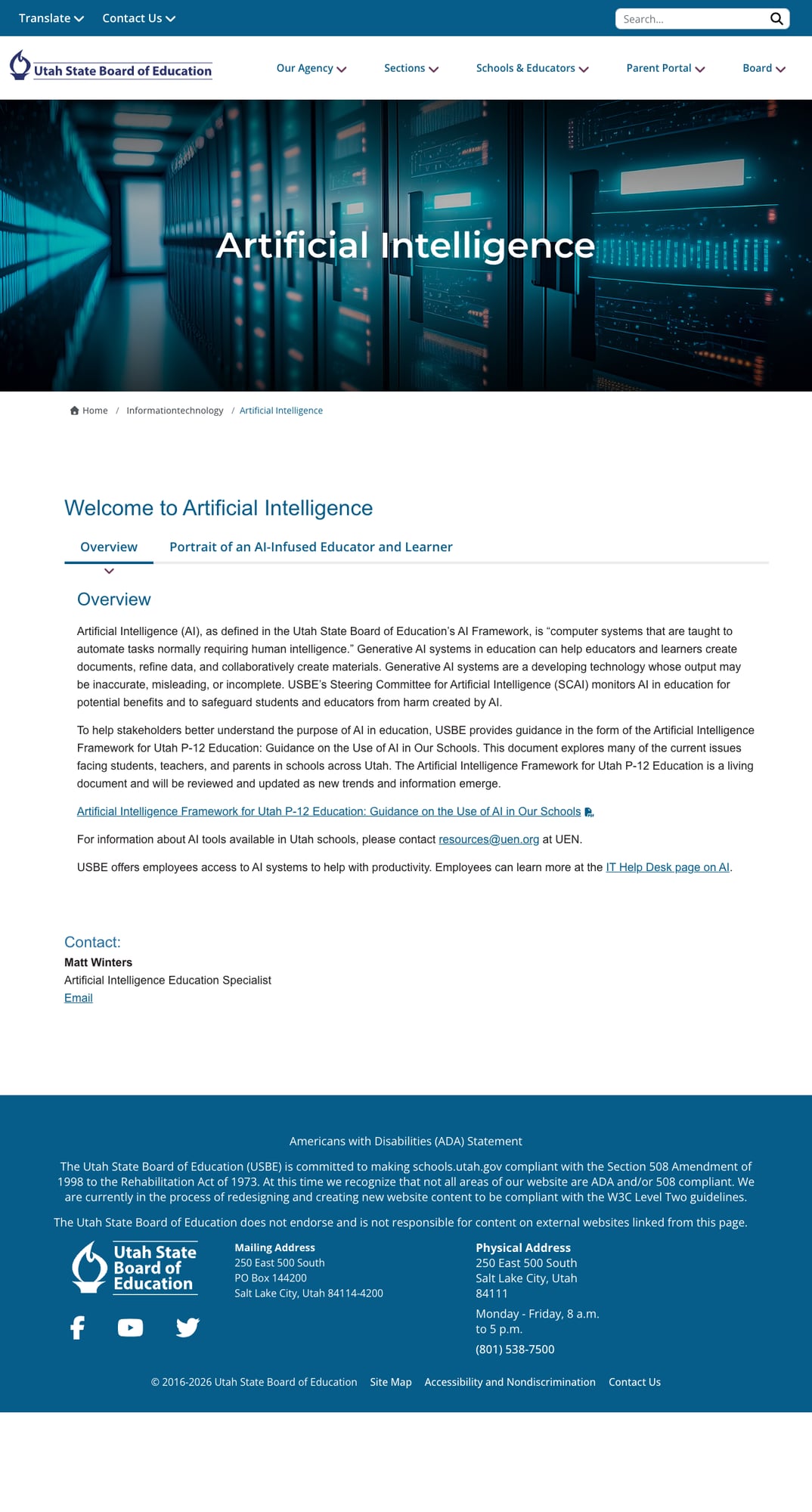
Utah has a dedicated Artificial Intelligence page accessible from the main navigation (Sections → Information Technology → Artificial Intelligence). The page presents the USBE's AI Framework definition, explains SCAI (Steering Committee for Artificial Intelligence) oversight, and links to the official "Artificial Intelligence Framework for Utah P-12 Education: Guidance on the Use of AI in Our Schools" document. It includes a named contact (Matt Winters, Artificial Intelligence Education Specialist) and references the Utah Education Network (UEN) for AI tools in schools. This level of forward-looking AI governance content is rare among state education websites.
Weaknesses
1. "Sections" Mega-Menu is a Flat Alphabetical Dump
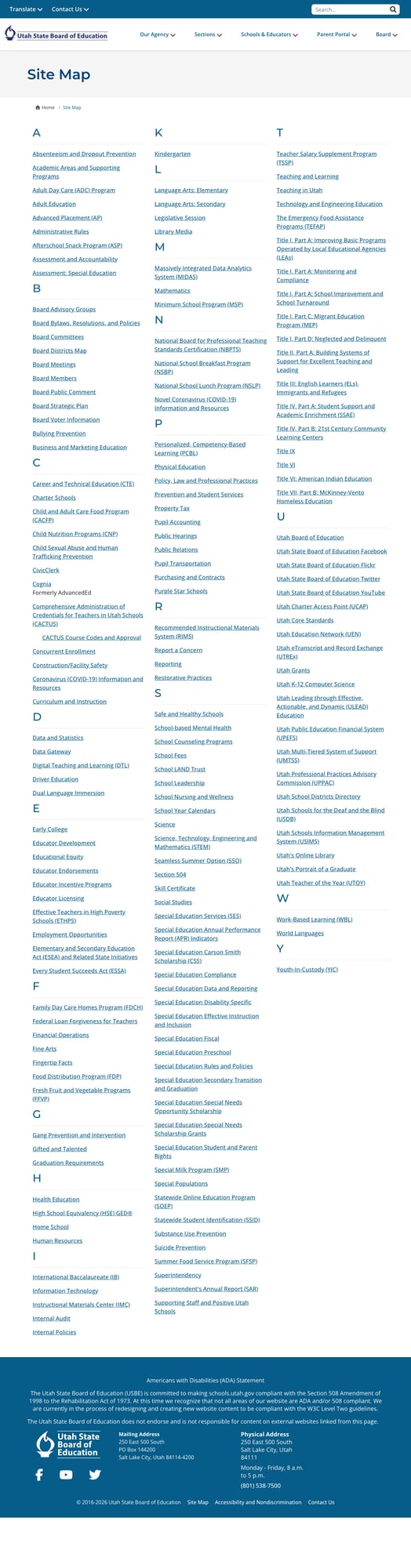
The "Sections" dropdown in the main navigation exposes all 26+ USBE administrative divisions as a flat alphabetical list — from Administrative Rules to ULEAD — with no visual grouping, categorization, or hierarchy. This is essentially a department directory masquerading as navigation. Users looking for something specific (say, information about school lunches) must know that it falls under "Child Nutrition" rather than an intuitive category like "Student Services." Compare this to the more audience-oriented "Schools & Educators" and "Parent Portal" dropdowns, which organize content by user need rather than internal org chart. The Sections mega-menu reflects the agency's organizational structure rather than how a parent, teacher, or administrator would think about finding information.
2. Self-Acknowledged Incomplete Accessibility Compliance
Utah's ADA statement in the footer is unusually candid: "At this time we recognize that not all areas of our website are ADA and/or 508 compliant. We are currently in the process of redesigning and creating new website content to be compliant with the W3C Level Two guidelines." This references "W3C Level Two" — likely WCAG 2.0 Level AA, which is itself outdated (WCAG 2.1 AA is the current standard, with WCAG 2.2 published in 2023). The site lacks a visible skip-to-content link, uses only 9 ARIA attributes across the entire homepage, and includes sr-only screen reader text primarily on decorative elements rather than providing comprehensive assistive navigation. No accessibility overlay widget (like UserWay or AudioEye) is deployed, though the strong security headers (CSP, HSTS, X-Frame-Options) show technical awareness.
3. Dated Visual Design and Content Typos
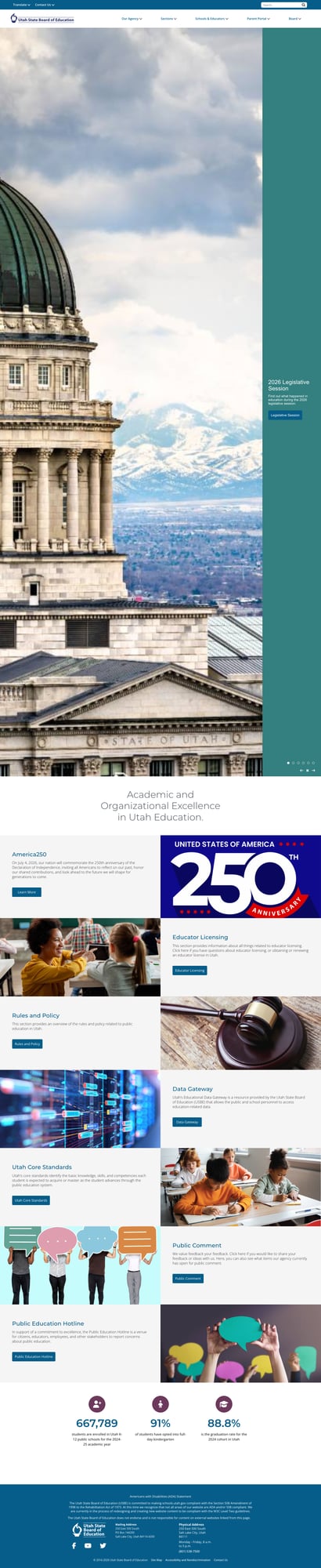
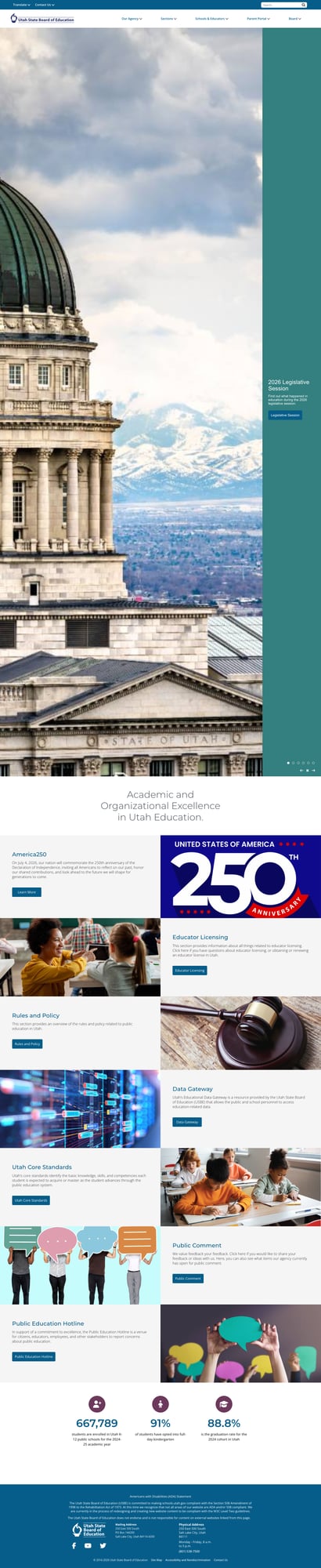
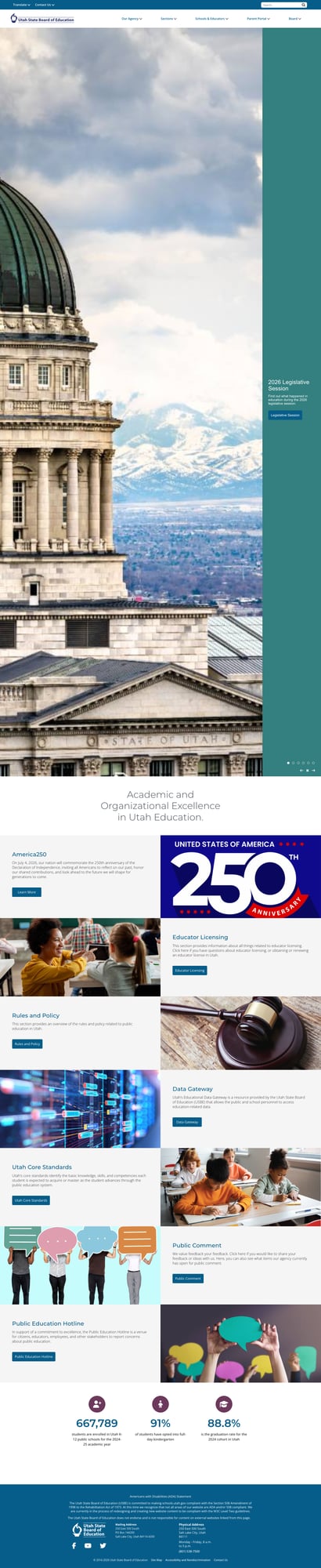
The site runs on Bootstrap with jQuery 3.5.1 (released 2020) and OmniUpdate CMS. While functional, the visual presentation feels several years behind modern government web design. The homepage features a large hero carousel — a pattern increasingly disfavored in UX research for low engagement — and the content sections below use alternating left-right image/text blocks that feel templated. More concerning is the content quality: the Public Comment section on the homepage reads "We value feedback your feedback" — a typo that has persisted through at least one content review cycle. The Data Gateway and School Report Card portals, while functionally strong, use completely different visual design languages from the main site and from each other, creating a fragmented brand experience across the USBE web presence.
4. Parent Portal Has Limited Scope Despite Good Structure
While the Parent Portal has an impressive sidebar menu with 15+ sections, the actual content is relatively thin. The main page is essentially a welcome letter from the Parent Liaison, and several sidebar items link to single-page resources rather than rich content areas. The Utah Fits All Scholarship Program — a significant school choice initiative — gets a single nav item but could benefit from its own dedicated landing experience. Additionally, there's no Spanish-language version of the Parent Portal itself; the Google Translate integration provides machine translation but lacks the curated, culturally appropriate content that states like Florida offer their multilingual families.

Opportunities
1. Reorganize "Sections" into Audience-Based Categories
The flat alphabetical "Sections" menu could be restructured into 4-5 thematic groups (e.g., "Teaching & Curriculum," "Student Services," "Finance & Operations," "Data & Accountability," "Policy & Governance") with clear subheadings. This would align with the audience-oriented approach already used in the "Schools & Educators" and "Parent Portal" dropdowns.
2. Unify Visual Identity Across Subdomains
The main site, Data Gateway, and School Report Card portals each have distinct visual designs. A shared design system — even just consistent header/navigation, typography, and color palette — would make the USBE web presence feel like one coherent platform rather than three separate websites.
3. Expand AI Integration Beyond Licensing
The ULA chatbot on the licensing page demonstrates that USBE has the technical capability and willingness to deploy AI-assisted navigation. Extending this to the main site — particularly for parent questions about school enrollment, special education rights, or school choice — could dramatically improve the user experience for families navigating the education system.
Threats
1. Aging CMS and Frontend Dependencies
OmniUpdate CMS, jQuery 3.5.1, and Bootstrap (pre-5.x based on the use of data-toggle attributes rather than data-bs-toggle) represent an aging technology stack. The html5shiv conditional comment targeting IE versions below 9 is particularly telling — this code hasn't been needed since IE was deprecated in 2022. As these dependencies age, security patches become scarcer and developer talent harder to find.
2. Accessibility Liability Gap
Utah's own ADA statement acknowledges non-compliance, which is both honest and legally risky. As OCR complaints and ADA lawsuits against government websites increase, the gap between the stated aspiration ("W3C Level Two") and current reality creates potential liability. The absence of a formal VPAT (Voluntary Product Accessibility Template) or regular third-party audit makes it difficult to track progress toward compliance.
Standout Feature
The ULA Licensing Assistant is the standout feature. Deployed directly on the Educator Licensing page, this AI chatbot offers both structured topic navigation (8 numbered categories including "Applying for a license," "Renewing a license," "Educator records") and free-text question input. It transparently discloses when AI generates responses and recommends users verify AI-generated content. In a sector where chatbots are rare and AI governance is still emerging, Utah has deployed both the technology and the policy framework simultaneously — the licensing chatbot paired with the dedicated AI Framework page creates a model for how state agencies can adopt AI tools responsibly.
Bottom Line
Utah's USBE website is a tale of strong backend infrastructure behind a middling frontend experience. Parents seeking school performance data will find everything they need through the Data Gateway and School Report Card — both are well-organized and current. Educators benefit from the AI-enhanced licensing section and comprehensive professional development resources. But casual visitors navigating the main site will encounter an organizational-chart-as-navigation design, content typos, and a visual presentation that feels several years behind peers. The 22-language translation and 100% link health demonstrate basic competence; the AI chatbot and governance framework hint at an agency that's investing in the future even as the current site shows its age.
Grade Breakdown
| Criterion | Weight | Score | Notes |
|---|---|---|---|
| Navigation & Information Architecture | 15% | 7/10 | Five top-level items with working mega-dropdowns and breadcrumbs. "Sections" is a flat A-Z dump of 26+ items with no grouping. 100% link health. |
| Accessibility (WCAG 2.1 AA) | 15% | 6/10 | Proper lang attribute, viewport meta, ARIA labels, sr-only text. No skip-to-content link. ADA statement acknowledges incomplete compliance. References outdated "W3C Level Two." |
| Search Functionality | 10% | 7/10 | OmniUpdate search returns 549 results with pagination and Advanced option. No autosuggest, filters, or spelling correction. |
| Mobile Responsive Design | 10% | 7/10 | Bootstrap responsive layout with hamburger menu. Content reflows at 375px. Touch targets adequate. |
| Data Transparency & Open Data | 10% | 8/10 | Excellent Data Gateway with 9 assessment tools, accountability indicators, enrollment dashboards, and finance overview. School Report Card with 2024-2025 data and Google Maps. |
| Parent Resources | 10% | 7/10 | Dedicated Parent Portal with 15+ sections and named contact. Content depth varies. No native multilingual content — relies on Google Translate. |
| Educator Resources | 10% | 8/10 | AI chatbot for licensing, MIDAS/Altitude platform, CACTUS lookup, AI governance framework, core standards, Teach in Utah recruitment. |
| Visual Design & Branding | 10% | 6/10 | Clean teal/white palette but feels dated. Hero carousel pattern. Homepage content typo. Three visually disconnected subdomains. |
| Performance & Load Speed | 10% | 8/10 | 190ms TTFB, 52KB page size. Strong security headers (HSTS, CSP, X-Frame-Options, X-Content-Type-Options). Reliable uptime. |
| Overall | 100% | 71/100 | C+ |
Discussion