OverviewAll statesNorth Dakota
71/100
Grade: C+ — Solid Infrastructure With a Data Powerhouse Hiding in Plain Sight
North Dakota's Department of Public Instruction (NDDPI) website lives on the state's nd.gov platform, powered by Drupal 11 — one of the more modern CMS foundations we've seen in this series. The site serves a relatively small state (119,622 K-12 students) but punches above its weight in data transparency, thanks to the Insights dashboard and an ambitious K-12 data modernization initiative called BRIDGE.
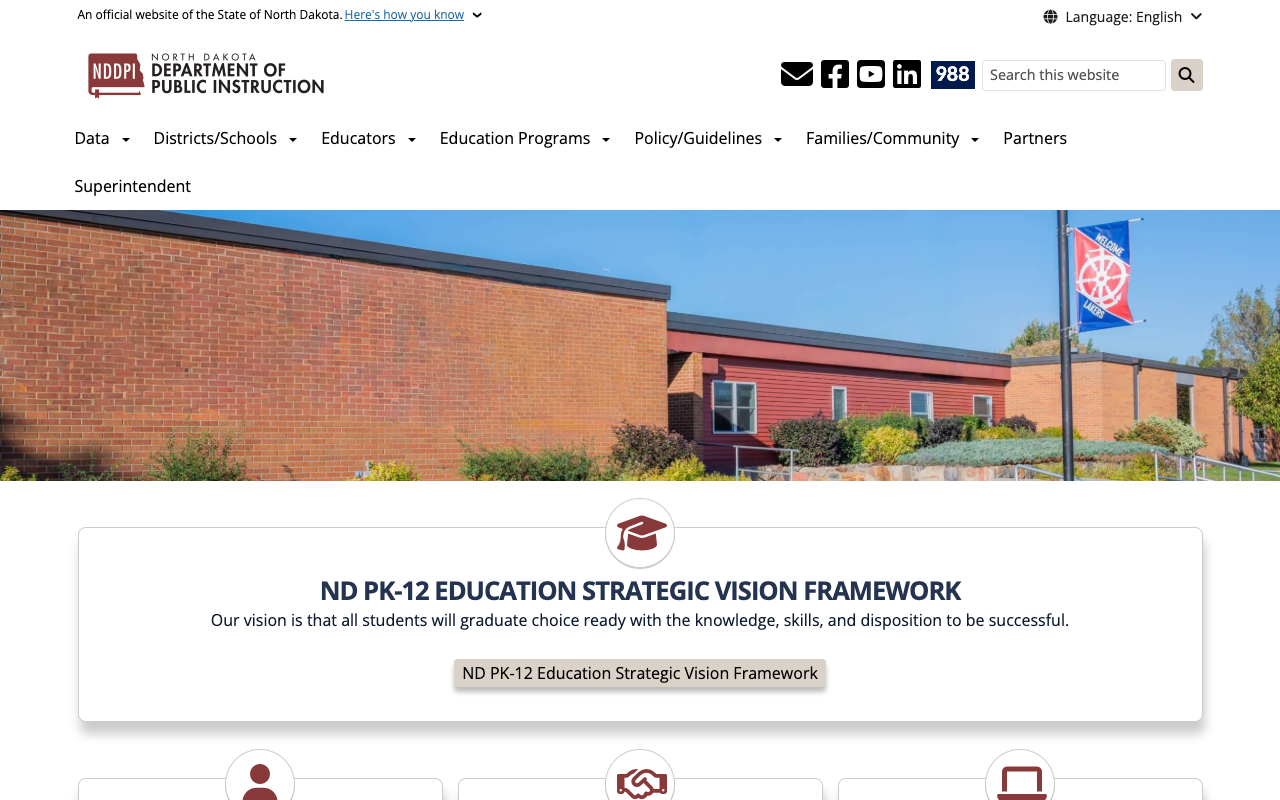
The homepage greets visitors with a clean maroon-and-white color scheme, a hero image of a North Dakota school building, and three featured cards highlighting the State Superintendent, ESSA, and the Insights dashboard. Below that, a three-column layout presents Recent News, Upcoming Events, and K-12 Data Modernization updates — a structure that prioritizes district administrators and educators over families. The navigation bar spans eight top-level items with dropdown menus, though it wraps to a second row on standard displays, pushing "Superintendent" onto its own line.
For a state that's actively migrating its entire student information system to Infinite Campus through the BRIDGE initiative, NDDPI's website does a commendable job of keeping stakeholders informed with weekly updates. Where it falls short is in parent-facing resources — the Families section feels like an afterthought compared to the rich data and educator tools available elsewhere on the site.
Strengths
1. Insights Dashboard — A Comprehensive Data Portal
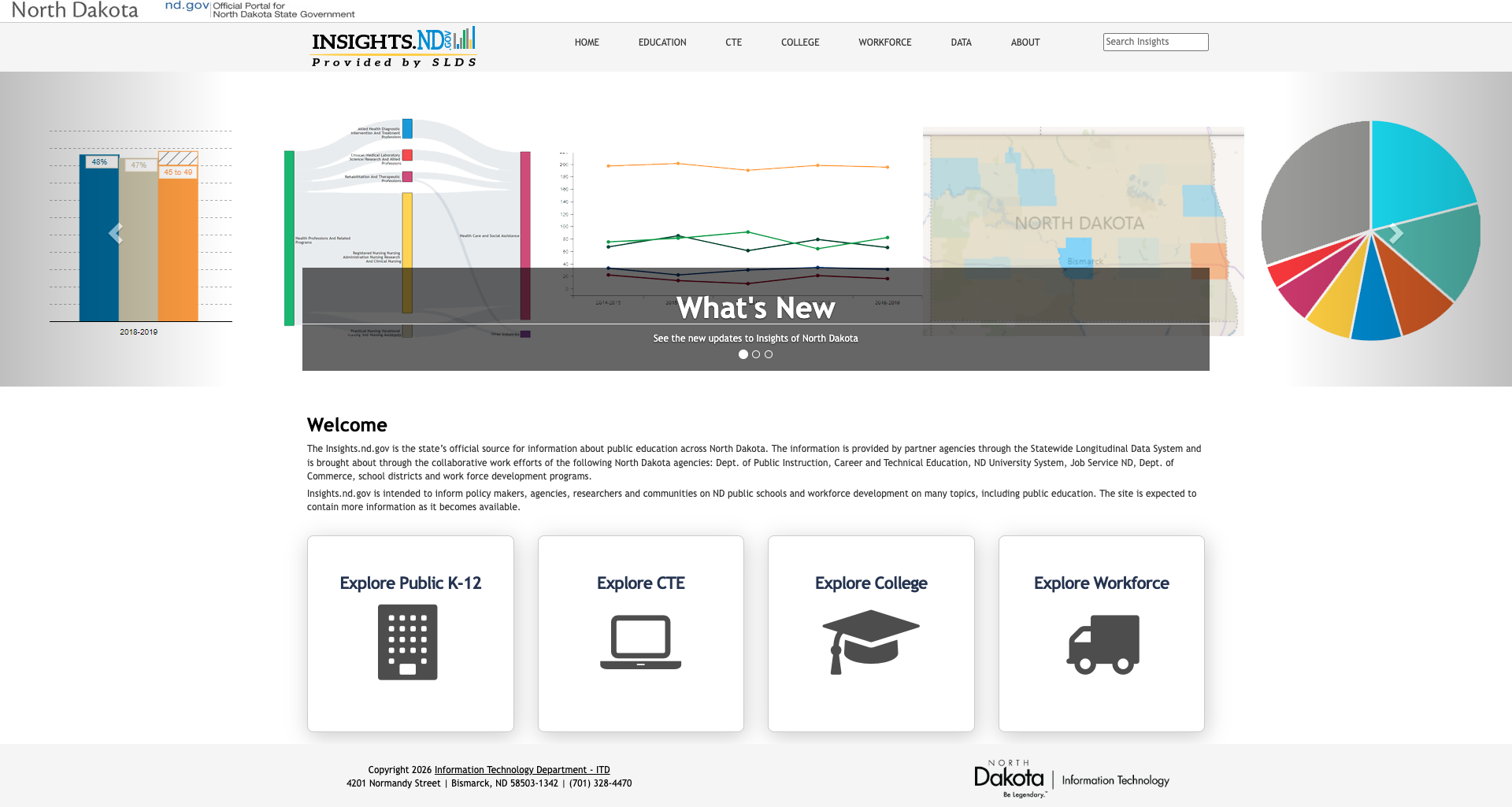
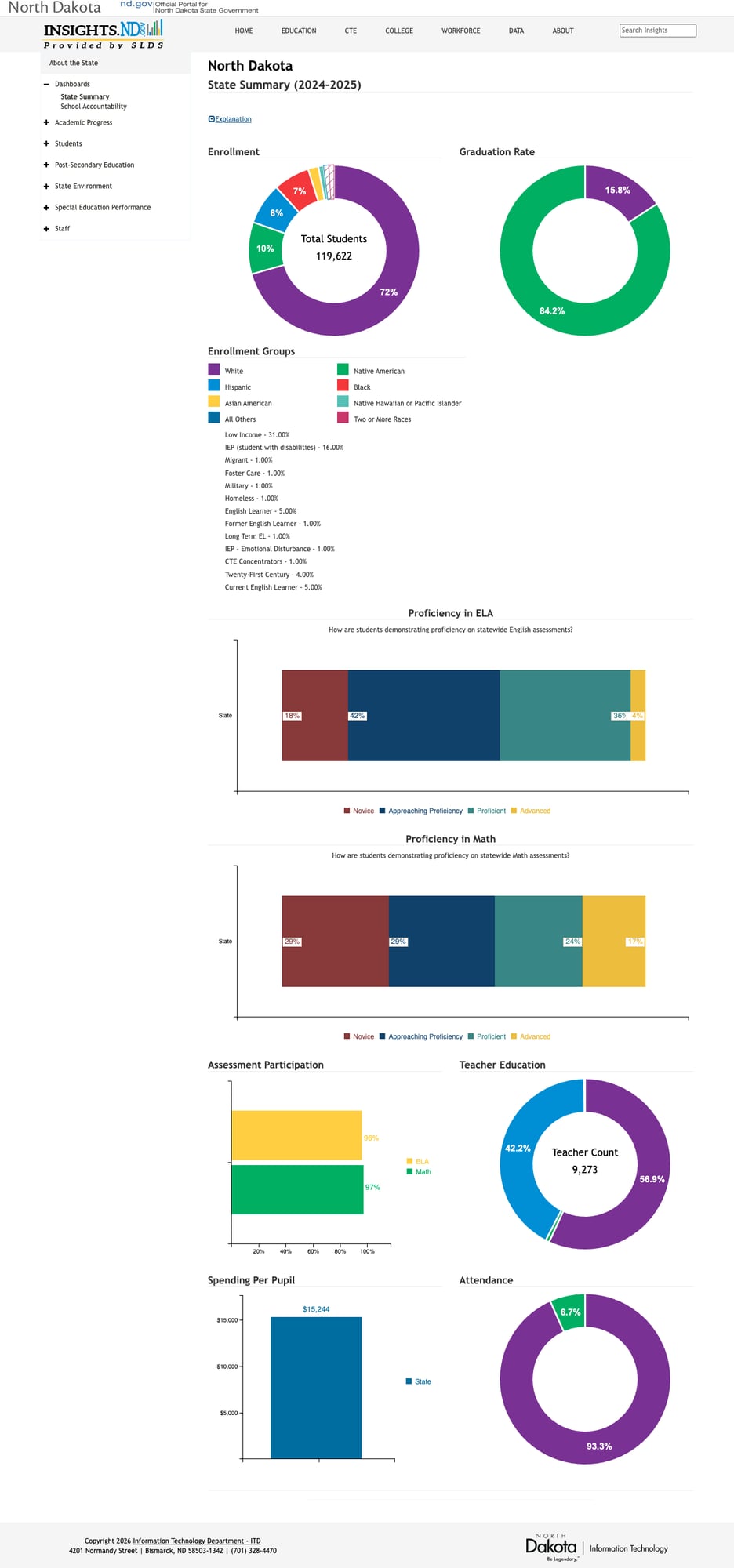
The standout feature of North Dakota's education web ecosystem is Insights, the state's official education data portal provided through the Statewide Longitudinal Data System (SLDS). Insights offers six data categories: Statewide Education Data, Data for Specific District or School, Adult Education, ND Long-Term Strategic Goals, STEM Opportunities, and Enrollment by Subject. The State Summary page displays 2024-2025 data including enrollment demographics (119,622 total students), graduation rates (84.2%), proficiency breakdowns in ELA and Math, assessment participation, teacher counts (9,273 with education level breakdown), spending per pupil ($15,244), and attendance rates (93.3%). The cross-agency collaboration — involving DPI, Career and Technical Education, the ND University System, Job Service ND, and the Department of Commerce — makes this a true cradle-to-career data ecosystem.
2. Strong Educator Resources Section
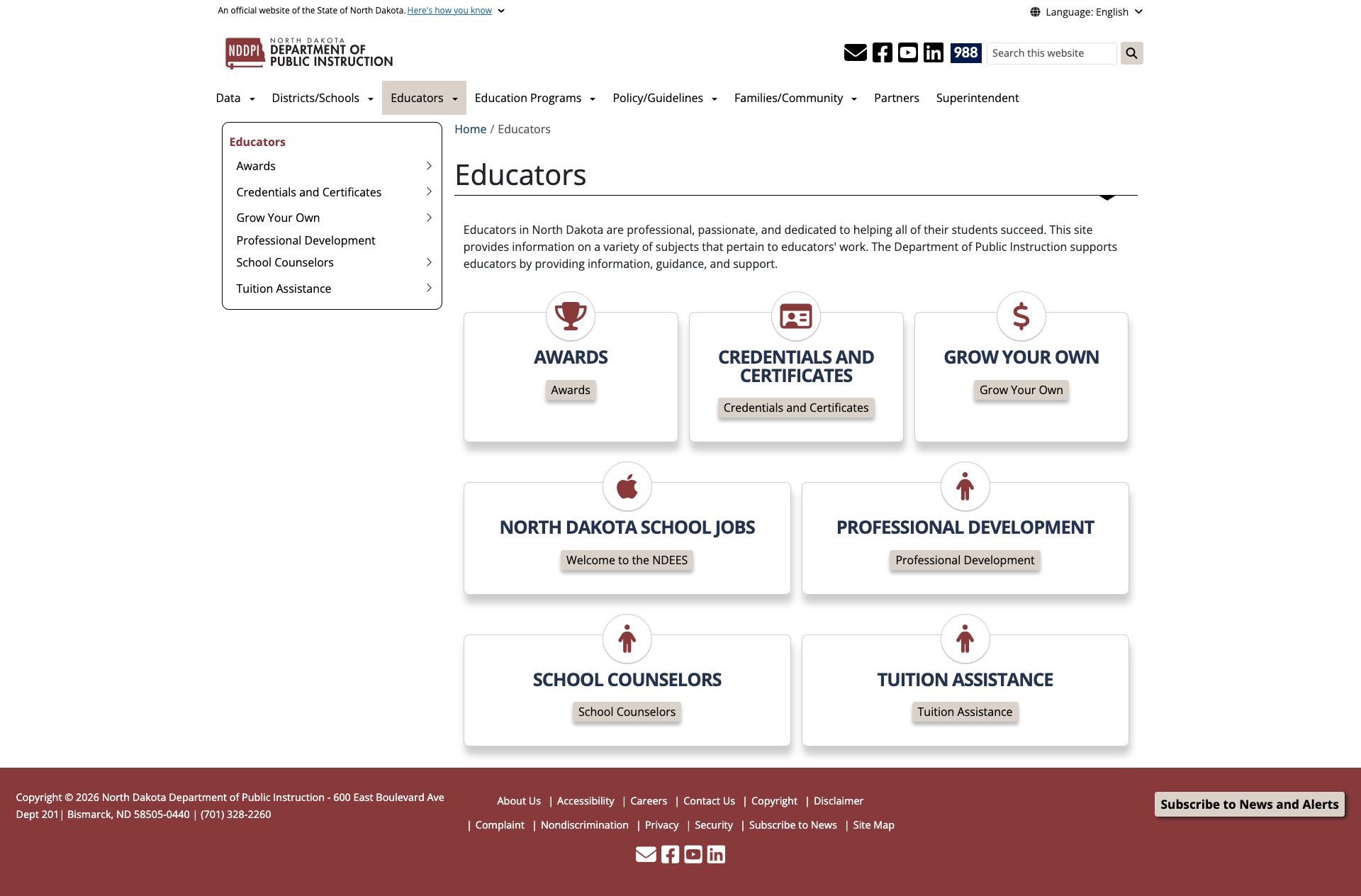
The Educators section is well-organized with seven distinct subsections: Awards, Credentials and Certificates, Grow Your Own (teacher pipeline program), North Dakota School Jobs (NDEES portal), Professional Development, School Counselors, and Tuition Assistance. Each links to a dedicated landing page with relevant resources. The "Grow Your Own" program stands out as a forward-thinking approach to teacher recruitment, while the integrated jobs portal (NDEES) provides a centralized hiring platform for North Dakota schools.
3. BRIDGE Data Modernization Initiative
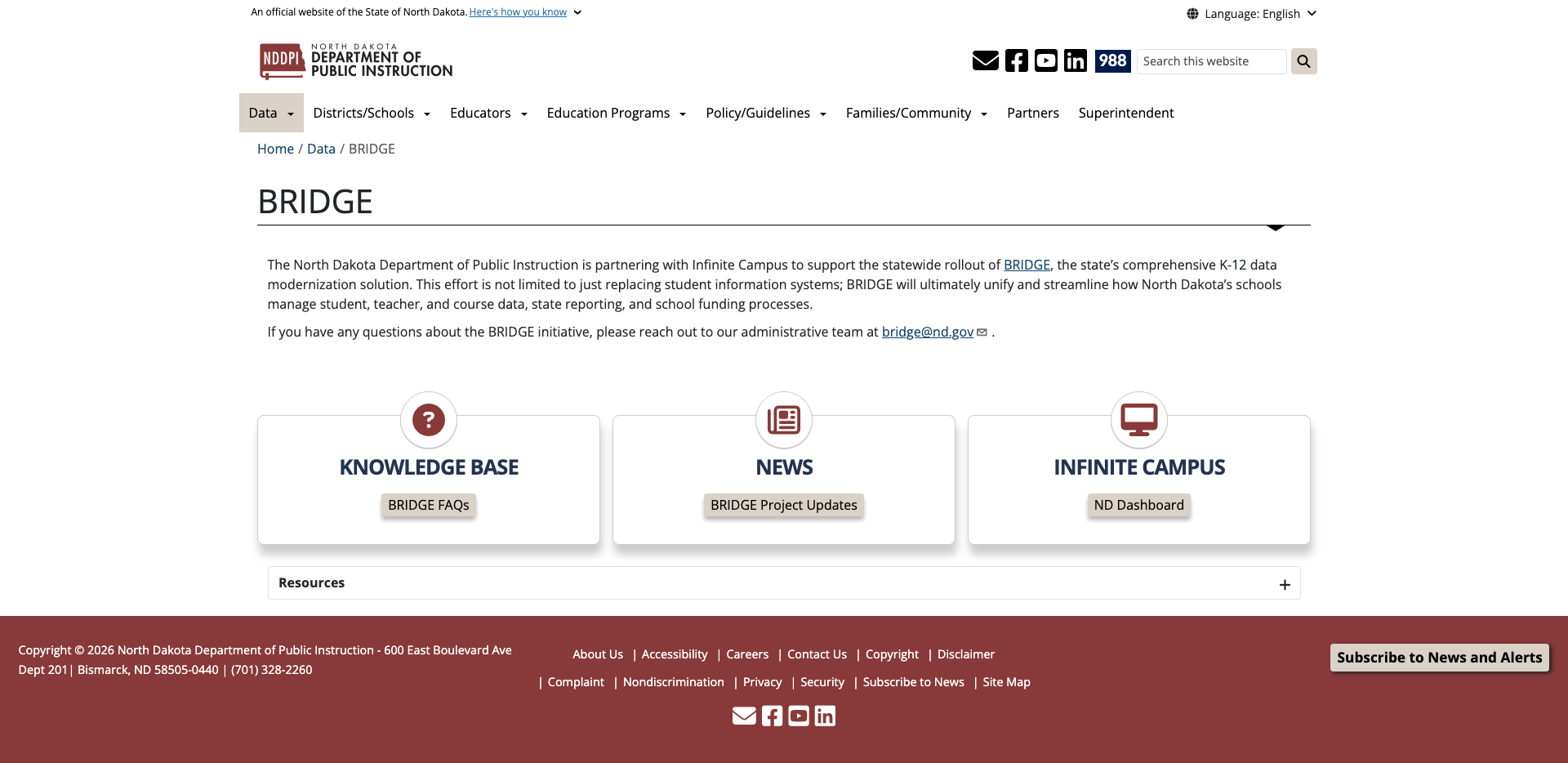
NDDPI is in the midst of a comprehensive K-12 data modernization effort called BRIDGE, partnering with Infinite Campus to replace legacy student information systems statewide. The BRIDGE page includes a Knowledge Base (FAQs), a dedicated News section with weekly project updates, and a link to the ND Dashboard within Infinite Campus. The homepage prominently features a "K-12 Data Modernization" news column with BRIDGE updates published multiple times per week — demonstrating an active, transparent communication strategy with districts. Contact information (bridge@nd.gov) is clearly displayed for stakeholders with questions.
4. Excellent Mobile Responsiveness
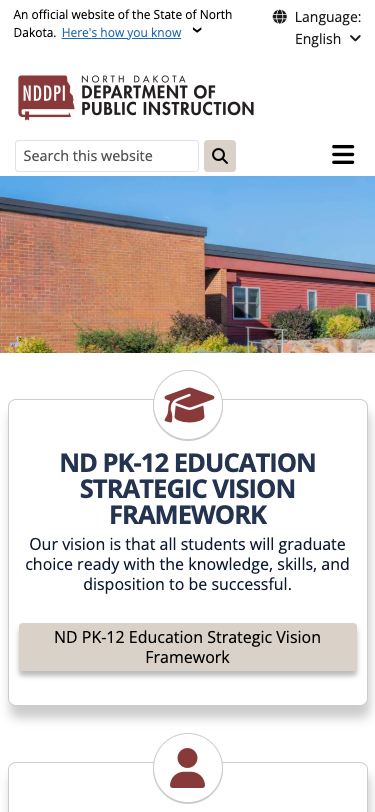
The site transitions cleanly to mobile viewports. At 375px width, the navigation collapses to a proper hamburger menu, the search bar remains accessible above the fold, and all content reflows without horizontal scrolling. The featured cards stack vertically, and the three-column news layout becomes a single scrollable column. Touch targets are appropriately sized, and the overall experience maintains full functionality across devices.
5. Multilingual Support and Accessibility Commitment
NDDPI offers Google Translate integration (GTranslate) with 18 languages, including less commonly supported languages like Swahili, Basque, Hmong, Nepali, Punjabi, Kurdish, and Pashto — a selection that appears deliberately chosen to serve North Dakota's specific immigrant and refugee communities. The site includes a dedicated Accessibility page that explicitly commits to WCAG 2.1 AA compliance and outlines the POUR principles. Monsido, a professional accessibility monitoring platform, runs continuously on the site. Skip-to-content links, proper ARIA labels, semantic HTML, and keyboard navigability are all present.
Weaknesses
1. Thin Family and Parent Resources
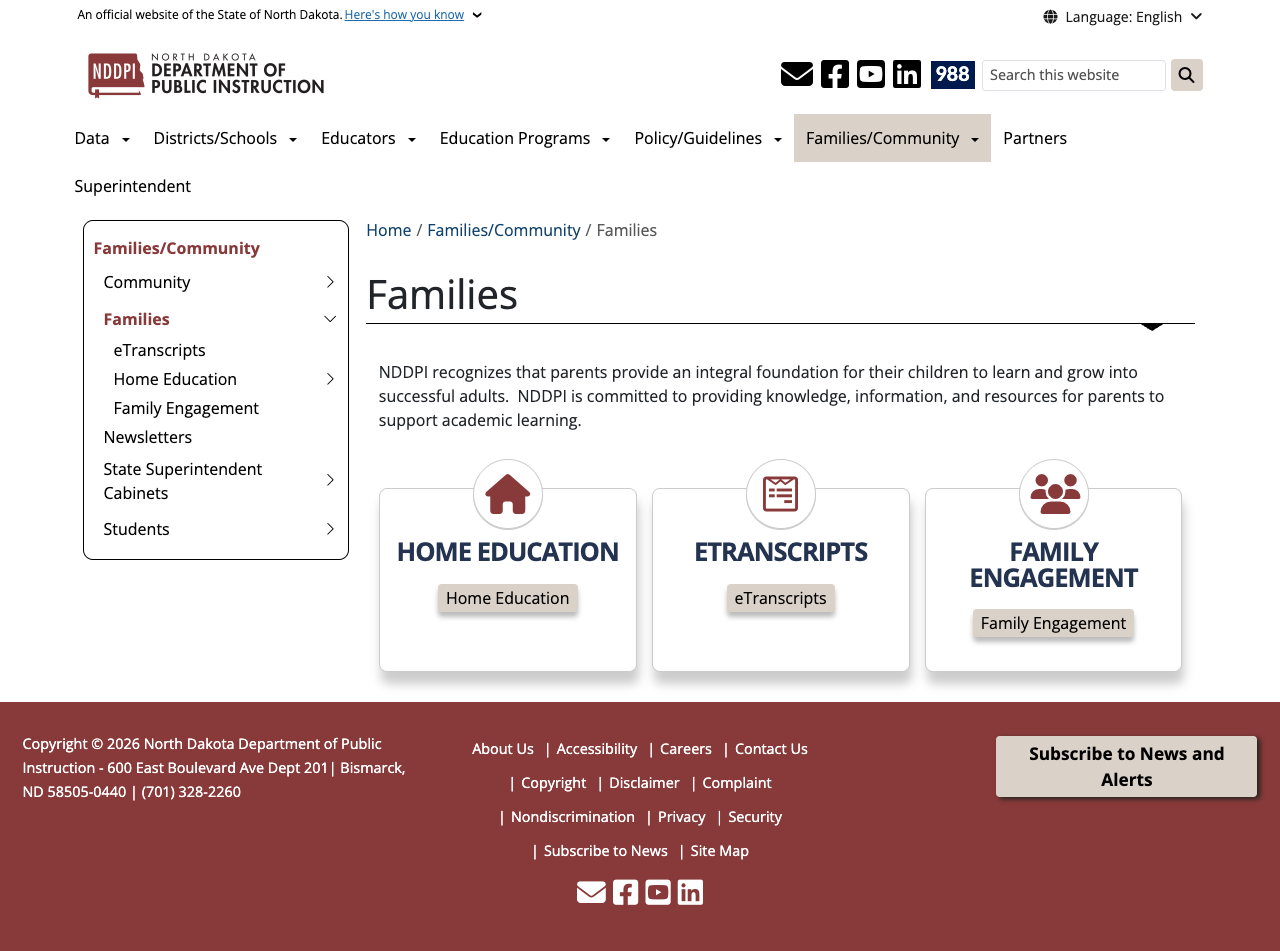
The Families section under Families/Community contains only three subsections: Home Education, eTranscripts, and Family Engagement. There are no grade-level resource guides, no school finder tool, no parent FAQ section, no "how to read your child's report card" guides, and no direct pathway for parents to access school-level data from Insights. For a state that emphasizes "choice ready" students in its strategic vision, the parent-facing resources don't equip families to make informed decisions. The broader Families/Community section adds Community, Newsletters, Superintendent Cabinets, and Students — but these are organizational categories, not the actionable parent resources that top-performing SEA sites provide.
2. Navigation Bar Overflow
With eight top-level menu items (Data, Districts/Schools, Educators, Education Programs, Policy/Guidelines, Families/Community, Partners, Superintendent), the main navigation bar wraps to a second row on standard 1280px displays. "Superintendent" sits alone on its own line, creating visual asymmetry and suggesting the information architecture could be consolidated. Several items — like "Partners" and "Superintendent" — could reasonably be nested under other sections or moved to the footer, reducing the top-level count and eliminating the two-row wrap.
3. Search Lacks Modern Features
The site uses Google Custom Search Engine (GCSE), which returns relevant results — a search for "school report card" correctly surfaces accountability reports, reading snapshots, and Insights data. However, there's no autocomplete, no search suggestions, no filters or facets, and no way to scope results by section (e.g., "Educators" or "Families"). For a Drupal 11 site, integrating a more advanced search experience (Solr, Elasticsearch, or Algolia) would significantly improve discoverability.
4. Insights Dashboard Visually Disconnected from Main Site
While Insights (insights.nd.gov) is excellent in content, it runs on a completely separate ASP.NET platform with its own design language, navigation, and branding. It uses jQuery 1.12.4 and D3 v3 — both substantially outdated. The visual disconnect between the modern Drupal 11 main site and the older Insights platform creates a jarring experience when users click from the NDDPI homepage to explore education data. Users arrive at what feels like an entirely different website with no clear way to navigate back to DPI.
Opportunities
Create a Parent Hub with School Finder: Build a dedicated parent portal that integrates Insights data into a user-friendly school lookup tool. Parents should be able to search by district or school name and see enrollment, proficiency, spending, and graduation data without navigating to a separate platform.
Consolidate Navigation: Reduce the top-level navigation to 6 items by moving "Partners" and "Superintendent" into secondary positions (footer or "About" dropdown). This would eliminate the two-row wrap and create a cleaner information architecture.
Modernize the Insights Platform: As the BRIDGE initiative modernizes the state's data infrastructure with Infinite Campus, consider migrating Insights to a modern framework (React, Next.js) that can share design components with the main Drupal 11 site. This would create a unified user experience across the ecosystem.
Threats
BRIDGE Migration Complexity: The statewide transition from legacy STARS to Infinite Campus is a massive undertaking. If the migration encounters delays or data integrity issues, it could undermine public trust in the state's education data — the very thing Insights does so well today. The weekly BRIDGE updates suggest awareness of this risk, but the transition period is inherently fragile.
Aging Insights Technology Stack: jQuery 1.12.4 reached end-of-life years ago, and D3 v3 is three major versions behind current. While the platform works today, the increasingly outdated technology stack creates long-term maintenance risk and limits the ability to add modern interactive features that parents and researchers expect.
Standout Feature
The Insights State Summary Dashboard is North Dakota's crown jewel. It aggregates 2024-2025 data across enrollment demographics, graduation rates, ELA and Math proficiency (with Novice/Approaching/Proficient/Advanced breakdowns), assessment participation, teacher counts and education levels, per-pupil spending ($15,244), and attendance rates — all on a single page with clear visualizations. The cross-agency SLDS collaboration behind Insights (DPI, CTE, University System, Job Service ND, Commerce) creates a comprehensive pipeline view that few states achieve. The ability to drill down to specific districts and schools makes this a genuinely useful tool for policymakers, researchers, and engaged parents.
Bottom Line
North Dakota's DPI website is a competent Drupal 11 site that does the basics well — all navigation links work, mobile is solid, accessibility is prioritized, and multilingual support is thoughtful. Its real strength lies beneath the surface: the Insights dashboard and BRIDGE modernization initiative represent serious investment in data infrastructure. But the parent-facing experience is underdeveloped, the navigation is overloaded, and the visual disconnect between the main site and Insights creates friction. If you're an educator or district administrator in North Dakota, you'll find what you need. If you're a parent trying to understand your child's school, you'll need to know where to look.
Grade Breakdown
| Criterion | Weight | Score | Notes |
|---|---|---|---|
| Navigation & Information Architecture | 15% | 7/10 | All 8 nav items functional with dropdowns, breadcrumbs throughout, sidebar nav on section pages. Nav wraps to 2 rows on standard displays. |
| Accessibility (WCAG 2.1 AA) | 15% | 8/10 | Explicit WCAG 2.1 AA commitment, Monsido monitoring, skip links, proper ARIA, GTranslate with 18 languages. Hero image uses empty alt text. |
| Search Functionality | 10% | 6/10 | Google Custom Search returns relevant results. No autocomplete, filters, or section scoping. |
| Mobile Responsive Design | 10% | 8/10 | Clean mobile layout at 375px, proper hamburger menu, search accessible, content reflows without horizontal scroll. |
| Data Transparency & Open Data | 10% | 8/10 | Excellent Insights dashboard with 2024-2025 data, SLDS, STARS, Financial Transparency portal, active BRIDGE modernization. |
| Parent Resources | 10% | 5/10 | Only 3 subsections (Home Education, eTranscripts, Family Engagement). No school finder, no grade-level guides, no parent FAQ. |
| Educator Resources | 10% | 7/10 | Seven well-organized categories including Grow Your Own pipeline program and NDEES jobs portal. |
| Visual Design & Branding | 10% | 6/10 | Consistent ND state branding with maroon/white scheme. Professional but not modern. Nav overflow. Insights visually disconnected. |
| Performance & Load Speed | 10% | 8/10 | 346ms TTFB, Drupal 11, HSTS, X-Frame-Options, X-Content-Type-Options security headers. Insights at 210ms TTFB. |
| Overall | 100% | 71/100 | C+ |
Discussion