OverviewAll statesMontana
62/100
Grade: C- — Solid Data Infrastructure on a Dated Platform
Montana's Office of Public Instruction (OPI) website sits at an interesting crossroads. Behind its aging DotNetNuke facade lies one of the more thoughtful data ecosystems in the country, anchored by the GEMS (Growth and Enhancement of Montana Students) data warehouse. The site also houses genuinely distinctive content — Montana is one of only a few states with a constitutionally mandated Indian Education for All program, and the OPI website gives it real visibility. But the delivery vehicle is showing its age, and several audience-facing pages feel like afterthoughts.
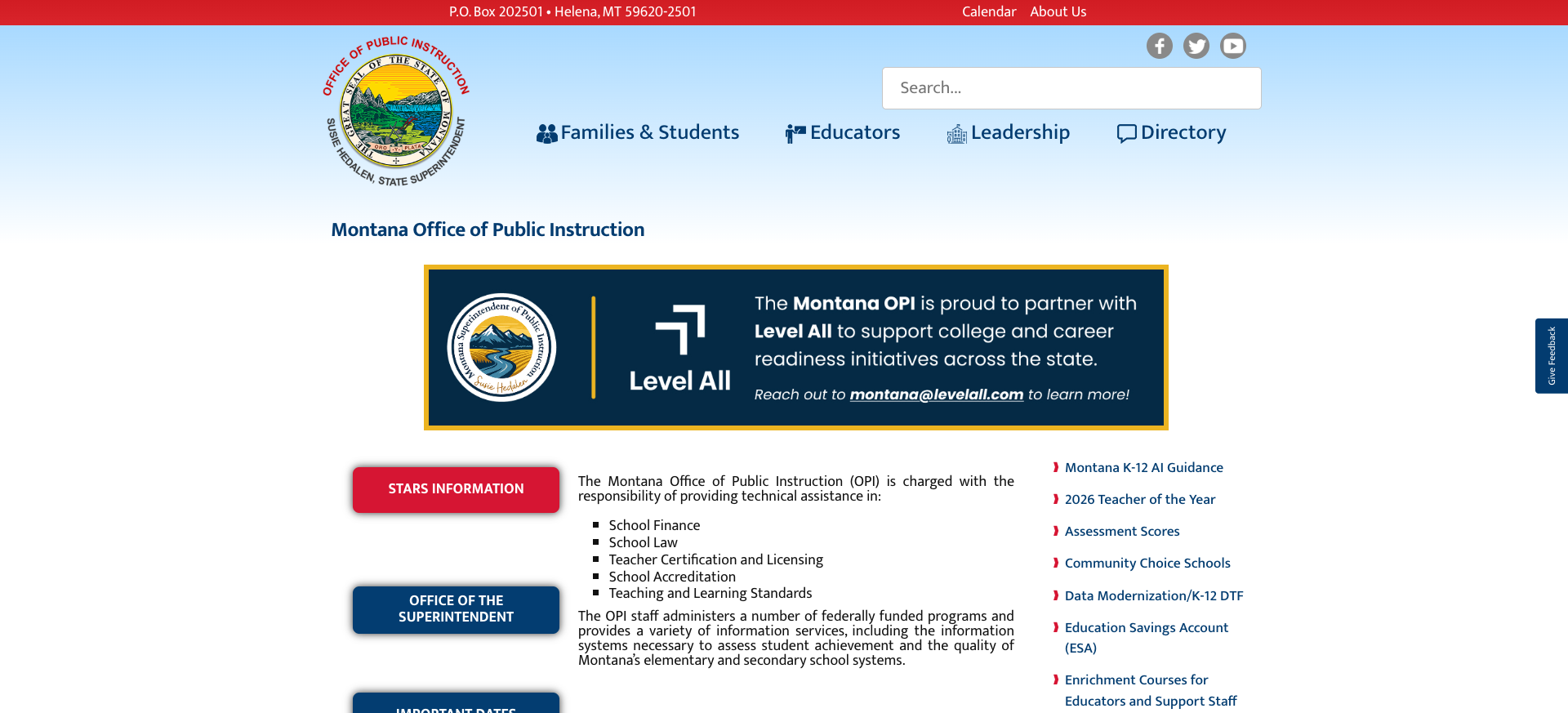
The site organizes content around four top-level navigation categories — Families & Students, Educators, Leadership, and Directory — each opening into a well-structured mega-menu with logical subcategories. All tested navigation links returned 200 status codes, a welcome departure from some states where entire nav sections lead to dead ends. For the professional audience (administrators, educators, data analysts), this site delivers. For parents or community members trying to understand Montana's schools, the experience is considerably less polished.
Strengths
1. GEMS Data Warehouse — A Comprehensive Data Ecosystem
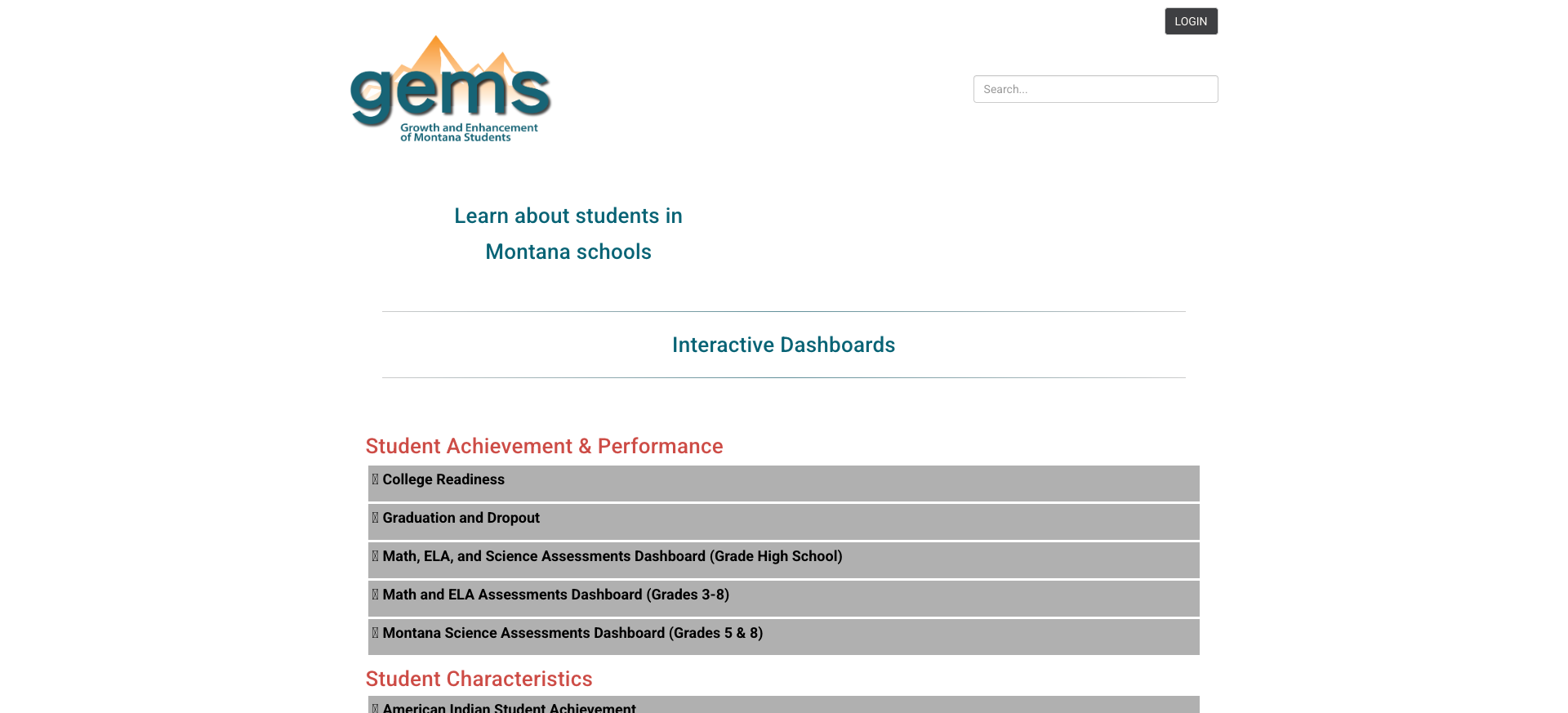
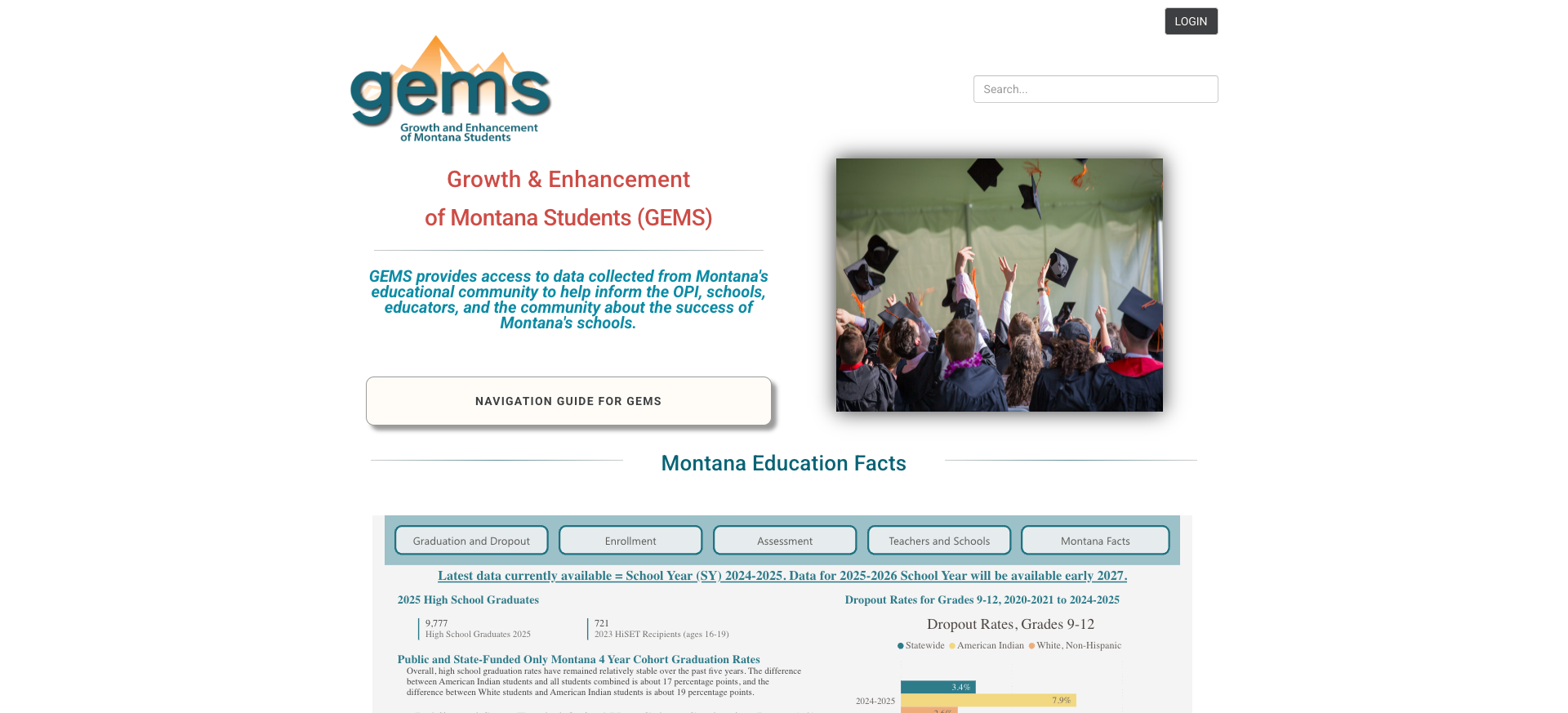
The standout feature of Montana's education web presence is GEMS (Growth and Enhancement of Montana Students) at gems.opi.mt.gov. This dedicated data portal provides interactive dashboards covering graduation and dropout rates, enrollment trends, assessment results (Math, ELA, Science at both 3-8 and high school levels), college readiness, and American Indian student achievement. The data is current — School Year 2024-2025 is the latest available — and the portal includes a navigation guide to help users orient themselves. Combined with the main site's Data & Reporting section (which includes EDUCATE/Infinite Campus integration, CSPR reporting, Find & Request Data, and Privacy & Data Governance), Montana offers a mature, multi-layered data ecosystem.
2. ESSA Report Cards with Three-Level Drill-Down
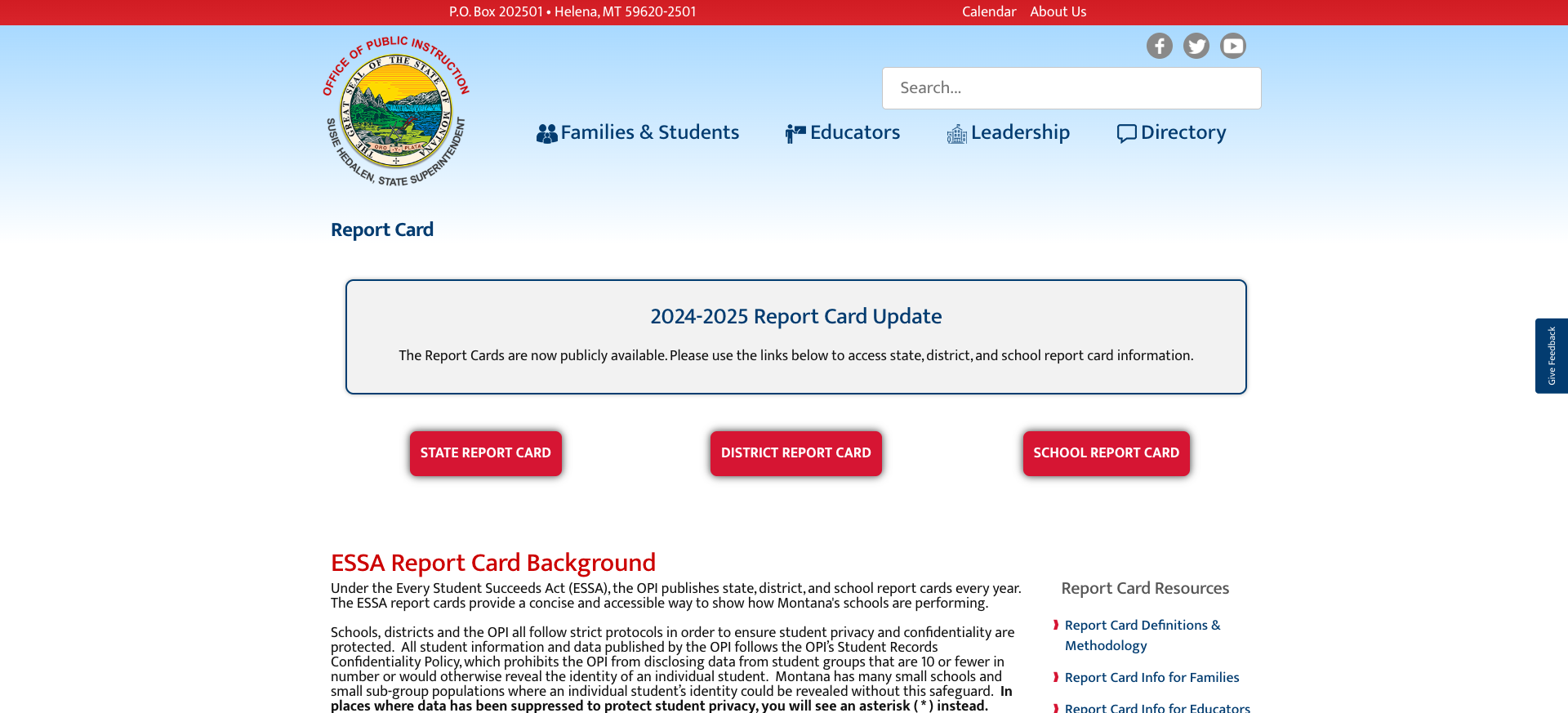
Montana's ESSA Report Card page offers 2024-2025 data with clean access points at state, district, and school levels. The page includes Report Card Resources in a sidebar — definitions and methodology, info for families, and info for educators — demonstrating awareness that different audiences need different entry points to accountability data. The privacy disclosure is also well-handled: Montana's many small schools require data suppression for groups of 10 or fewer students, and the site clearly explains this practice.
3. Indian Education for All — A Constitutional Commitment Made Visible
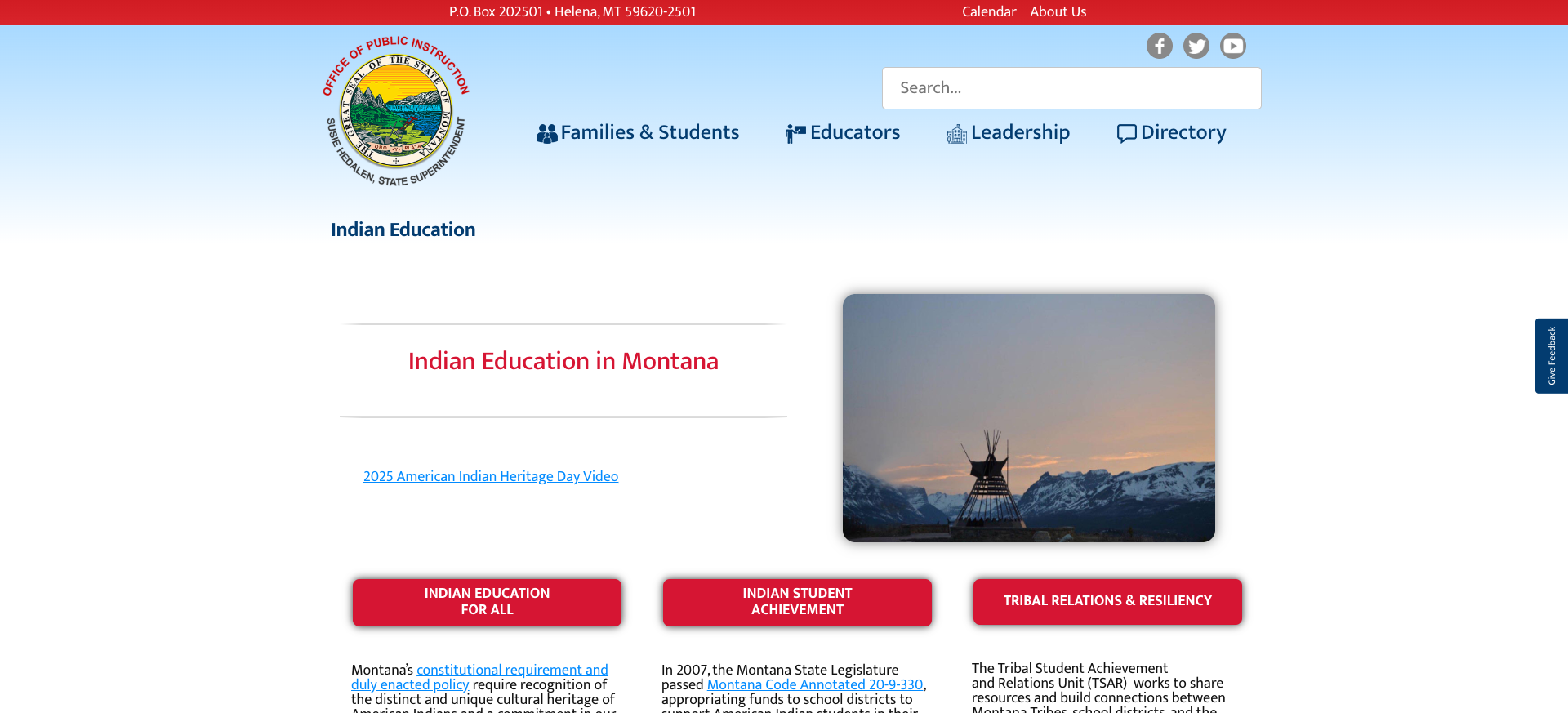
Montana is unique among states in its constitutional requirement to recognize "the distinct and unique cultural heritage of American Indians" in its educational system. The OPI website gives this mandate real digital presence through a dedicated Indian Education section organized into three pillars: Indian Education for All (the constitutional and legislative framework), Indian Student Achievement (funding and support programs), and Tribal Relations & Resiliency (the Tribal Student Achievement and Relations Unit connecting tribes, schools, and districts). The site also features an Indian Education for All Feedback Portal via Qualtrics and links to a 2025 American Indian Heritage Day Video. This is substantive, not performative — a genuine differentiator.
4. Comprehensive Educator Licensure and Professional Development
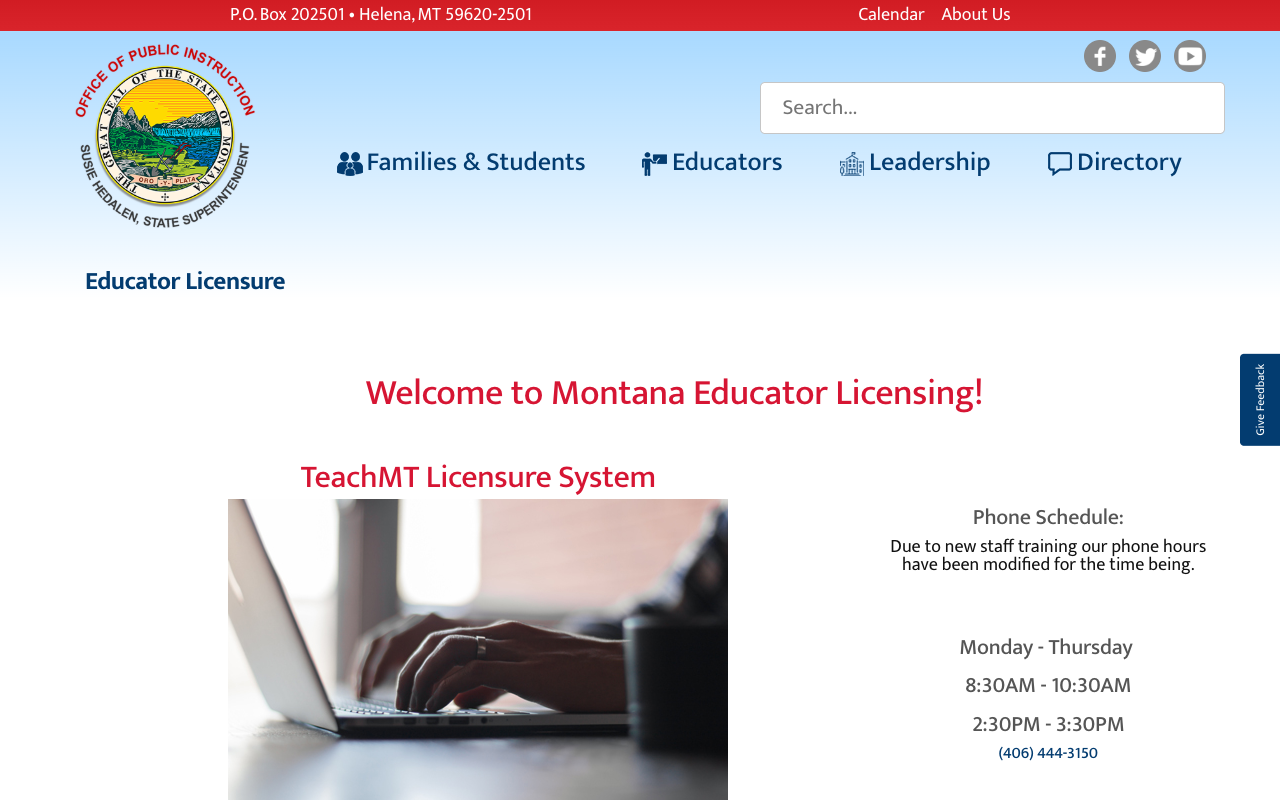
The Educators section is the deepest and most functional area of the site. The TeachMT (TMT) Licensing System at teachmontana.com provides credential lookup and management. The licensure section covers license options and requirements, renewal and reinstatement, educator recruitment and retention, a Jobs for Teachers board, and the Montana Teacher Residency program. Professional development is supported through the OPI PDU Academy on Canvas (mtopi.catalog.instructure.com) where educators can earn Professional Development Units online. The Teaching & Learning subsection spans 13 topics from Career & Technical Education to Literacy to Multi-Tiered Systems of Support.
Weaknesses
1. No Multilingual Support
Montana has no site-wide translation capability — no Google Translate widget, no language selector, no Spanish-language content. While Montana's English Learner population (approximately 3.2% of students) is smaller than many states, the lack of any multilingual support is a significant gap for families who need it most. The English Learners page exists under Family & Student Support, but it's aimed at educators and administrators, not at the families themselves.
2. Parent Resources Page Is Bare-Bones
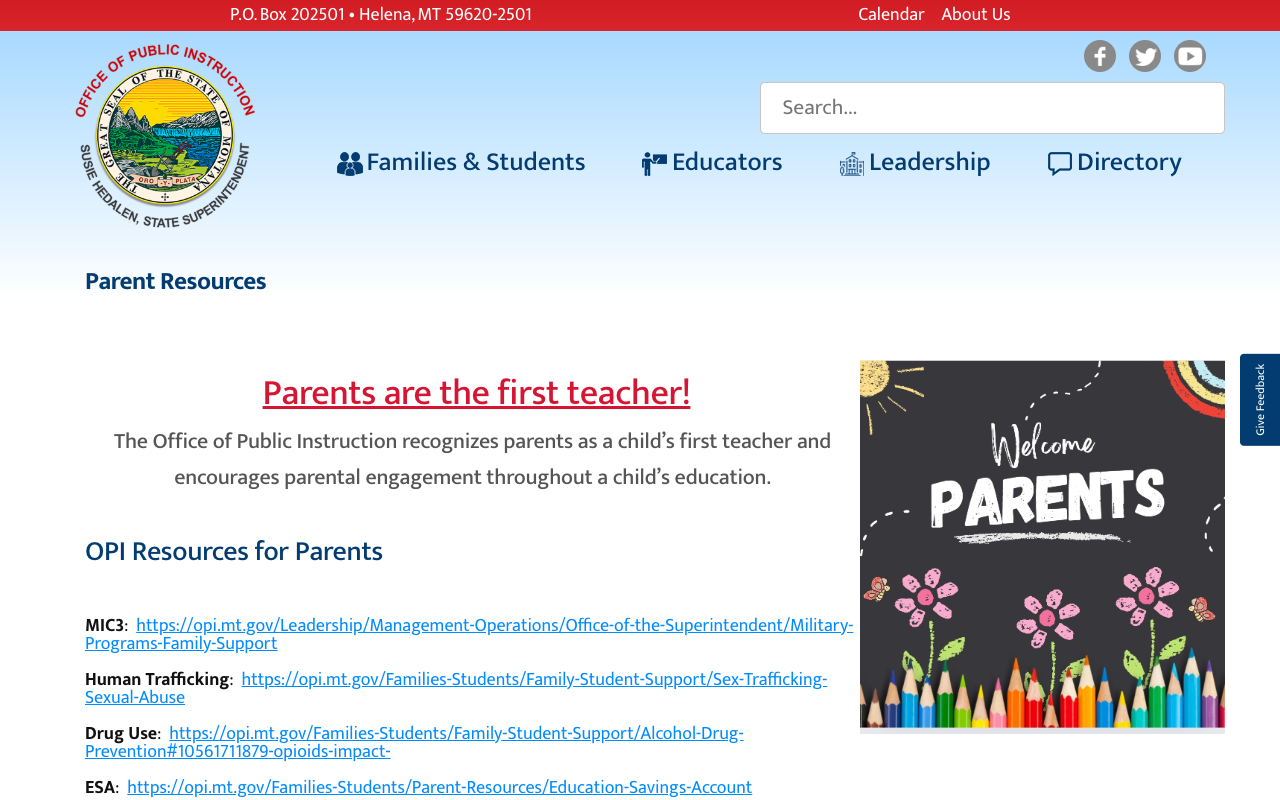
The Parent Resources page — the designated entry point for Montana families — is strikingly underdeveloped. It consists of a "Parents are the first teacher!" heading followed by a flat list of topic labels with raw URLs displayed as link text (e.g., "MIC3: https://opi.mt.gov/Leadership/Management-Operations/..."). There are no descriptions, no visual hierarchy, no grade-level organization, and no plain-language explanations of what each resource offers. The page also includes links to "Online Community Virtual Events" from 2023 and 2024 with no 2025 or 2026 content visible, and a "Montana Families" section at the bottom that appears to have broken or empty image links.
3. Dated Visual Design and Cluttered Homepage
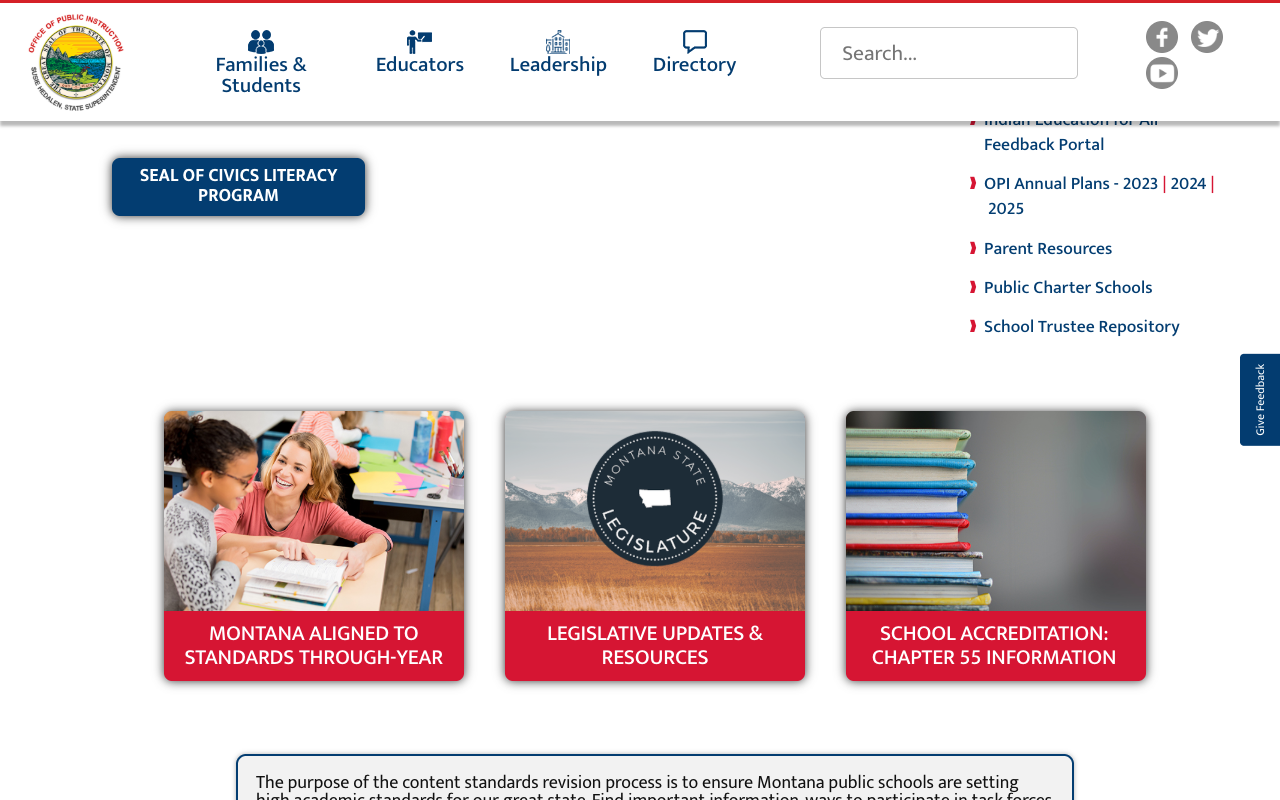
The site runs on DotNetNuke (copyright 2002-2018) with Bootstrap 3.3.7 — a framework that's been end-of-life since 2019. The homepage opens with a large Level All partnership banner that pushes OPI's own content below the fold. Below that, the layout mixes three different content presentation styles: red/blue call-to-action buttons on the left, a text description block in the center, and a bullet-point link list on the right. Further down, image cards, text callouts, and press releases compete for attention without clear visual hierarchy. The overall effect is functional but cluttered.
4. No Breadcrumb Navigation
Despite having a 4-level-deep URL hierarchy (e.g., /Leadership/Academic-Success/Every-Student-Succeeds-Act-ESSA/Report-Card), the site provides no breadcrumb trails on any interior page. Users navigating deep into the site must rely on the top navigation mega-menu or the browser back button to reorient themselves — a significant usability gap for a content-heavy government site.
5. Missing Security Headers
While the site implements X-Frame-Options and X-XSS-Protection, it lacks HSTS (HTTP Strict Transport Security), Content-Security-Policy, and Referrer-Policy headers. For a government education site handling data links and user searches, these are standard security practices that should be in place.
Opportunities
Modernize the Parent Portal: The data infrastructure already exists through GEMS and ESSA Report Cards. A redesigned parent section with plain-language guides, visual navigation by grade level or topic, and proper link text (instead of raw URLs) would dramatically improve the family experience.
Add Multilingual Support: Even a basic Google Translate widget would extend access to non-English-speaking families. Given the Tribal Relations focus, consideration for Indigenous language support would be especially meaningful.
Platform Migration: The DotNetNuke platform is effectively end-of-life. A migration to a modern CMS (WordPress, Drupal 10, or a headless CMS) would enable responsive design improvements, better accessibility tooling, and reduced maintenance burden. The GEMS portal shows Montana has the technical capacity for modern web development.
Threats
Aging Platform Risk: DotNetNuke's last major update was 2018. Continued reliance on this platform means accumulating security debt and increasingly limited ability to implement modern web standards (WCAG 2.2, Core Web Vitals optimization, progressive enhancement).
Content Fragmentation: Key services span multiple subdomains (gems.opi.mt.gov, teachmontana.com, apps.opi.mt.gov, mtopi.catalog.instructure.com, learninghub.mrooms.net) with no single sign-on or consistent navigation between them. As each portal ages independently, the user experience will continue to diverge.
Standout Feature
GEMS (Growth and Enhancement of Montana Students) at gems.opi.mt.gov is Montana's standout. This dedicated data warehouse provides interactive dashboards covering student achievement, enrollment, graduation rates, dropout data, teacher and school information, and Montana-specific facts — all with current 2024-2025 data. The portal includes a navigation guide, a search function, and breakdowns by American Indian student status, reflecting Montana's commitment to tracking educational equity for its Indigenous populations. Combined with the ESSA Report Cards offering state/district/school drill-down, Montana provides one of the more complete data transparency stories in the country.
Bottom Line
Montana's OPI website is a solid resource for education professionals — administrators, data analysts, and educators will find deep licensure tools, comprehensive data through GEMS, and a well-organized Teaching & Learning section. Parents and community members, however, will encounter a dated design, bare-bones family resources, and no multilingual support. The GEMS data warehouse and the Indian Education for All program are genuine bright spots that deserve a more modern delivery vehicle. Visit for the data; tolerate the packaging.
Grade Breakdown
| Criterion | Weight | Score | Notes |
|---|---|---|---|
| Navigation & Information Architecture | 15% | 7 | Four well-organized mega-menu categories, logical hierarchy, all links functional. No breadcrumbs. |
| Accessibility (WCAG 2.1 AA) | 15% | 6 | Proper lang attribute, viewport meta, alt text on images, ARIA landmarks. No accessibility widget, older Bootstrap 3. ADA Notice page present. |
| Search Functionality | 10% | 6 | DNN search returns relevant results (398 for "report card"), relevance/date sorting, advanced tips. No autosuggest or faceted filters. |
| Mobile Responsive Design | 10% | 6 | Bootstrap 3 grid reflows content, hamburger menu collapses. Functional but basic — no touch optimization or mobile-first design. |
| Data Transparency & Open Data | 10% | 8 | GEMS data warehouse with interactive dashboards, ESSA Report Cards at 3 levels with 2024-2025 data, Find & Request Data page, Privacy & Data Governance. Strong. |
| Parent Resources | 10% | 4 | Dedicated page exists but bare-bones: raw URLs as link text, no descriptions, stale event listings, no multilingual support. |
| Educator Resources | 10% | 7 | TeachMT licensure system, PDU Academy on Canvas, 13+ Teaching & Learning topics, Jobs for Teachers, Teacher Residency, Indian Education. |
| Visual Design & Branding | 10% | 5 | Consistent red/blue/white branding but dated DNN platform (2018). Cluttered homepage with promotional banner. Mixed typography and layout styles. |
| Performance & Load Speed | 10% | 6 | TTFB 0.3-1.1s across pages, total load ~0.8-1.4s. Acceptable. X-Frame-Options present but missing HSTS and CSP. |
| Overall | 100% | 62/100 | C- |
Discussion