OverviewAll statesKentucky
65/100
Grade: C — Strong Data Backbone, Dated Delivery
Kentucky's Department of Education website (education.ky.gov) is a study in contrasts: behind a dated SharePoint interface and an overwhelming 17-item navigation bar sits one of the most comprehensive data ecosystems in the country. The state's School Report Card Suite — combining an interactive SRC Dashboard, downloadable datasets stretching back to 2011, and a Campus Parent & Student Portal through Infinite Campus — rivals the best we've seen in this series. But the vessel delivering all that transparency could use a serious modernization effort.
The site runs on SharePoint and sits within the Commonwealth of Kentucky's unified ky.gov platform, which brings consistent branding, accessibility infrastructure, and a standardized footer across all state agencies. For parents searching for school data or transcript information, the Quicklinks section on the homepage provides direct paths organized by audience (Communities, Families and Students, Educators). For educators, the Education Professional Standards Board (EPSB) integration and GoTeachKY recruitment pipeline show genuine investment in the teaching workforce.
The challenge is getting to all of this. With 17 top-level navigation items spanning two rows of small text, finding a specific resource requires either prior knowledge of the site's structure or effective use of the search function — which, fortunately, works reasonably well.
Strengths
1. Outstanding Data Transparency Through Open House
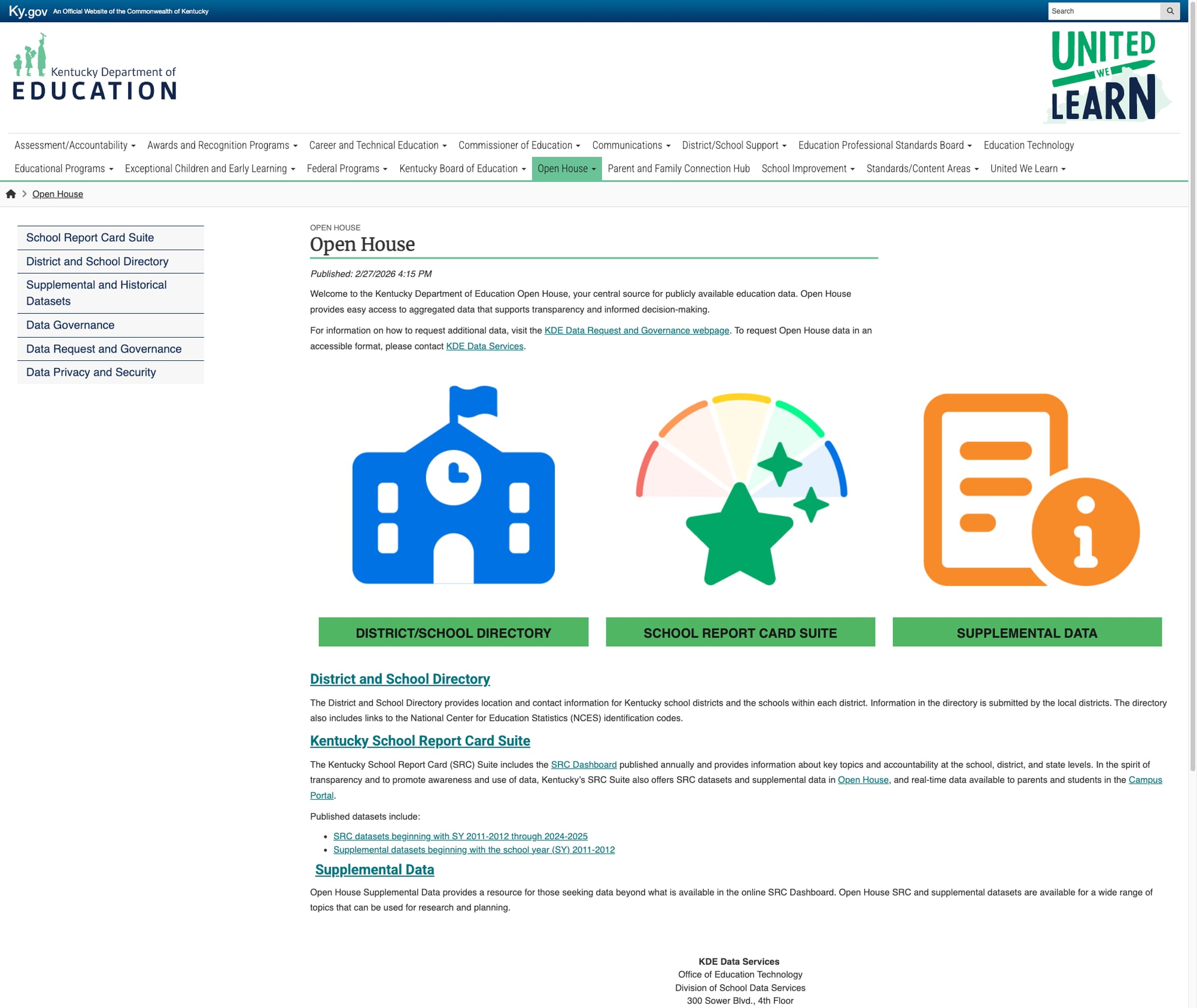
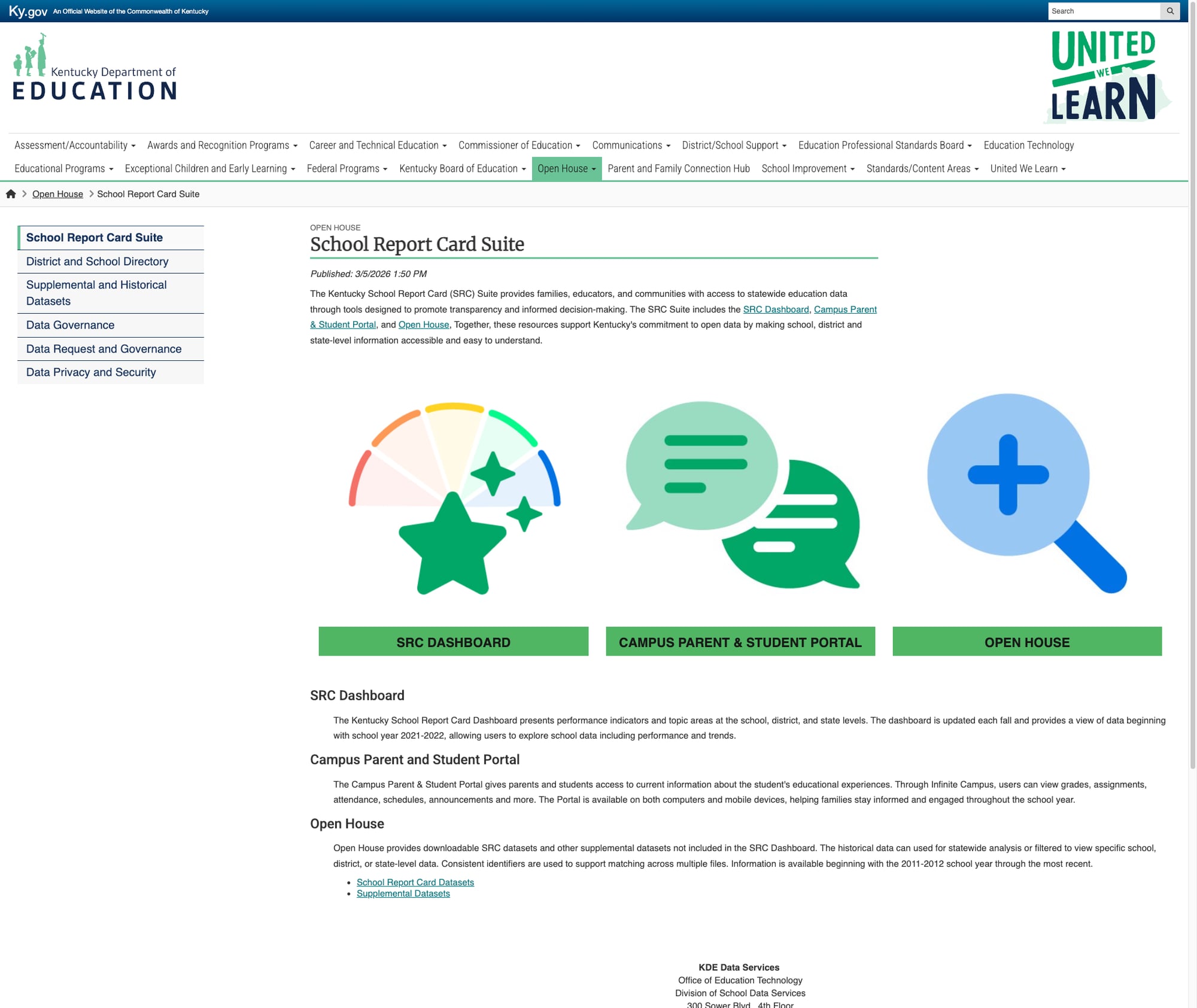
Kentucky's Open House portal (openhouse.education.ky.gov) is the crown jewel of this site. It provides three major pathways: a District and School Directory, the School Report Card Suite, and Supplemental Data. The SRC datasets are available from SY 2011-2012 through 2024-2025, making Kentucky one of the few states offering over a decade of publicly downloadable education data. The portal also includes Data Governance, Data Request and Governance, and Data Privacy and Security sections — demonstrating a mature approach to open data that many states lack entirely.
2. Functional Search with Scope Options
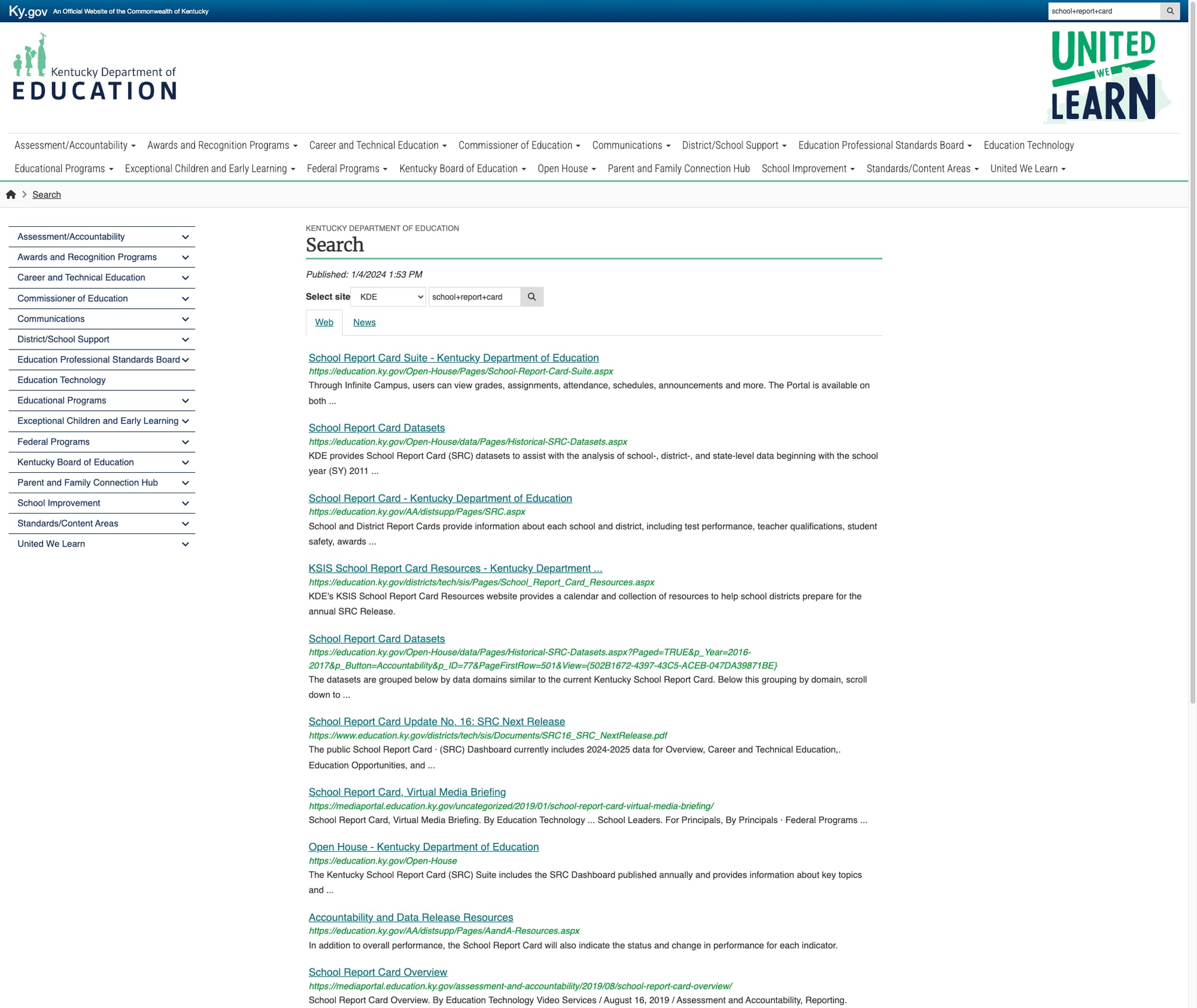
The site search returns relevant, well-organized results. A query for "school report card" returns the School Report Card Suite page as the top result, followed by related datasets and resources. The search also offers scope filtering — users can search within KDE or across all of Kentucky.gov — and toggle between Web and News/Press Releases results. While it lacks autosuggest or faceted filtering, the core search functionality delivers accurate results that help users find what they need.
3. Dedicated Parent and Family Connection Hub
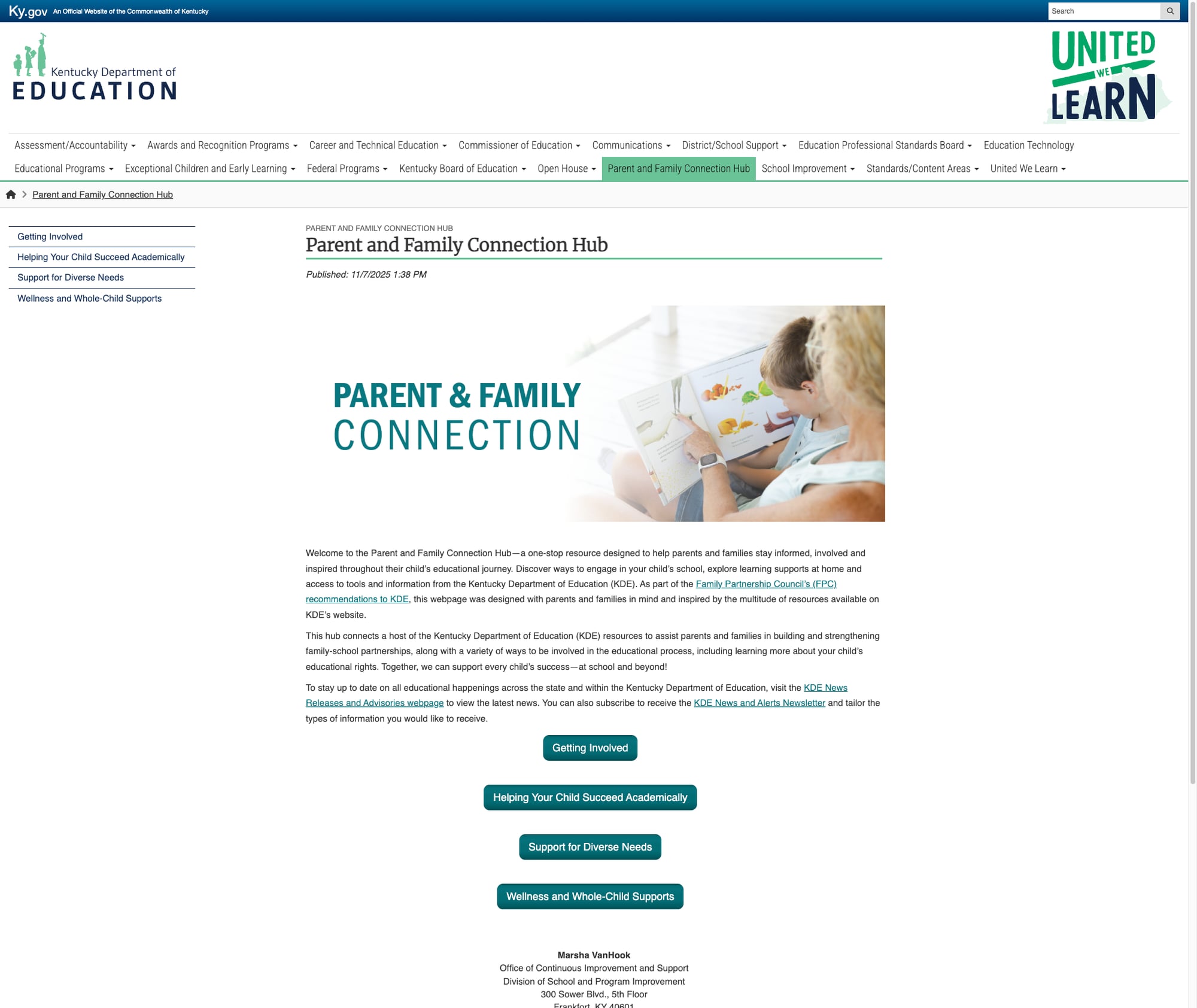
The Parent and Family Connection Hub is a thoughtfully organized resource that goes beyond the typical "parent resources" afterthought seen on many SEA sites. It's structured around four clear action areas: Getting Involved, Helping Your Child Succeed Academically, Support for Diverse Needs, and Wellness and Whole-Child Supports. The page was developed based on recommendations from Kentucky's Family Partnership Council (FPC), which means it reflects actual parent input rather than bureaucratic guesswork. Published in November 2025, it's also relatively fresh content.
4. Modern School Report Card Dashboard
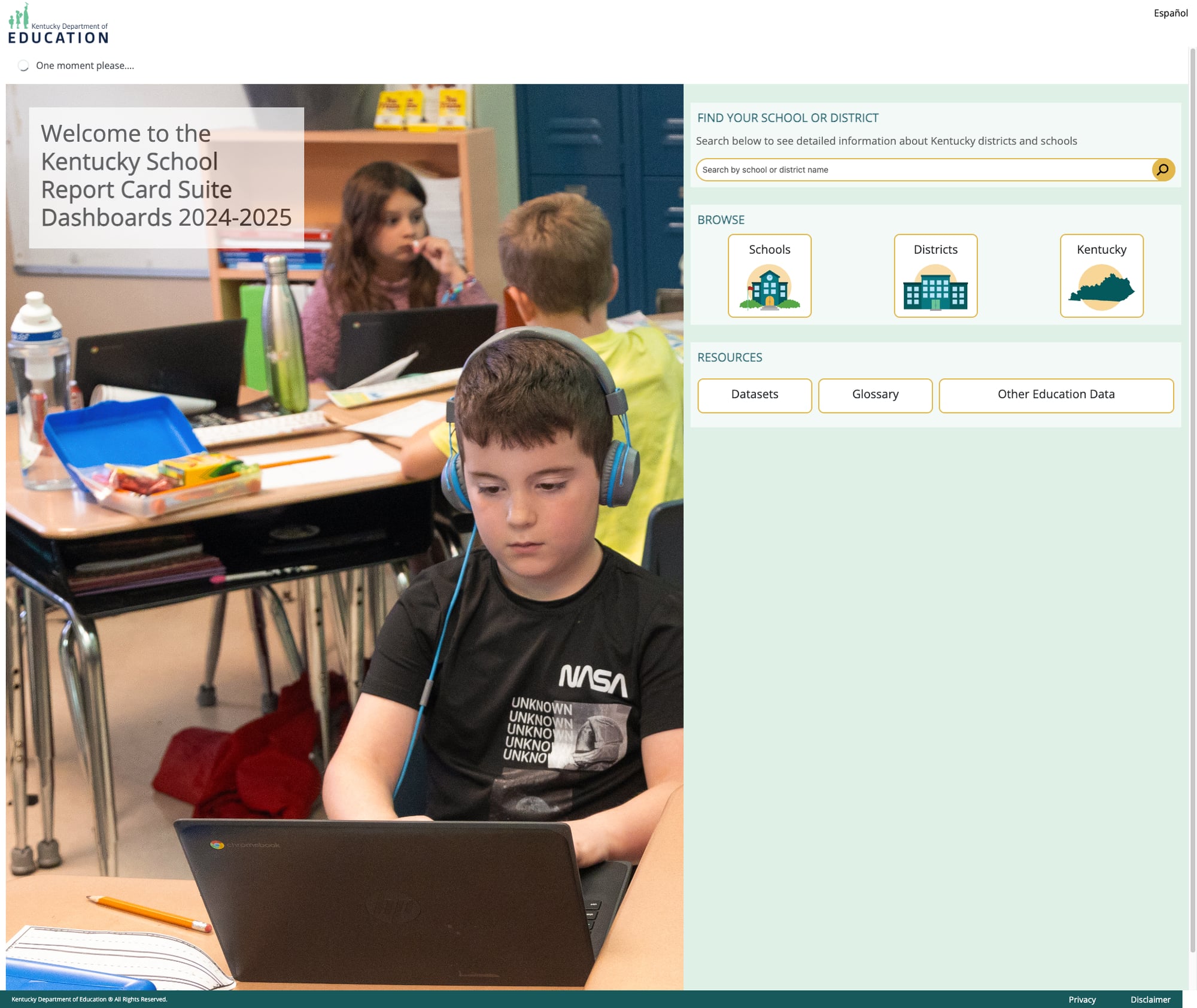
The Kentucky School Report Card (kyschoolreportcard.com) is a standalone application that's significantly more modern than the main KDE site. It features a school/district search, browseable categories (Schools, Districts, Kentucky-level), downloadable Datasets, a Glossary, and links to Other Education Data. Notably, it offers Spanish language support ("Español" toggle in the header) — one of the only bilingual features in the entire KDE ecosystem. The dashboard presents 2024-2025 data, keeping Kentucky current with the most recent school year.
5. Comprehensive Educator Ecosystem
The EPSB (Education Professional Standards Board) is fully integrated into the KDE website, providing educators with certification lookup, board meeting information, ethics resources, and the Local Educator Assignment Data (LEAD) tool. The GoTeachKY initiative links directly from the EPSB section, creating a clear pipeline from interest to certification. Educators also benefit from dedicated Quicklinks covering Academic Standards, the Model Curriculum Framework, KyMTSS, and the Kentucky Reading Academies.
Weaknesses
1. Overwhelming 17-Item Flat Navigation
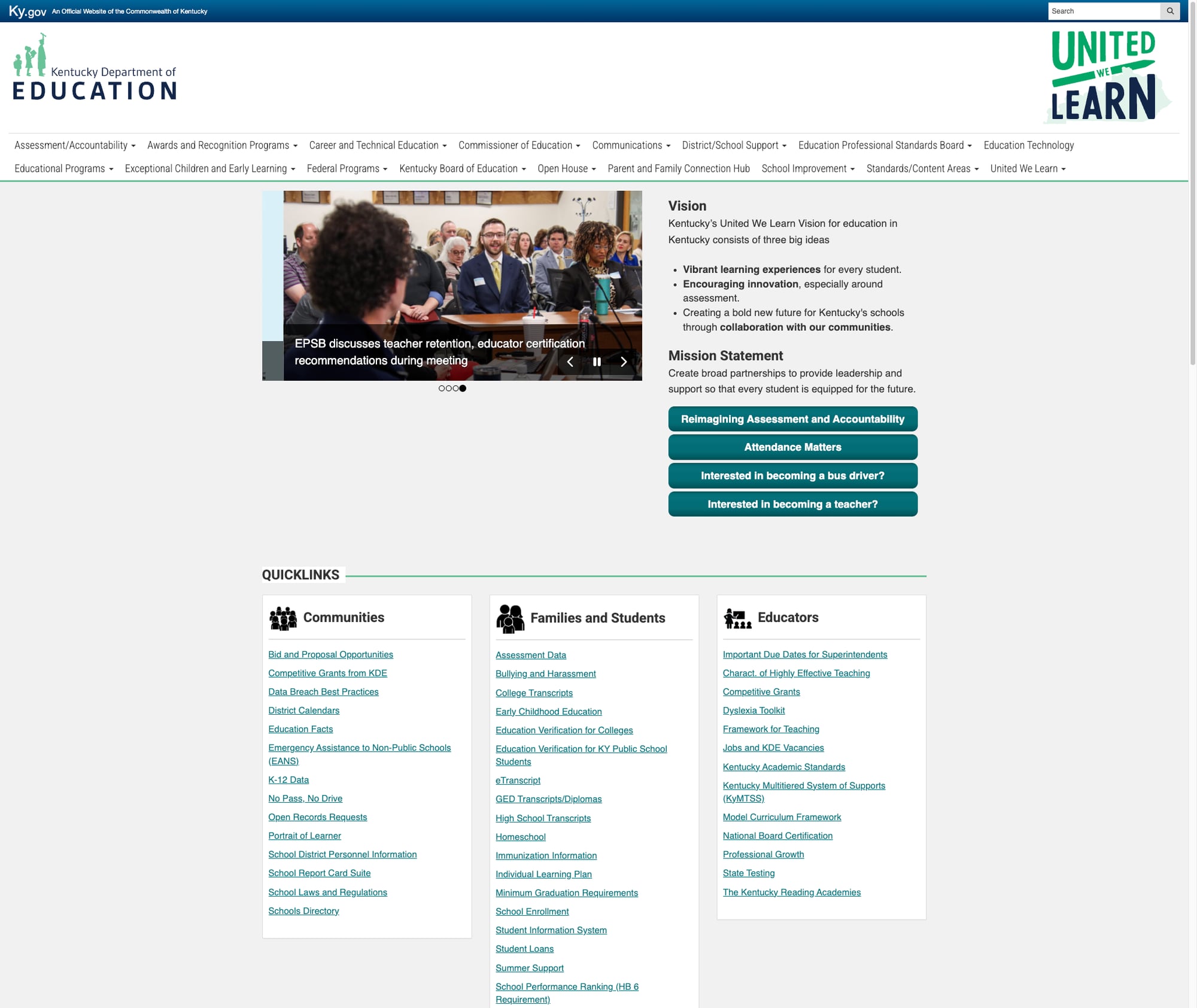
The primary navigation bar contains 17 top-level items displayed across two rows of small text: Assessment/Accountability, Awards and Recognition Programs, Career and Technical Education, Commissioner of Education, Communications, District/School Support, Education Professional Standards Board, Education Technology, Educational Programs, Exceptional Children and Early Learning, Federal Programs, Kentucky Board of Education, Open House, Parent and Family Connection Hub, School Improvement, Standards/Content Areas, and United We Learn. This is an information architecture challenge — the navigation is organized by KDE's internal organizational structure rather than by user needs or tasks. Most visitors are parents, educators, or community members, not people who know which KDE division handles their question.
2. No Integrated Multilingual Support
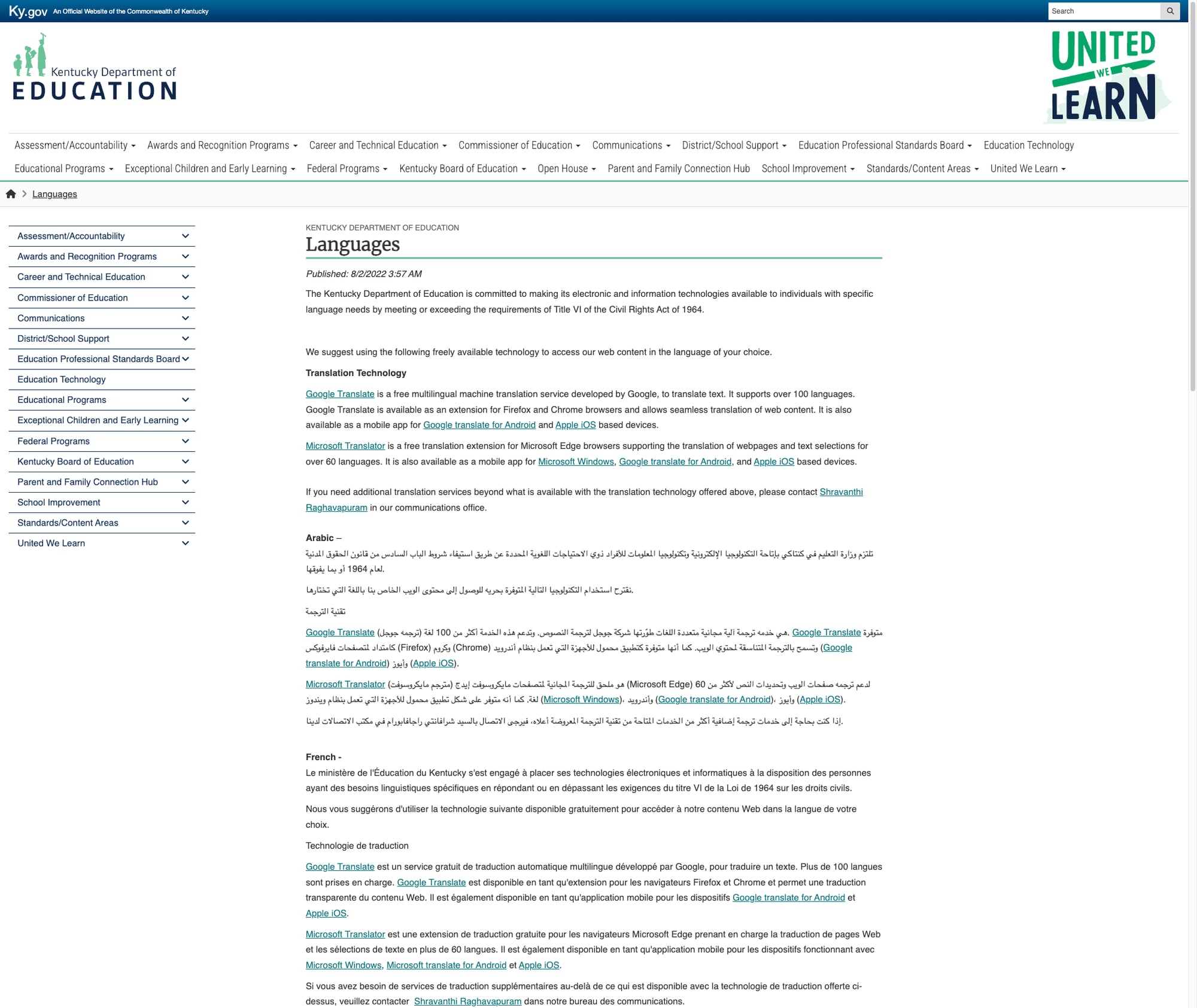
Despite Kentucky's growing English Learner population, the main KDE site offers no built-in translation. The Languages page (published August 2022) simply directs users to third-party tools like Google Translate and Microsoft Translator, providing instructions in Arabic, French, and other languages. While the School Report Card dashboard offers Spanish, the main site — where parents navigate for enrollment, transcripts, immunization requirements, and other critical information — has no translation toggle. This creates a significant accessibility gap for non-English-speaking families navigating the education system.
3. Dated SharePoint Visual Design
The site runs on SharePoint, and it shows. The visual design features a functional but uninspired layout with inconsistent content formatting, zero-width character artifacts in text (visible in the homepage Vision heading), and a design aesthetic that feels circa 2015. The homepage Hero carousel and CTA buttons use a clean teal color scheme that works well, but interior pages revert to plain SharePoint layouts with minimal visual hierarchy. The contrast between the modern kyschoolreportcard.com application and the main KDE site is stark.
4. Quicklink to School Report Card Suite Returns 404
The homepage Quicklinks section includes a "School Report Card Suite" link under the Communities column. From the homepage HTML, this link points to https://openhouse.education.ky.gov/src, which loads correctly. However, the original legacy path (/school/pages/SchoolReportCardSuite.aspx) — still referenced in some internal pages — returns a custom 404 page. This suggests incomplete URL migration following the site's transition to its current structure. The 404 page itself, while branded, simply tells users to search for the content — adding friction for anyone following an old bookmark or internal link.
Opportunities
Audience-based navigation redesign: Restructuring the navigation around user roles (Parents & Families, Educators, School Administrators, Community Members) would dramatically improve findability. The existing Quicklinks section already demonstrates this approach — elevating it to the primary navigation would serve users far better than the current 17-item department-based structure.
Integrated translation widget: Adding a Google Translate widget site-wide (as many other state agencies do) would immediately serve Kentucky's non-English-speaking families. The School Report Card's Spanish support proves the state recognizes this need — extending it to the main site is a logical next step.
Consolidate data tools under one umbrella: Kentucky has multiple data platforms (Open House, SRC Dashboard, kyschoolreportcard.com, Campus Parent & Student Portal) that could benefit from a unified entry point with clearer differentiation of each tool's purpose and audience.
Threats
SharePoint platform limitations: As web expectations evolve, the SharePoint platform will increasingly constrain the site's ability to deliver modern user experiences. The gap between the main site and newer applications like the School Report Card Dashboard will only widen, creating an inconsistent experience that could erode user trust.
Legacy URL decay: The site's migration from its previous structure left behind broken internal links (like the old School Report Card Suite path). As content continues to be reorganized under the "United We Learn" initiative, maintaining URL redirects will become increasingly important to preserve accessibility for users following existing links from district websites, bookmarks, and search engine results.
Standout Feature
The School Report Card Suite at openhouse.education.ky.gov/src is Kentucky's standout feature. It brings together three distinct but complementary tools — the SRC Dashboard for interactive data exploration, the Campus Parent & Student Portal (via Infinite Campus) for real-time student information, and Open House for downloadable datasets — into a single coherent ecosystem. With data stretching back to SY 2011-2012 and current 2024-2025 dashboard data, it demonstrates a genuine commitment to transparency that many states aspire to but few achieve this comprehensively.
Bottom Line
Kentucky's education website rewards those who know where to look. Its data transparency tools — particularly the Open House portal and School Report Card Suite — are among the best in the nation, and the Parent and Family Connection Hub shows genuine responsiveness to family needs. But the overwhelming navigation, dated SharePoint design, and lack of integrated multilingual support create real barriers for casual visitors. If you're an administrator or data researcher, you'll find a treasure trove here. If you're a parent trying to figure out immunization requirements or graduation credits, you may need to lean heavily on search.
Grade Breakdown
| Criterion | Weight | Score | Notes |
|---|---|---|---|
| Navigation & Information Architecture | 15% | 6/10 | 17-item flat nav organized by department rather than user need; Quicklinks and breadcrumbs help; all nav items functional |
| Accessibility (WCAG 2.1 AA) | 15% | 6/10 | Skip to main content, font size adjustment, Languages page present; relies on ky.gov platform accessibility; no visible WCAG audit badge |
| Search Functionality | 10% | 7/10 | Accurate results, scope filtering (KDE/Kentucky.gov), Web/News tabs; no autosuggest, no faceted filters |
| Mobile Responsive Design | 10% | 5/10 | SharePoint responsive framework present but 17-item nav likely problematic on mobile; ky.gov header adapts; older SharePoint layouts not mobile-first |
| Data Transparency & Open Data | 10% | 9/10 | Exceptional — Open House with datasets from 2011-2025, SRC Dashboard, Campus Portal, downloadable files, Data Governance section |
| Parent Resources | 10% | 7/10 | Dedicated Parent and Family Connection Hub with 4 clear sections; comprehensive Quicklinks; no integrated translation |
| Educator Resources | 10% | 8/10 | EPSB integrated, GoTeachKY, Kentucky Academic Standards, certification lookup, KyMTSS, Reading Academies, professional growth |
| Visual Design & Branding | 10% | 5/10 | Consistent teal/white branding, United We Learn identity; dated SharePoint layouts, zero-width character artifacts, stark contrast with modern School Report Card |
| Performance & Load Speed | 10% | 6/10 | Pages load adequately; bot protection blocks automated access (curl blocked); no apparent CDN optimization |
| Overall | 100% | 65/100 | C |
Discussion