OverviewAll statesIndiana
69/100
Grade: C — A Data Powerhouse Wrapped in a Sparse Shell
The Indiana Department of Education (IDOE) website lives at in.gov/doe/ as a subsite of Indiana's statewide IN.gov platform. For an agency that has been nationally recognized for educational innovation — including a first-in-the-nation diploma redesign and the GPS accountability dashboard — the web presence doesn't quite match the ambition. What you'll find is an exceptionally deep data ecosystem and strong educator tools hidden behind a minimalist homepage and a navigation system that asks you to know what you're looking for before you arrive.
Indiana serves over 1.1 million K-12 students across more than 1,900 schools. Parents, educators, administrators, and policymakers all come to this site — and the experience they get depends heavily on which door they enter through. The main IDOE site is functional but sparse; the standalone tools (Indiana GPS, LVIS, EdData) are where the real action lives.
First impressions are mixed: a professional navy-and-gold banner, a hero image, four content cards — and then a large blank area that hides additional content behind JavaScript-triggered fade-in animations that may never fire for automated tools or screen readers visiting without scrolling.
Strengths
1. Extraordinary Data Center & Reports
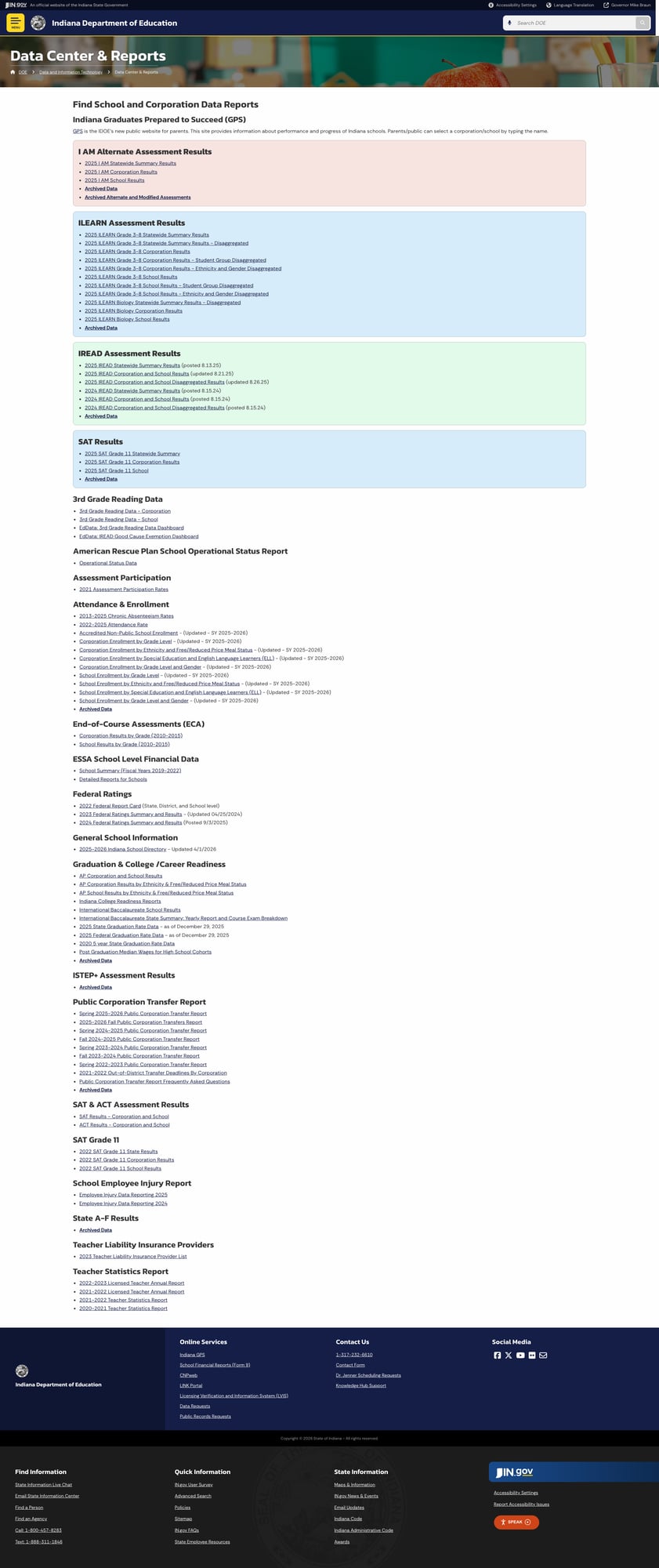
The Data Center & Reports page at /doe/it/data-center-and-reports is one of the most comprehensive data repositories we've seen in any state. It offers dozens of report categories including: I AM alternate assessment results, ILEARN assessment results (grades 3-8 with statewide, corporation, and school-level breakdowns plus disaggregation), IREAD-3 reading assessment results, SAT results, 3rd grade reading data, attendance and enrollment data, corporation and school enrollment by ethnicity/grade/free-meal status, end-of-course assessment results, ESSA financial data, federal ratings, general school information (directory), graduation and college/career readiness data, ISTEP+ archived results, public corporation transfer reports, SAT & ACT results, school employee injury reports, State A-F results (archived), and teacher statistics reports.
Most datasets include multiple years of data with "Archived Data" links for historical access. The page is purely functional — no frills, just data — but it delivers exactly what researchers, administrators, and policymakers need.
2. Deep Educator Resources Ecosystem
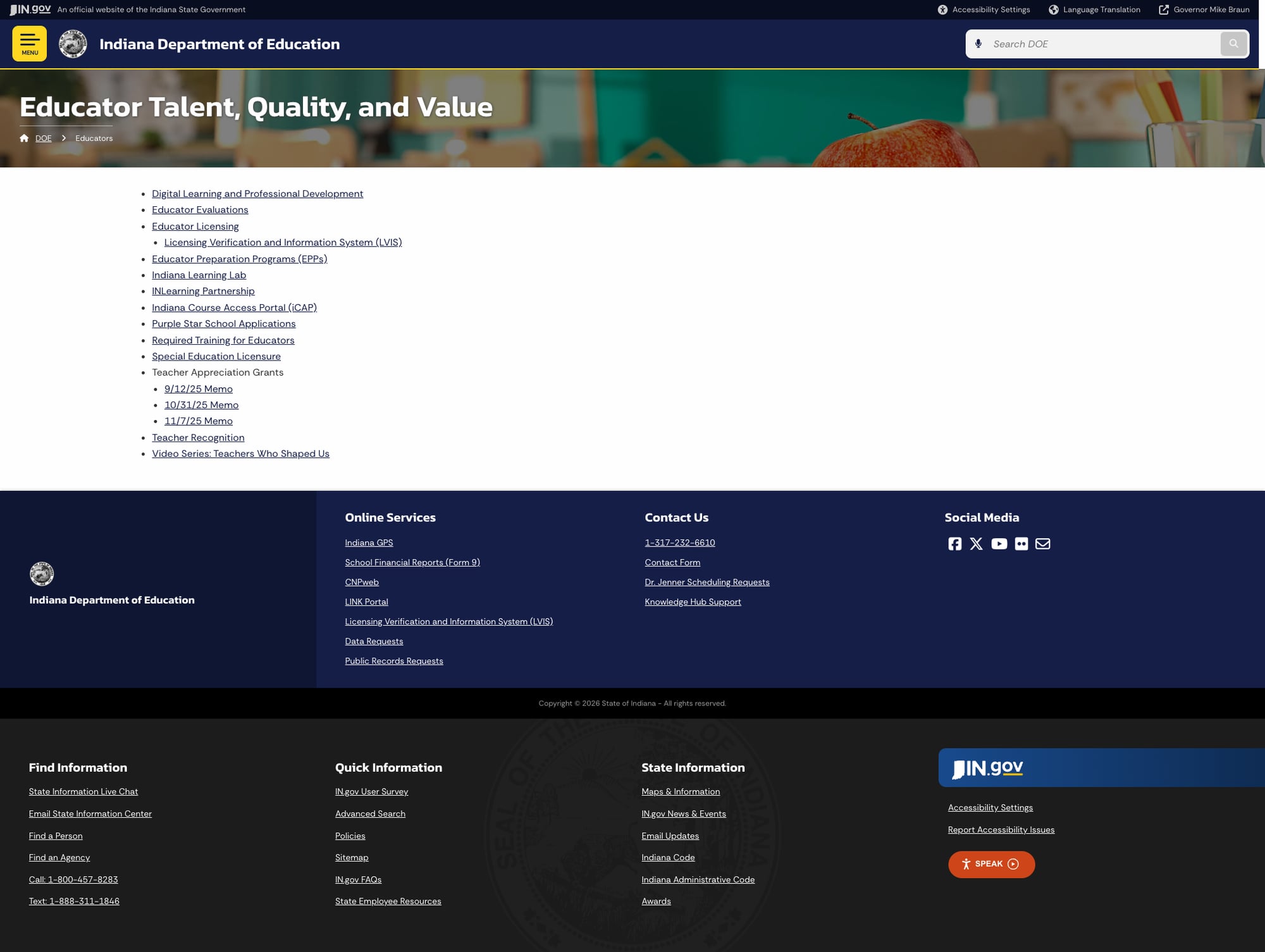
IDOE has built a robust ecosystem for educators that goes well beyond a simple resources page. The Educator section includes:
- LVIS (Licensing Verification and Information System) at
license.doe.in.gov— a Power Apps-based portal for license lookups, applications, and renewals with 15+ sub-pages covering everything from approved MAT programs to suicide prevention training - Moodle at
moodle.doe.in.gov— a full learning management system for professional development - Indiana Learning Lab and INLearning Partnership for ongoing educator support
- Indiana Course Access Portal (iCAP) for course offerings
- Teacher of the Year program and Teacher Recognition awards
- Educator Evaluations with detailed frameworks
- Required Training for Educators covering CPR/AED, child abuse prevention, human trafficking, and suicide prevention
The licensing sub-section alone has step-by-step application instructions, conversion guides, and testing requirements — the kind of practical detail that educators actually need.
3. Active Content and Transparent Communication
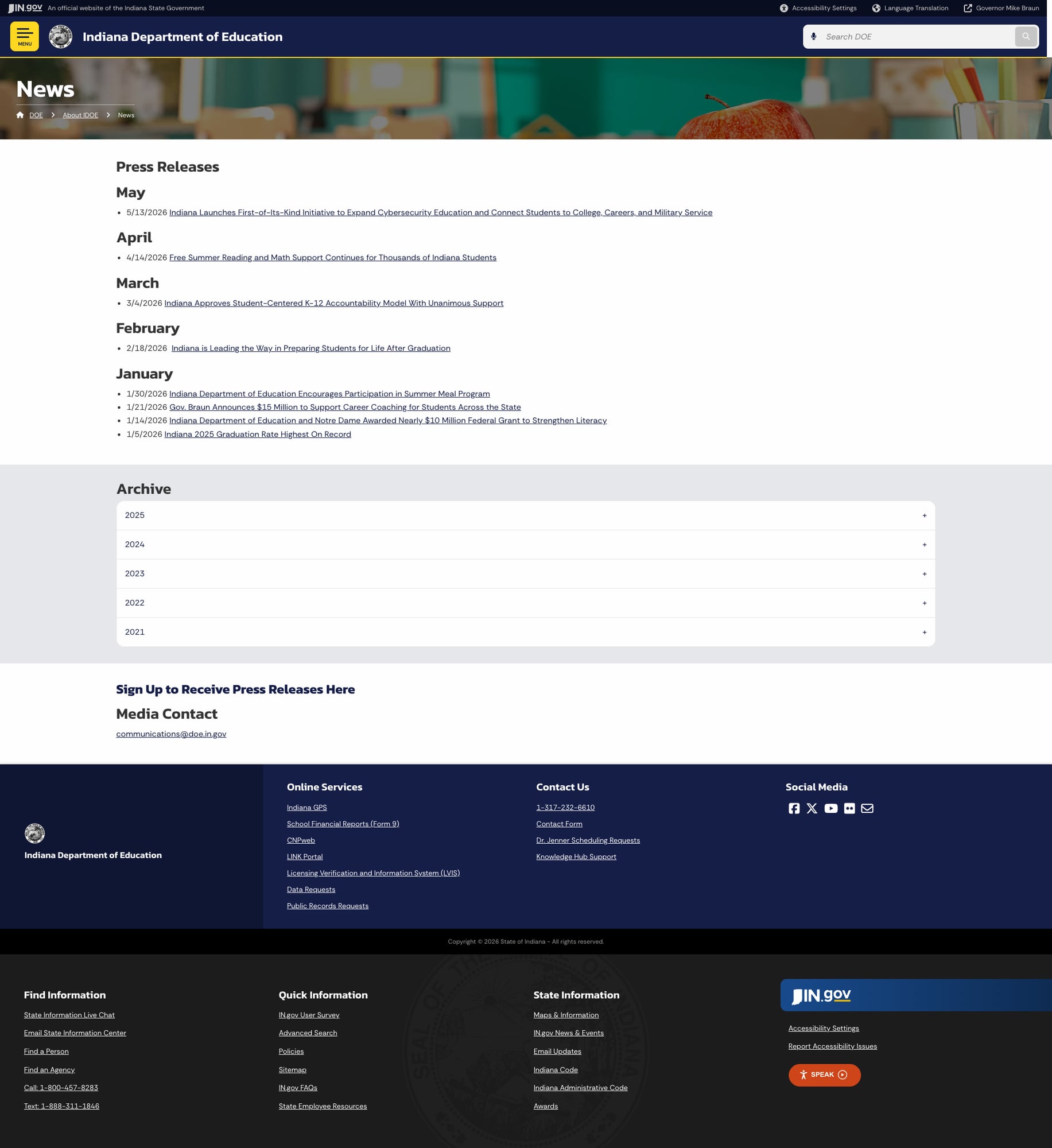
IDOE's news section demonstrates a genuinely active and communicative agency. The most recent press release (5/13/2026) was published just one day before this review. The news archive stretches back to 2021 with releases organized by month and year in an accordion interface.
Dr. Jenner's Weekly Update provides a regular communication channel, and the site offers email subscription signup for press releases. The agency maintains an active presence across five social media platforms (Facebook, X/Twitter, YouTube, Flickr, and email newsletters).
The breadth of press releases covers substantive education policy — accountability model approvals, assessment results, grant announcements, and educator recognition — not just ceremonial content. This is a communications team that takes transparency seriously.
4. 100% Navigation Link Health
Every single navigation link across the IDOE site returned HTTP 200. All nine top-level sections (About, Students, Educators, Data & IT, School Operations, Legal, Nutrition, Accountability, Jobs) loaded successfully. All tested sub-pages responded correctly. All external tools (Indiana GPS, LVIS, LINK Portal, CNPweb, EdData, Moodle) are operational. In a review series where broken navigation links are endemic, Indiana's perfect link health is a genuine achievement.
Weaknesses
1. Search Relevance Needs Work
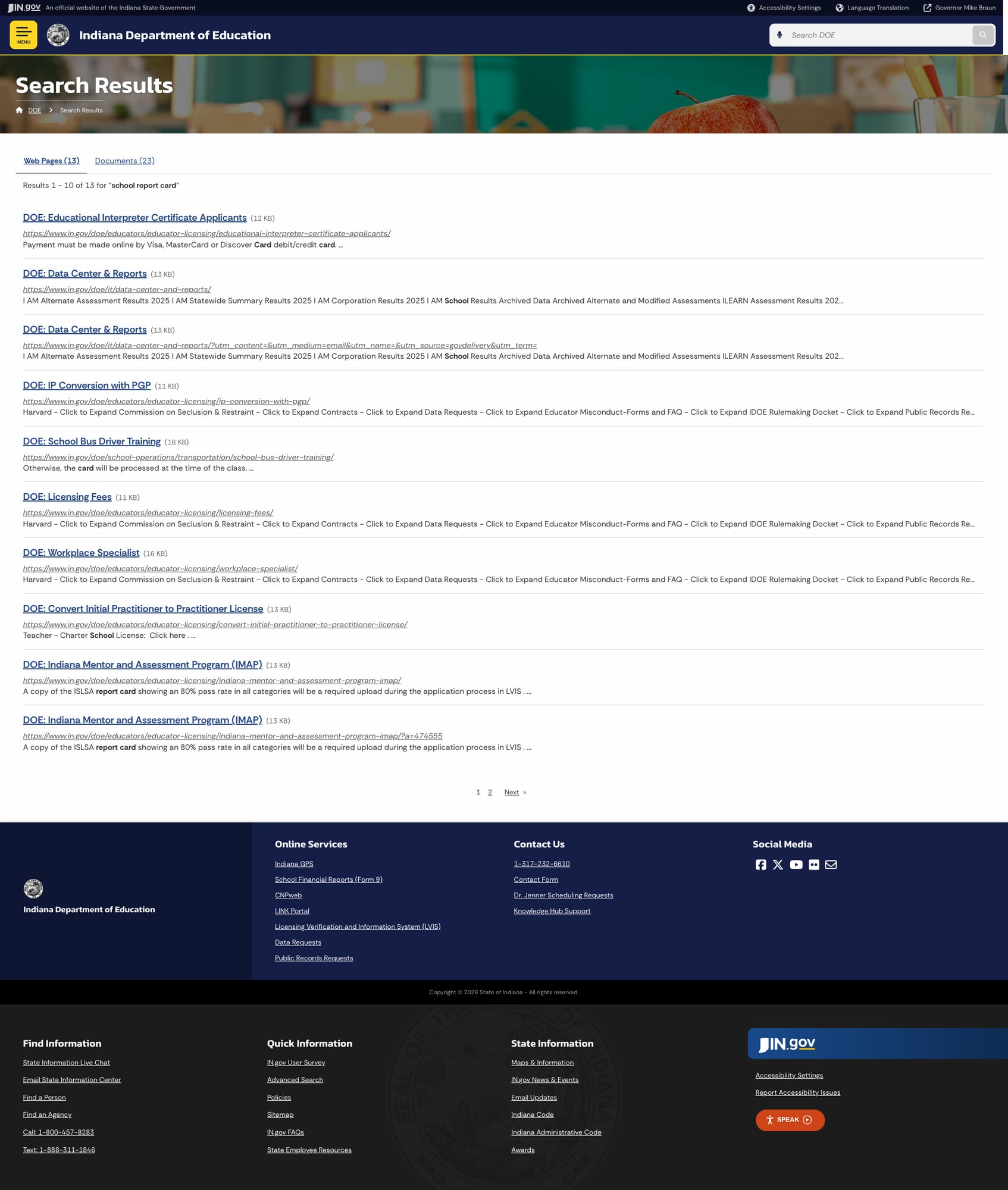
IDOE uses Funnelback search (accessed at /doe/search-results) with both text and voice input options. The search returned results for "school report card" — 13 web pages and 23 documents — but the relevance ranking is poor. The first result was "Educational Interpreter Certificate Applicants," which has nothing to do with school report cards. The actual Data Center & Reports page appeared second and third in the results.
There's no autosuggest, no spelling correction, and no filtering beyond a "Web Pages" vs. "Documents" tab toggle. The search works, but it doesn't help users find what they're actually looking for efficiently.
2. Homepage Is Sparse and AOS-Dependent
The IDOE homepage presents four content cards (Student Learning & Pathways, Educator Talent, Data and IT, Dr. Jenner's Weekly Update) followed by what appears to be a large blank area. In reality, four additional content sections (Frequently Visited Sites, Legal, School Operations, State and Federal Grants) exist in the HTML but rely on AOS (Animate on Scroll) JavaScript to fade into view. If AOS doesn't initialize — due to aggressive script blocking, slow connections, or accessibility settings — that content is invisible.
This is more than a cosmetic issue: the "Frequently Visited Sites" section contains 11 quick links (Assessment, Data Center, Educator Licensing, Graduation Pathways, etc.) that represent the most useful shortcut content on the homepage. Hiding them behind JavaScript animations means some visitors never see them.

3. No Dedicated Parent Portal
Indiana has no dedicated parent-facing section or portal. Parent-relevant content is scattered across the "Student Learning and Pathways" section — school choice programs (Choice Scholarship, ESA, CSA), homeschool information, and the Military Children and Families page are all mixed in with curriculum standards and assessment details.
Indiana GPS (discussed in the Standout Feature section) is arguably a parent-facing tool, but it lives on a separate subdomain with no prominent link from the main IDOE homepage. Parents looking for "How is my child's school doing?" need to know that Indiana GPS exists — the main site doesn't guide them there intuitively.
4. Section Landing Pages Are Just Bullet Lists
Nearly every section landing page — Students, Educators, Data & IT, School Operations — is a simple bulleted list of links with no introductory text, no visual hierarchy, and no content summaries. The Students page has 32 bullet-pointed links. The IT page has 16. There's no categorization, no "start here" guidance, and no indication of what each link contains.
For first-time visitors who don't know the difference between ILEARN, IREAD-3, and I AM assessments, these pages offer no help. They're alphabetized directories, not user-oriented guides.
Opportunities
1. Build a Proper Parent Portal
Indiana's school choice programs (Choice Scholarship, ESA, CSA) and the GPS dashboard are genuine parent-facing assets — but they need a unified front door. A dedicated "Parents & Families" section that organizes resources by life stage (early childhood, elementary, high school, postsecondary planning) and prominently features Indiana GPS would dramatically improve the parent experience.
2. Add Content Summaries to Section Landing Pages
Transforming the bulleted-list landing pages into organized, card-based layouts with brief descriptions would help visitors understand what each resource offers before clicking through. Even a one-sentence description per link would be a significant improvement.
3. Replace AOS With Visible Content
The homepage's AOS-dependent sections should always be visible, with animation as progressive enhancement rather than a prerequisite for content display. A noscript fallback or CSS-only initial state would ensure the "Frequently Visited Sites" and other content sections are accessible to all visitors.
Threats
1. IN.gov Platform Constraints
IDOE operates within the statewide IN.gov template, which means design decisions, navigation patterns, and technical infrastructure are partially outside the agency's control. The hamburger-menu-only navigation pattern (no persistent horizontal nav bar) and the template-driven footer are IN.gov standards — and they limit IDOE's ability to create a more user-friendly information architecture.
2. Data Portal Fragmentation
Indiana's data lives across at least six separate systems: the main Data Center & Reports page, Indiana GPS (indianagps.doe.in.gov), EdData (eddata.doe.in.gov), LVIS (license.doe.in.gov), LINK Portal (link.doe.in.gov), and CNPweb (cnp.doe.in.gov). Each has its own authentication, design, and user experience. For the state that designed Indiana GPS specifically to give families a unified view of school performance, the backend fragmentation is ironic.
Standout Feature
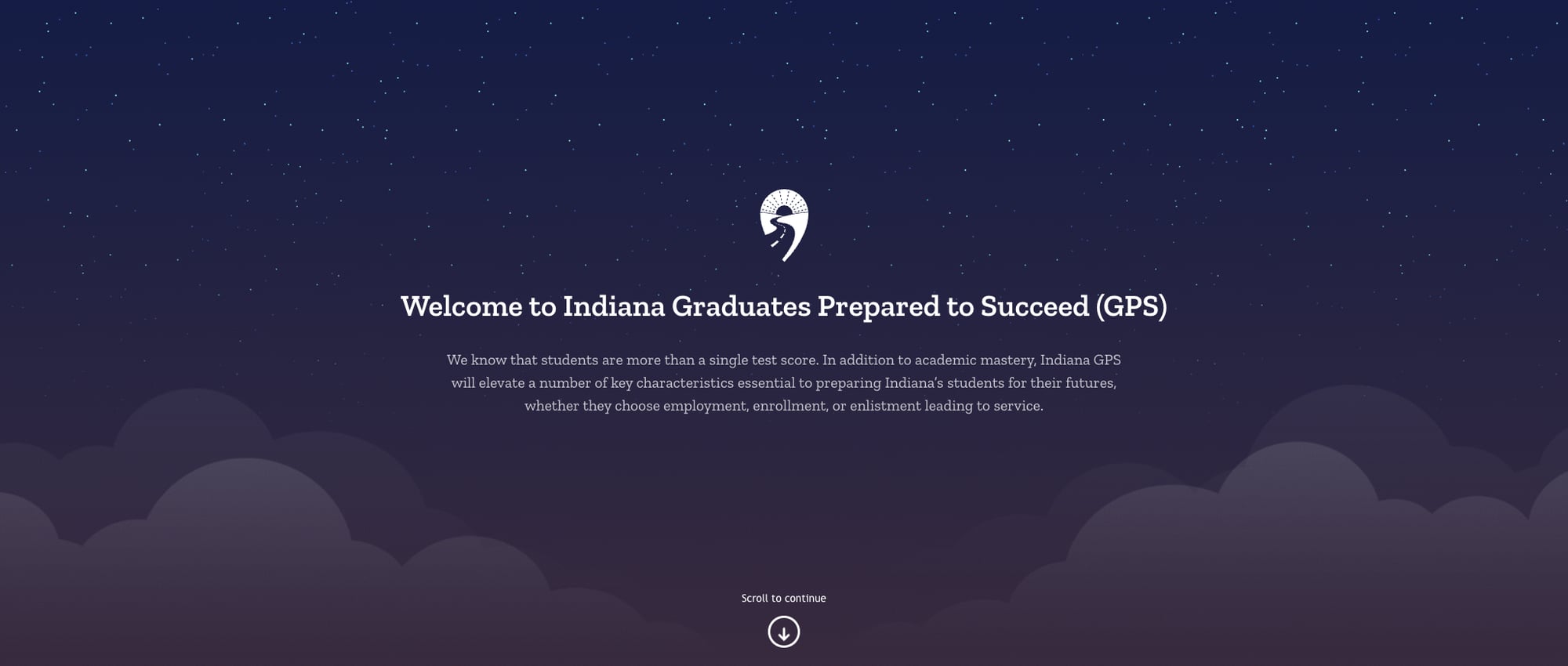
Indiana Graduates Prepared to Succeed (GPS) at indianagps.doe.in.gov is Indiana's reimagined school accountability dashboard — and it's legitimately impressive. Rather than reducing schools to a single letter grade, GPS evaluates five "characteristics" that Indiana considers essential for lifelong success: Academic Mastery, Career & Postsecondary Readiness, Communication & Collaboration, Work Ethic, and Civic/Financial/Digital Literacy.
The GPS dashboard, unanimously approved by the Indiana State Board of Education in March 2026, represents a philosophical departure from traditional accountability systems. It treats school performance as multidimensional — measuring not just test scores but the skills and dispositions that matter for students' futures. The tool opened with a visually striking, modern interface (night sky with clouds and a compass logo) that immediately communicates ambition.
This is the kind of tool that other states should study: accountability that's both rigorous and holistic, presented in a way that parents and community members can actually understand.
Bottom Line
Indiana's Department of Education website is a tale of two experiences. Behind the scenes, IDOE has built one of the strongest data ecosystems in any state education agency — dozens of report categories, a groundbreaking GPS accountability tool, and robust educator licensing infrastructure. But the front door doesn't do justice to what's inside. The sparse homepage, bullet-list landing pages, and absent parent portal mean that casual visitors may never discover the depth that exists. If you're a data-savvy researcher or an educator navigating the licensing system, Indiana delivers. If you're a parent trying to understand your child's school, you'll need to know where to look.
Grade Breakdown
| Criterion | Weight | Score | Notes |
|---|---|---|---|
| Navigation & Information Architecture | 15% | 7/10 | Deep menu structure with 9+ sections, all links functional, breadcrumbs present — but hamburger-only nav and no persistent horizontal menu reduce discoverability |
| Accessibility (WCAG 2.1 AA) | 15% | 8/10 | IN.gov platform provides strong foundation: screen-reader mode, skip links, ARIA labels, SPEAK button, accessibility settings. AOS animations are an accessibility risk |
| Search Functionality | 10% | 5/10 | Funnelback search returns results but with poor relevance ranking. Voice search is a nice touch. No autosuggest, no filtering, no spelling correction |
| Mobile Responsive Design | 10% | 5/10 | Viewport meta is correct and many pages reflow well, but homepage card grid doesn't collapse on mobile. AOS-dependent content may not appear |
| Data Transparency & Open Data | 10% | 9/10 | Outstanding — Data Center has dozens of report categories with multi-year data. Indiana GPS is a modern accountability dashboard. Financial transparency via Form 9 and EdData |
| Parent Resources | 10% | 5/10 | No dedicated parent portal. Parent-relevant content scattered under Students. Indiana GPS serves parents but isn't prominently linked. Google Translate for multilingual support |
| Educator Resources | 10% | 8/10 | Comprehensive — LVIS licensing system, Moodle for PD, Indiana Learning Lab, 15+ licensing sub-pages, evaluations, Teacher of the Year, required training sections |
| Visual Design & Branding | 10% | 6/10 | Clean navy/gold IN.gov template with professional typography. But homepage is sparse, section landing pages are plain bullet lists, and AOS hides content |
| Performance & Load Speed | 10% | 8/10 | Excellent 183ms TTFB, 52KB page size. Fast and reliable on IN.gov infrastructure |
| Overall | 100% | 69/100 | C |
Discussion