OverviewAll statesArizona
73/100
Grade: C+ — Strong Data Tools Anchored to a Dated, Personality-Driven Homepage
The Arizona Department of Education's website at azed.gov serves approximately 1.2 million K-12 students across 2,417 public schools, 565 charter schools, and 291 CTED school sites. For parents researching school options, educators seeking certification, or administrators navigating state programs, this site is their primary digital gateway.
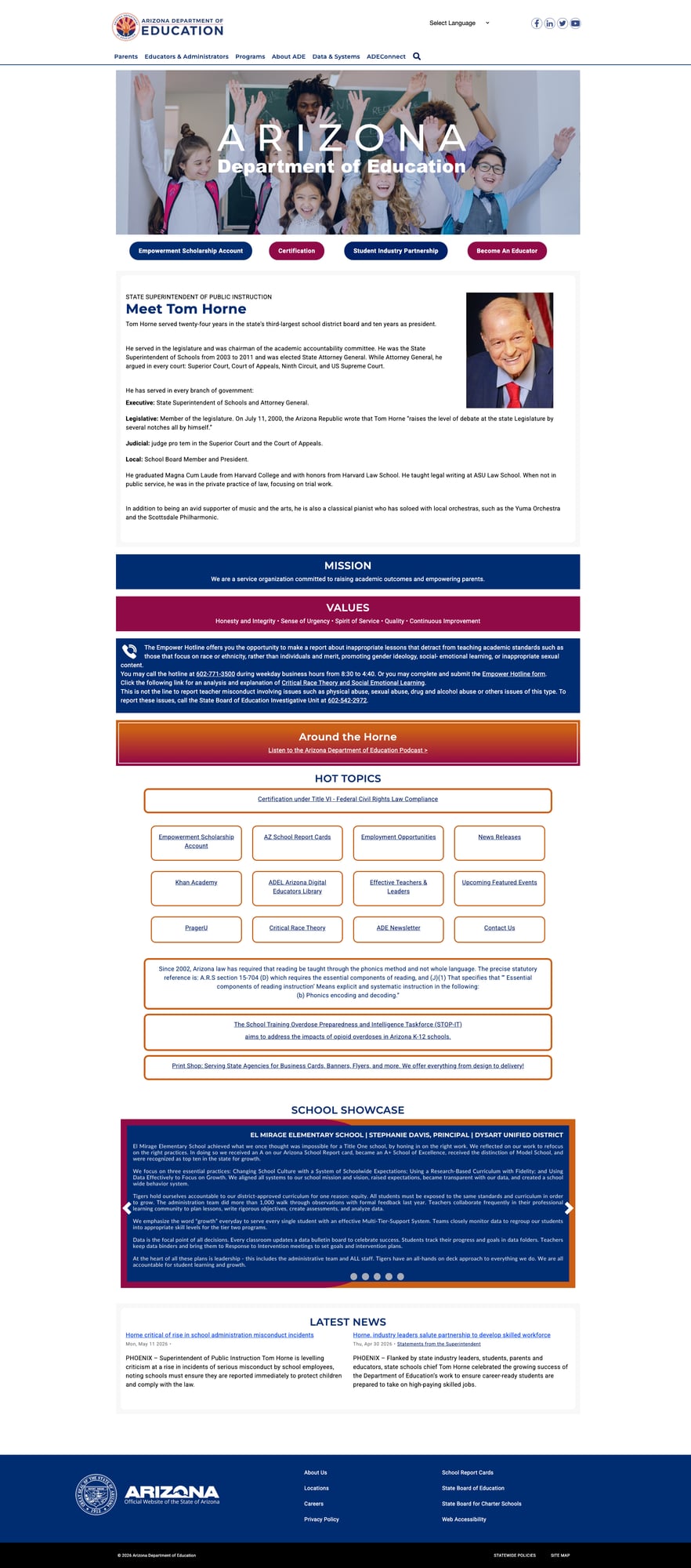
First impressions are mixed. The site loads blazingly fast (sub-300ms) and features a clean audience-based navigation bar with well-organized dropdown menus. But scroll past the banner image and you immediately encounter a full-length biographical essay about Superintendent Tom Horne — complete with his Harvard credentials, judicial career, and piano recitals — occupying the prime real estate that most SEA sites dedicate to quick links, data dashboards, or parent-facing resources. It's a striking design choice that prioritizes personality over utility.
Beneath the surface, Arizona has built genuinely excellent standalone tools. The AZ School Report Cards portal at azreportcards.azed.gov is a modern, well-designed data platform. The Arizona Digital Educators Library (ADEL) is a purpose-built resource hub. But the main site wrapping these tools runs on Drupal 7 — a CMS that reached end-of-life in January 2025 — and the homepage design reflects its age.
Strengths
1. Excellent Parent & Family Resources Hub
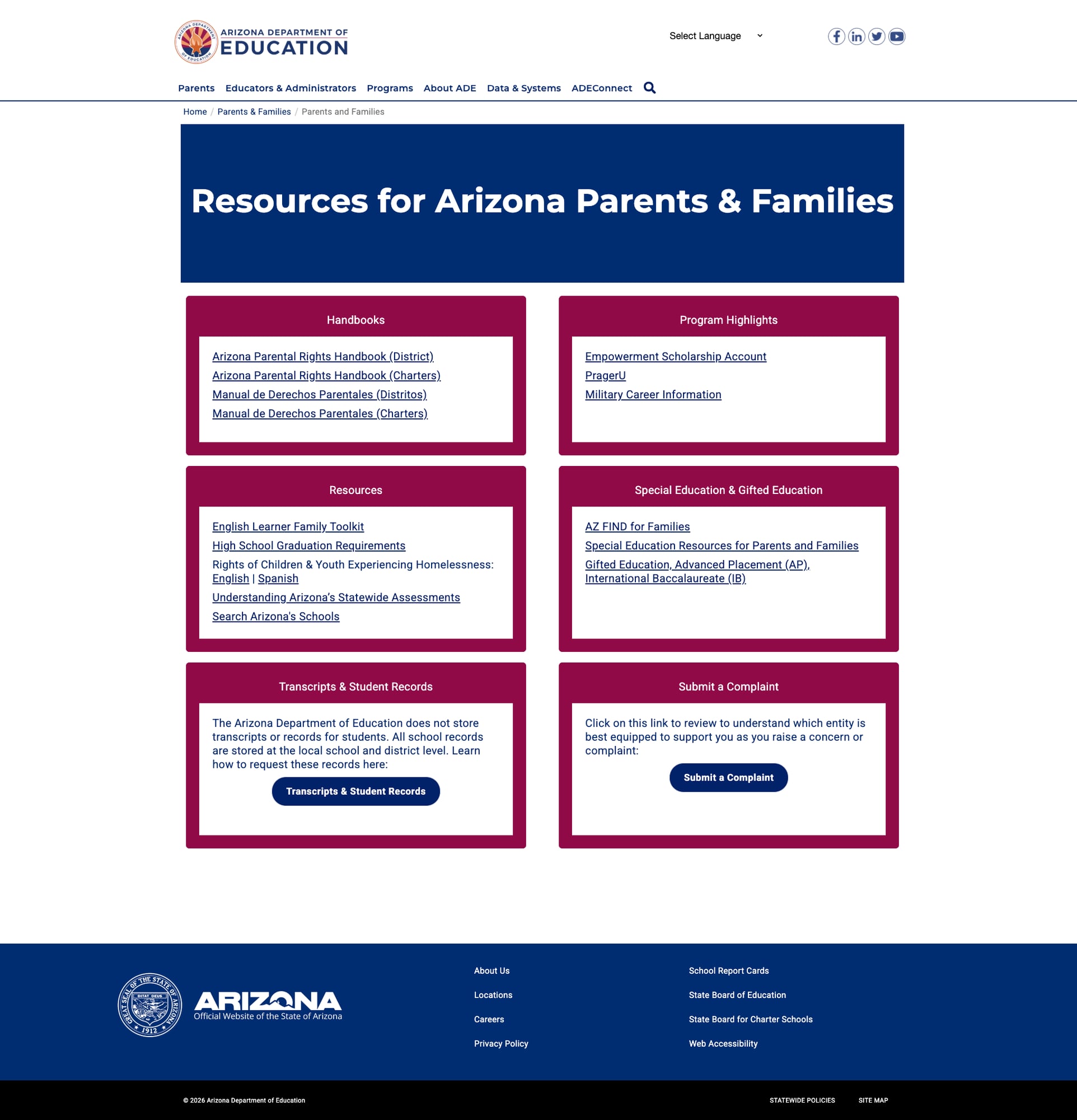
The dedicated Parents & Families page is one of Arizona's strongest sections. It organizes resources into clearly labeled card sections: Handbooks, Program Highlights, Resources, Special Education & Gifted Education, Transcripts & Student Records, and Submit a Complaint. The Arizona Parental Rights Handbooks are available in both English and Spanish (for both district and charter schools), and the page includes practical links like "Search Arizona's Schools," "High School Graduation Requirements," and the English Learner Family Toolkit. The layout is clean, scannable, and gets parents to the information they need without jargon.
2. Solid Mobile Responsiveness
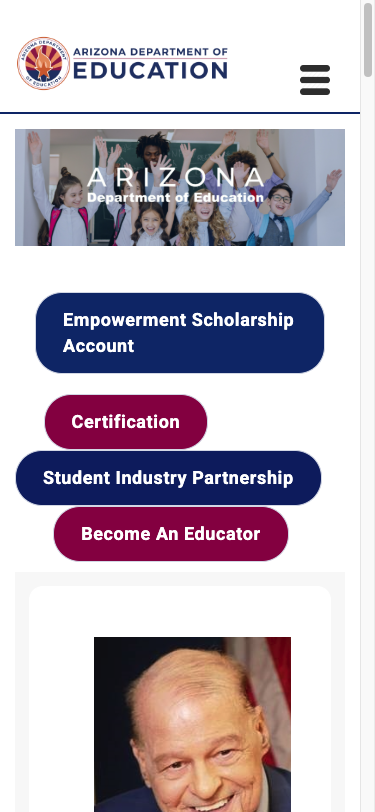
Unlike many Drupal 7 sites, azed.gov handles mobile viewports well. At 375px width, the navigation collapses to a clean hamburger menu, content reflows properly, and the call-to-action buttons (Empowerment Scholarship Account, Certification, Student Industry Partnership, Become An Educator) stack vertically with touch-friendly sizing. There's no horizontal scroll and the proper viewport meta tag is in place. The site is genuinely usable on a phone.
3. Deep Empowerment Scholarship Account (ESA) Section
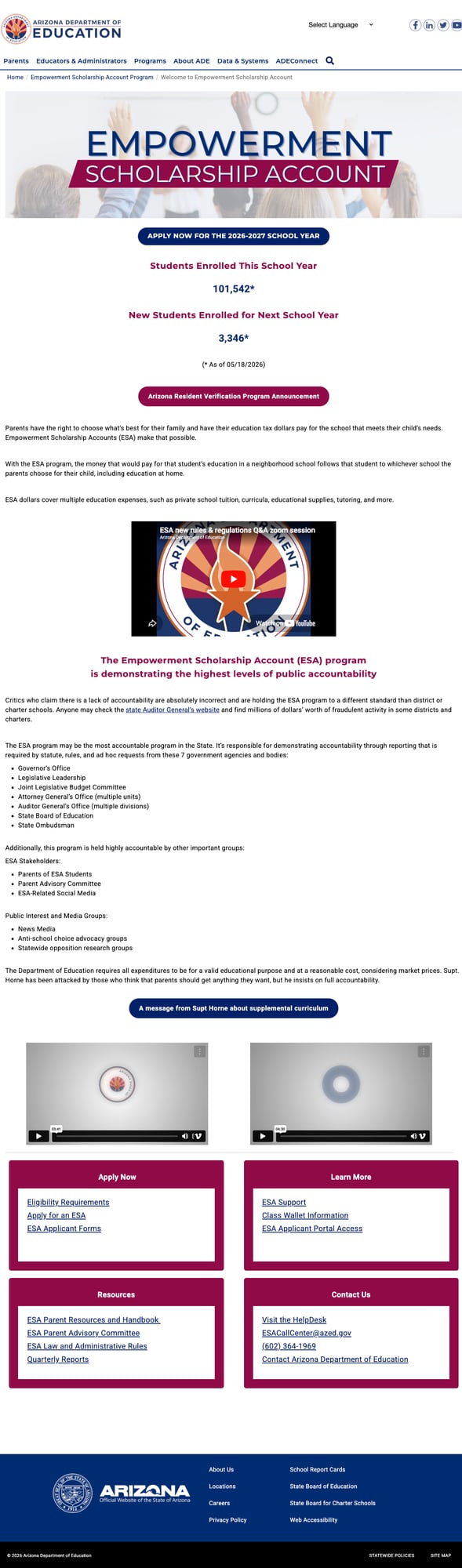
The ESA page is remarkably comprehensive. It displays real-time enrollment data (101,542 students enrolled for the current school year, 3,346 new students for next year), links to eligibility requirements and application forms, and includes embedded videos explaining the program. The page is organized into clear sections: Apply Now, Learn More, Resources, and Contact Us. For a program that serves over 100,000 families, this level of transparency and organization is commendable.
4. Well-Structured Educator Certification Portal
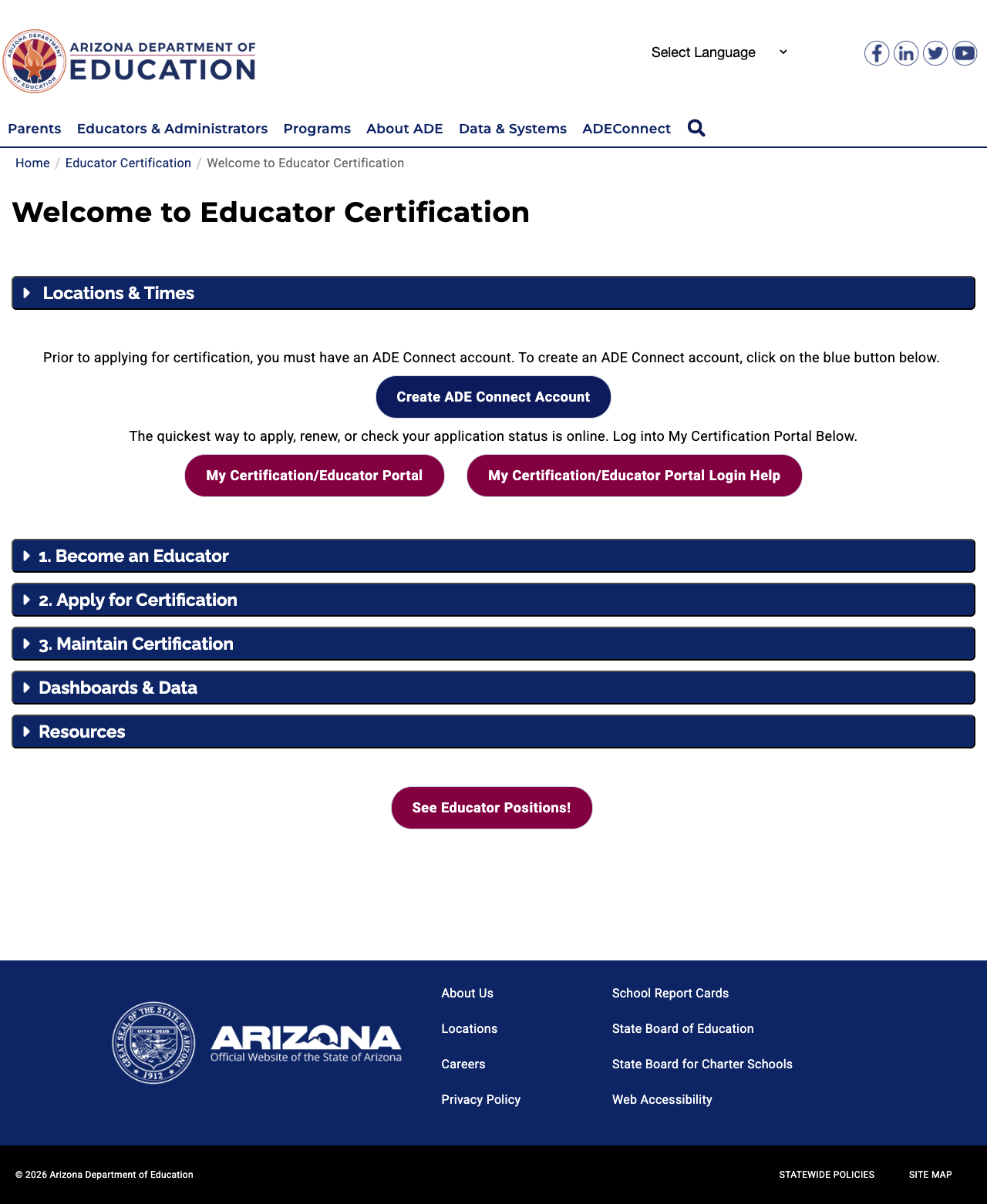
The Educator Certification page uses collapsible accordion sections to organize a complex process into digestible steps: Locations & Times, Become an Educator, Apply for Certification, Maintain Certification, Dashboards & Data, and Resources. Direct links to the My Certification/Educator Portal and ADE Connect account creation put educators two clicks from the tools they need. The "See Educator Positions!" CTA at the bottom connects certification to job opportunities.
5. Modern Standalone Data and Learning Tools
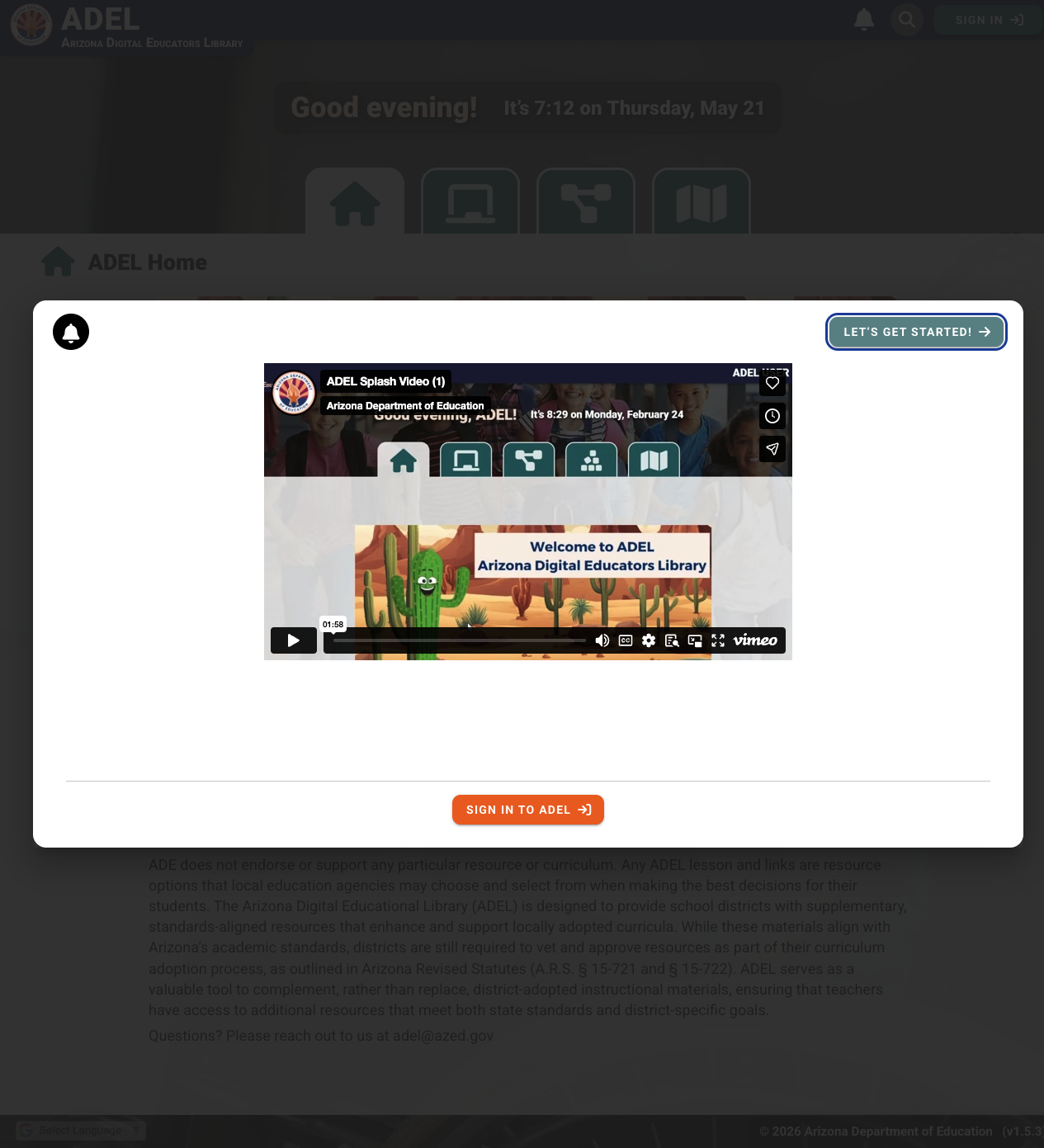
Arizona's satellite tools are genuinely impressive. The ADEL (Arizona Digital Educators Library) is a purpose-built platform with a modern dark-themed UI, video tutorials, and content sections organized by resource type. It feels like a product, not a government afterthought. Similarly, the Public Educator Search through OACIS and the School & Student Data pages demonstrate investment in specialized tools. The AZ School Report Cards tool (covered in Standout Feature below) rounds out a strong data ecosystem.
Weaknesses
1. Homepage Dominated by Superintendent Biography
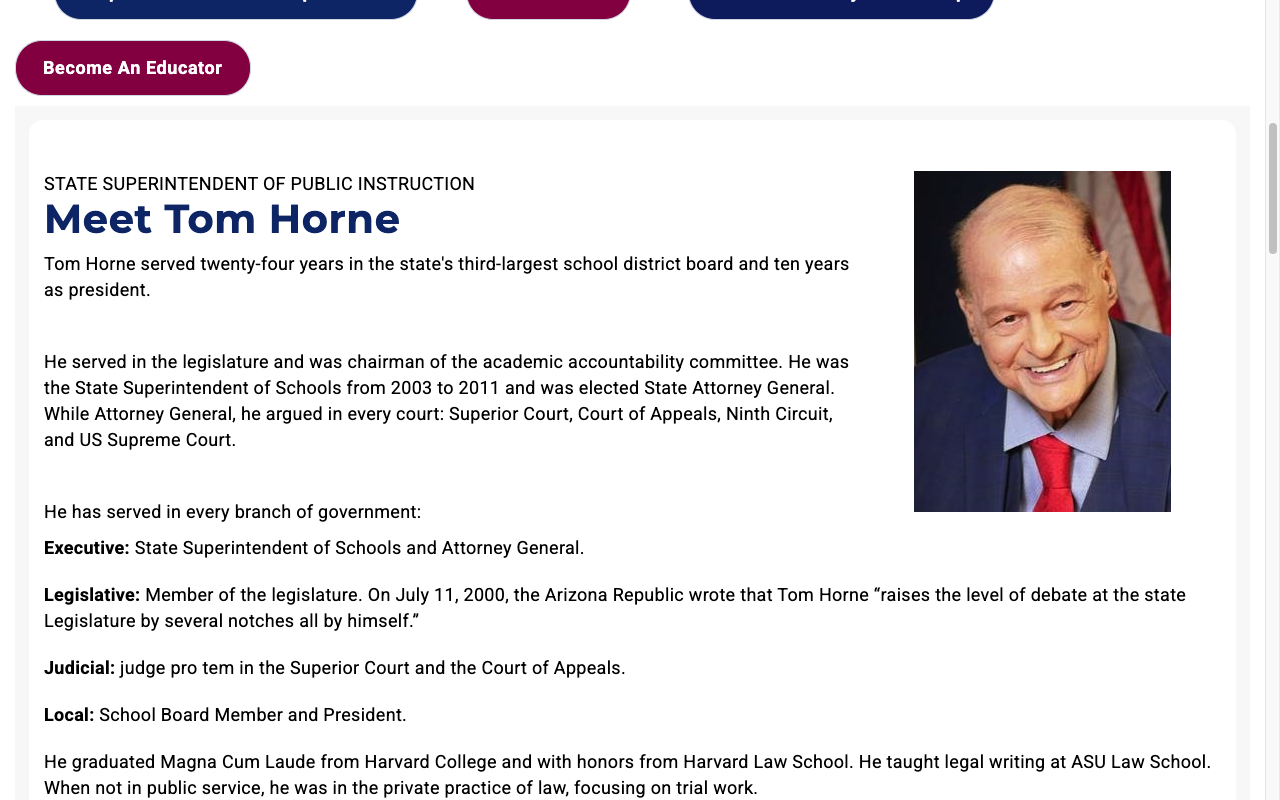
The most valuable real estate on any website — the content immediately below the hero banner — is entirely consumed by a multi-paragraph biography of Superintendent Tom Horne. The section covers his 24 years on a school board, legislative career, Attorney General tenure, Harvard education, trial law practice, and piano performances with the Yuma Orchestra. This is content that belongs on an "About" page. On the homepage, it pushes quick links, data tools, news, and parent resources far below the fold. A parent visiting azed.gov to find their child's school report card must scroll past judicial credentials and classical music achievements to find anything useful.
2. Politically Charged Content on the Homepage
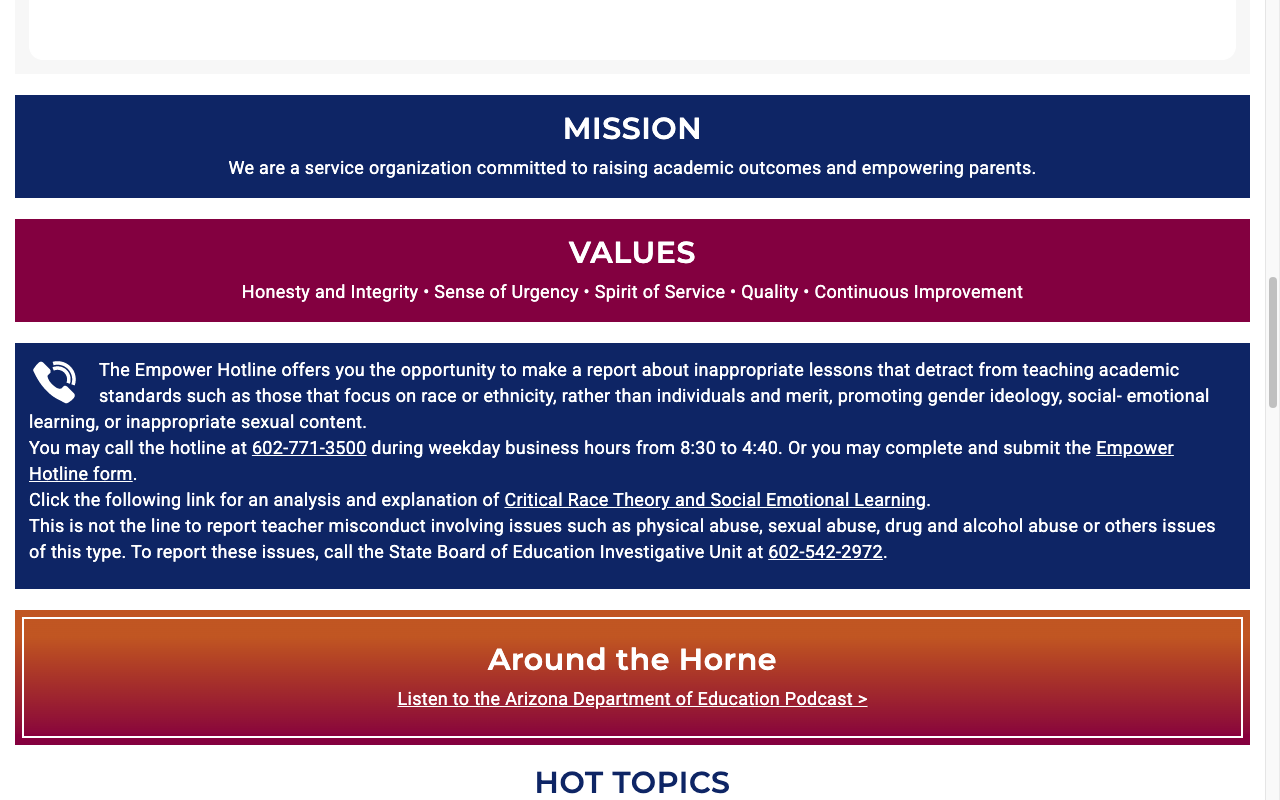
Below the superintendent bio, the homepage features the "Empower Hotline" — a prominent section inviting users to "make a report about inappropriate lessons that detract from teaching academic standards such as those that focus on race or ethnicity, rather than individuals and merit, promoting gender ideology, social-emotional learning, or inappropriate sexual content." This is followed by links to Critical Race Theory explainers, PragerU kids content, and a statutory notice about phonics requirements. While these reflect current policy positions, placing them on the homepage — ahead of the "Hot Topics" quick links grid and news section — creates a homepage that reads more as a political platform than a service portal. An SEA homepage should prioritize connecting users to services and data.
3. Drupal 7 End-of-Life and Accessibility Heading Issues
Arizona's site runs on Drupal 7, which reached official end-of-life in January 2025. While the site acknowledges this in its accessibility statement (noting "the extent or degree that the existing ASET Drupal7 CMS components comply"), it creates ongoing risk. More immediately visible: several H2 heading elements contain raw image filenames — "Home-Banner.jpg", "Tom Horne 2024.jpg", and "phoneicon.png" — rather than descriptive text. Screen readers will announce these filenames to users, making the page confusing for visually impaired visitors. This is a straightforward fix that would meaningfully improve accessibility.
4. Cluttered Hot Topics Section
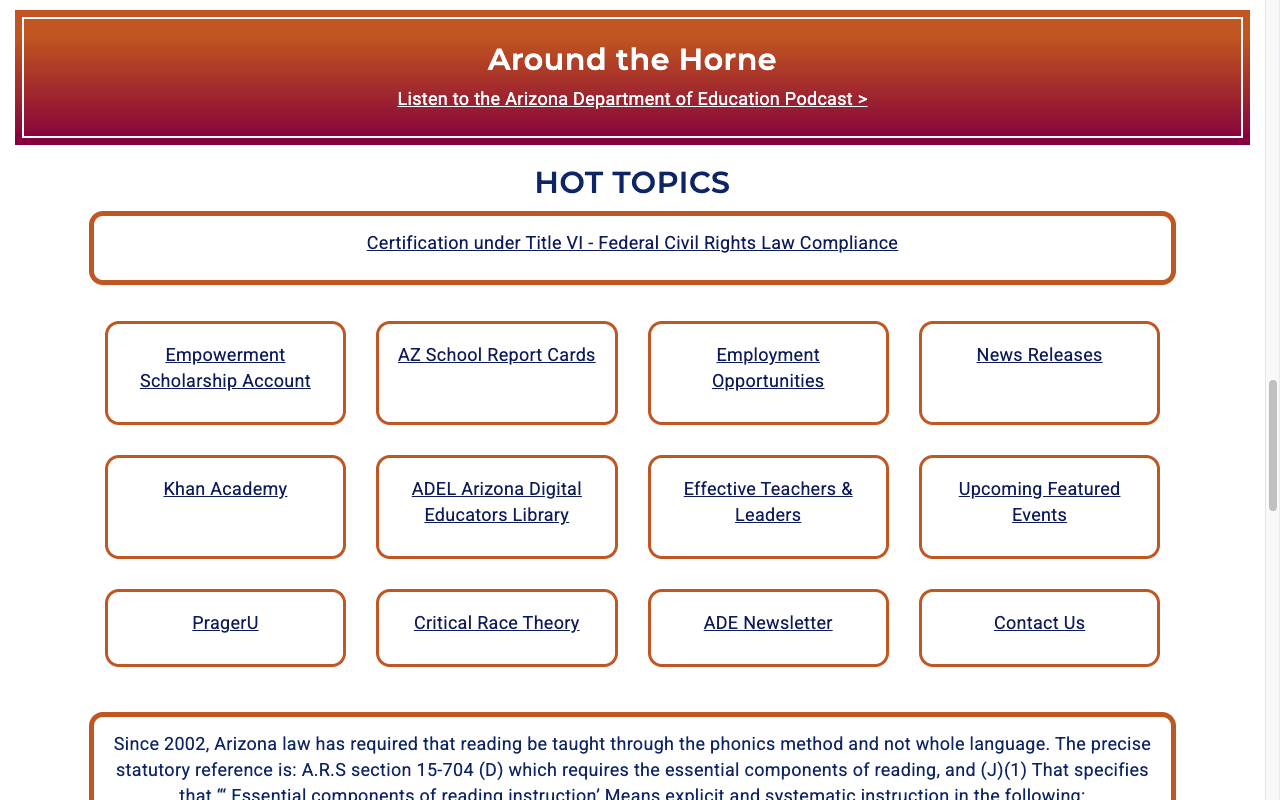
The "Hot Topics" grid mixes genuinely useful quick links (AZ School Report Cards, Employment Opportunities, Contact Us) with promotional content (Khan Academy partnership, PragerU), policy-focused items (Critical Race Theory, Title VI Certification), and internal tools (ADE Newsletter signup, ADEL). The 12-item grid with no categorization or prioritization makes it difficult for users to distinguish service links from policy content. A "Quick Links" section organized by audience (Parents, Educators, Administrators) would serve users better.
Opportunities
Redesign the homepage around user tasks. Replace the superintendent bio with audience-based pathways ("I'm a parent looking for...", "I'm an educator who needs...") and surface the excellent data tools (Report Cards, ADEL, Educator Search) above the fold. Move the bio to the existing About ADE section.
Migrate from Drupal 7 to a supported CMS. With Drupal 7 past end-of-life, Arizona should plan migration to Drupal 10/11 or another modern CMS. The current accessibility statement already acknowledges CMS-imposed limitations. A migration would also fix the heading-as-filename issues and enable modern accessibility features.
Add Spanish-language site support. Arizona has a 30%+ Hispanic/Latino population, yet the site relies solely on GTranslate (Google Translate widget) for multilingual support. A dedicated Spanish-language section — particularly for the Parents & Families area, ESA information, and school search — would dramatically improve access for the families who need it most.
Threats
Drupal 7 security exposure. Running an end-of-life CMS on a .gov domain creates a growing attack surface. Without official security patches, any discovered vulnerability requires custom mitigation or acceptance of risk. The Cloudflare protection layer helps, but it's a band-aid on a structural issue.
Accessibility litigation risk. The H2 headings containing image filenames are clear WCAG 2.1 AA violations (Success Criterion 1.3.1: Info and Relationships). Combined with the EOL CMS and the 2 images missing alt text, there's exposure to accessibility complaints despite the strong accessibility statement and Monsido scanning commitment.
Standout Feature
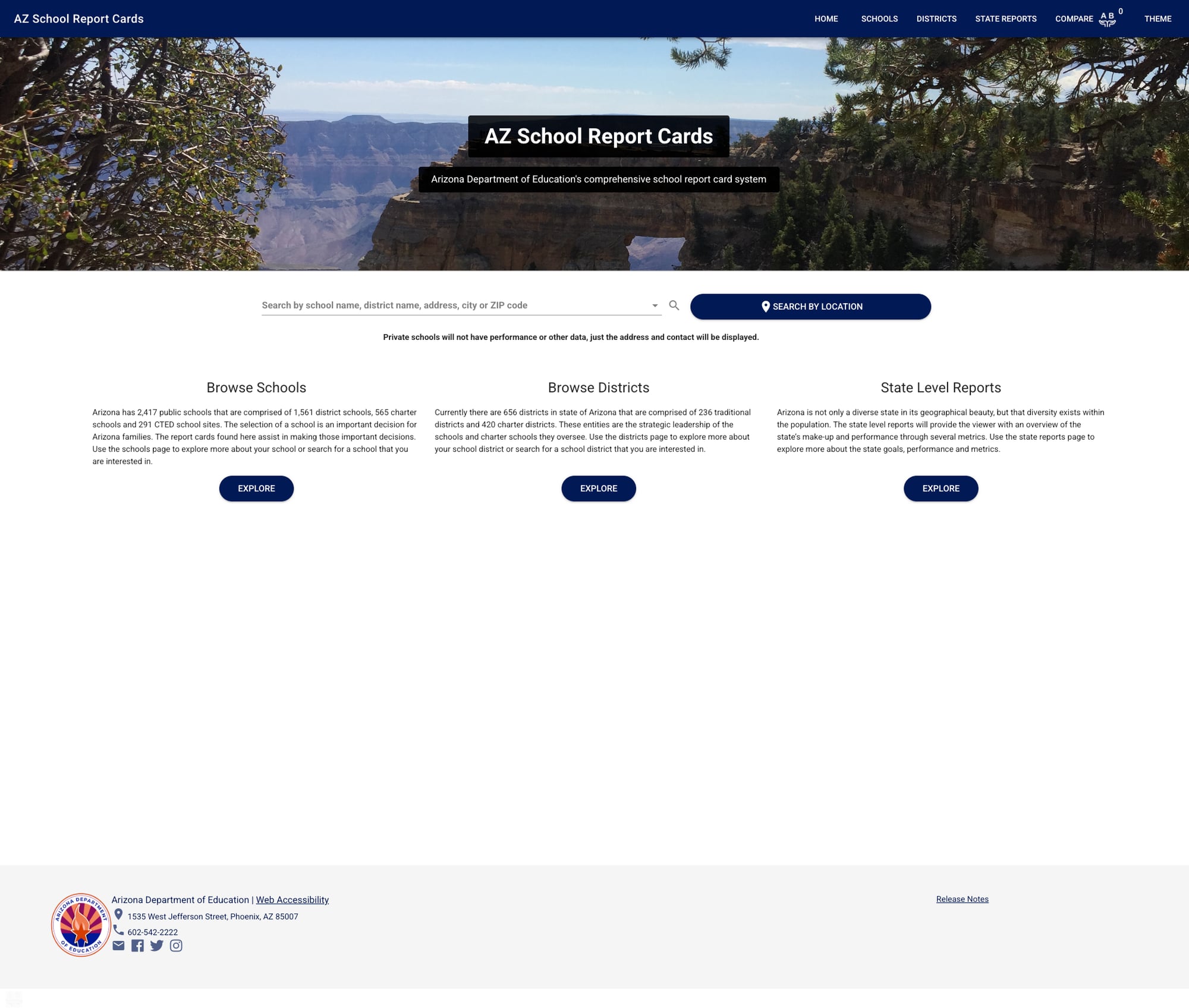
AZ School Report Cards (azreportcards.azed.gov) is Arizona's crown jewel. This standalone application provides comprehensive data for all 2,417 public schools, 656 districts (236 traditional + 420 charter), and state-level reports. The interface is modern and clean with a search bar that accepts school name, district name, address, city, or ZIP code, plus a "Search by Location" geolocation feature. Three clear pathways — Browse Schools, Browse Districts, and State Level Reports — make the data accessible to any audience. A "Compare" feature (visible in the top navigation) lets users evaluate schools side-by-side. The tool sits on its own subdomain with its own navigation, effectively functioning as an independent product. It's the kind of data tool every state should aspire to build.
Bottom Line
Arizona's education website is a tale of two experiences. The standalone data tools — particularly AZ School Report Cards and ADEL — are modern, well-designed, and genuinely useful. The underlying site infrastructure is fast, mobile-responsive, and has solid navigation architecture. But the homepage's focus on superintendent personality and policy positions over user tasks, combined with the aging Drupal 7 platform and accessibility issues, holds the overall experience back. Parents, educators, and administrators will find what they need here — they'll just have to scroll past the piano recitals first.
Grade Breakdown
| Criterion | Weight | Score | Notes |
|---|---|---|---|
| Navigation & Information Architecture | 15% | 7/10 | Audience-based dropdowns with breadcrumbs; all nav links functional; some sub-items use hover-only disclosure |
| Accessibility (WCAG 2.1 AA) | 15% | 7/10 | Skip link, lang attr, WCAG 2.2 statement, Monsido scanning; BUT H2 headings contain image filenames, 2 images lack alt text |
| Search Functionality | 10% | 7/10 | Dedicated search page with Program Area filter (45+ categories) and pagination; no autosuggest or spelling correction |
| Mobile Responsive Design | 10% | 8/10 | Proper viewport, hamburger menu, clean content reflow, touch-friendly CTAs |
| Data Transparency & Open Data | 10% | 8/10 | Excellent AZ Report Cards tool; Public Educator Search; School & Student Data; ADEL library |
| Parent Resources | 10% | 7/10 | Well-organized Parents & Families page; Spanish handbooks; ESA info; GTranslate only (no native Spanish) |
| Educator Resources | 10% | 8/10 | Strong certification portal with accordions; ADEL library; Academic Standards; Become An Educator CTA |
| Visual Design & Branding | 10% | 5/10 | Consistent navy/maroon palette but Drupal 7 dated look; superintendent bio dominates homepage; cluttered Hot Topics; H2 filenames |
| Performance & Load Speed | 10% | 9/10 | 19ms TTFB, 277ms full load, HTTP/2, Cloudflare CDN, ~1.9MB transfer |
| Overall | 100% | 73/100 | C+ |
Discussion